


C209A IC For Metal Detector
#C209A IC
#oscillator circuit
#100uH inductor
#sensor
#metal detection
#inductor
#electronic circuit
#detection system
#coil
#frequency oscillator
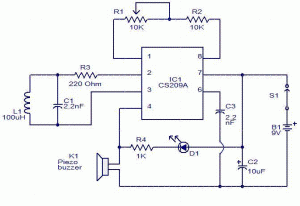
Description: The following circuit illustrates a C209A integrated circuit (IC) designed for a metal detector application. Key features include a 100 µH inductor used as a sensor and an oscillator circuit, where the inductor plays a crucial role in the detection process.
The C209A IC serves as the core component of the metal detector circuit, integrating various functionalities necessary for detecting metallic objects. The circuit typically consists of a power supply section, the C209A IC itself, an oscillator circuit, and a sensor inductor of 100 µH.
The power supply section provides the necessary voltage and current to the circuit, ensuring stable operation of the IC. The C209A IC is responsible for processing the signals from the oscillator, which generates an alternating current (AC) signal that is modulated by the presence of metallic objects.
The 100 µH inductor is strategically placed in the circuit as the sensor element. When a metal object comes near the inductor, it affects the inductance, which in turn alters the frequency of the oscillation produced by the oscillator circuit. This frequency shift is detected by the C209A IC, which then triggers an output signal indicating the presence of metal.
In addition to the basic components, the circuit may include additional elements such as capacitors for filtering, resistors for biasing, and diodes for signal rectification. These components work together to enhance the performance of the metal detector, improving sensitivity and response time.
Overall, the C209A metal detector circuit is a practical application of electronic principles, effectively utilizing inductance changes to detect metallic objects with precision.The following circuit shows a C209A IC for metal detector circuit diagram. Features: 100uH as a sensor, oscillator circuit, Inductor determines ..
The C209A IC serves as the core component of the metal detector circuit, integrating various functionalities necessary for detecting metallic objects. The circuit typically consists of a power supply section, the C209A IC itself, an oscillator circuit, and a sensor inductor of 100 µH.
The power supply section provides the necessary voltage and current to the circuit, ensuring stable operation of the IC. The C209A IC is responsible for processing the signals from the oscillator, which generates an alternating current (AC) signal that is modulated by the presence of metallic objects.
The 100 µH inductor is strategically placed in the circuit as the sensor element. When a metal object comes near the inductor, it affects the inductance, which in turn alters the frequency of the oscillation produced by the oscillator circuit. This frequency shift is detected by the C209A IC, which then triggers an output signal indicating the presence of metal.
In addition to the basic components, the circuit may include additional elements such as capacitors for filtering, resistors for biasing, and diodes for signal rectification. These components work together to enhance the performance of the metal detector, improving sensitivity and response time.
Overall, the C209A metal detector circuit is a practical application of electronic principles, effectively utilizing inductance changes to detect metallic objects with precision.The following circuit shows a C209A IC for metal detector circuit diagram. Features: 100uH as a sensor, oscillator circuit, Inductor determines ..

Sensor-Activated Relay Pulser Circuit
A sensor activates transistor Q1 to turn on the low-frequency 555 oscillator, which generates pulses to control LAMP II. The sensor may respond to variations in light or temperature. Either resistor RA or RB can function as the sensor, depending...

STEORN DEMO LIVE & STREAM
The positioning of a coil by even a millimeter can significantly impact the success or failure of a project. When there are tens of millimeters of possible positions, the likelihood of incorrect placement—and thus failure—greatly increases. This situation necessitates an...

Automatic plant waterer
The unit consists of a sensor, timer, and electric water pump. The sensor is embedded in the soil, and when dry, the electronics operate the water pump for a preset time. The circuit is composed of a level-sensitive Schmitt trigger,...

Gate automatic lamp circuit
The circuit utilizes multiple integrated circuits to form an automatic lighting device that is activated by door and window sensors. It includes CD4093 digital integrated circuits, a relay, and a power supply circuit. The system typically remains closed when a...

1kH Synthetic Inductor
Inductors can be easily simulated using operational amplifiers. The circuit presented is designed to achieve an inductance of 1000 H (one thousand Henry) with effective damping. This configuration enables the construction of a resonant circuit with a center frequency of...

Inductor saturation tester alternative route to dump the excess energy
Yes, it does charge the inductor again. Diodes are beneficial as they do not charge the inductor back but dissipate a significant amount of instantaneous power due to the forward voltage drop. One approach would be to monitor the current...

Field disturbance sensor-alarm
The change in ambient light triggers the alarm by changing the resistance of LDR1 and LDR2.
The circuit utilizes two light-dependent resistors (LDR1 and LDR2) to detect variations in ambient light levels. LDRs are passive components that exhibit a change in...

Automatic Room light Control With Bi Directional Visitor Counter
The objective of this project is to create a controller-based model that counts the number of individuals entering a specific room and activates the lighting accordingly. This is achieved through the use of sensors that detect the current number of...

Cheap Metal Detector Circuit
The working principle of this inexpensive and simple-to-build metal detector circuit involves mixing two equal frequencies, which results in a low-frequency interference.
The metal detector circuit operates on the principle of heterodyning, where two frequencies are combined to produce a new...