


2 Digit Counter (PIC12F629)
#PIC12F629
#counter
#7-segment display
#microcontroller
#tri-state
#digital
#embedded
#Microchip
#output lines

Description: This article describes a 2-Digit Counter using a Microchip PIC12F629. It shows what can be done with an 8-pin chip having just 5 output lines and one input line. The chip drives two 7-segment displays and this would normally require 7 lines to drive the segments plus another one or two lines to select the displays. We have shown how a single line can be used to drive two different segments by using the tri-state of an output. More: Each output of the chip has three states: HIGH, LOW and FLOATING (high impedance). The high impedance state occurs when the line is in the input state and any line can be changed from output to input at any time during the running of the program.
The 2-digit counter circuit utilizing the Microchip PIC12F629 is an efficient design that leverages the capabilities of an 8-pin microcontroller. The PIC12F629 features five configurable I/O pins that can be utilized for output, while one pin serves as an input. This configuration allows for the control of two 7-segment displays, which typically would require more pins for segment control and display selection.
In this design, the microcontroller outputs are configured to operate in a tri-state mode. This means that each output can be set to HIGH, LOW, or FLOATING (high impedance). The FLOATING state is particularly useful as it allows for the connection of multiple outputs to a single line without interference, enabling one output to drive two segments of the 7-segment displays. By alternating the state of the output pins, the microcontroller effectively multiplexes the display, reducing the total number of required lines from what would normally be seven for the segments and additional lines for display selection.
The counter functionality is implemented within the firmware of the PIC12F629. The program controls the counting logic, incrementing the displayed number on the 7-segment displays with each clock pulse or external trigger received on the input pin. The design takes advantage of the microcontroller's ability to switch pin configurations dynamically, allowing for seamless transitions between input and output modes as needed during operation.
Overall, this circuit demonstrates the versatility of the PIC12F629 in driving multiple outputs while minimizing the number of required connections, making it suitable for compact designs where pin count is a critical factor.This article describes a 2-Digit Counter using a Microchip PIC12F629. It shows what can be done with an 8-pin chip having just 5 output lines and one input line. The chip drives two7-segment displays and this would normally require 7 lines to drive the segments plus another one or two lines to select the displays. We have shown how a single line can be used to drive two different segments by using the tri-state of an output.
Each output of the chip has three states: HIGH, LOW and FLOATING (high impedance). The high impedance state occurs when the line is in the input state and any line can be changed from output to input at any time during the running of the program. The cir
The 2-digit counter circuit utilizing the Microchip PIC12F629 is an efficient design that leverages the capabilities of an 8-pin microcontroller. The PIC12F629 features five configurable I/O pins that can be utilized for output, while one pin serves as an input. This configuration allows for the control of two 7-segment displays, which typically would require more pins for segment control and display selection.
In this design, the microcontroller outputs are configured to operate in a tri-state mode. This means that each output can be set to HIGH, LOW, or FLOATING (high impedance). The FLOATING state is particularly useful as it allows for the connection of multiple outputs to a single line without interference, enabling one output to drive two segments of the 7-segment displays. By alternating the state of the output pins, the microcontroller effectively multiplexes the display, reducing the total number of required lines from what would normally be seven for the segments and additional lines for display selection.
The counter functionality is implemented within the firmware of the PIC12F629. The program controls the counting logic, incrementing the displayed number on the 7-segment displays with each clock pulse or external trigger received on the input pin. The design takes advantage of the microcontroller's ability to switch pin configurations dynamically, allowing for seamless transitions between input and output modes as needed during operation.
Overall, this circuit demonstrates the versatility of the PIC12F629 in driving multiple outputs while minimizing the number of required connections, making it suitable for compact designs where pin count is a critical factor.This article describes a 2-Digit Counter using a Microchip PIC12F629. It shows what can be done with an 8-pin chip having just 5 output lines and one input line. The chip drives two7-segment displays and this would normally require 7 lines to drive the segments plus another one or two lines to select the displays. We have shown how a single line can be used to drive two different segments by using the tri-state of an output.
Each output of the chip has three states: HIGH, LOW and FLOATING (high impedance). The high impedance state occurs when the line is in the input state and any line can be changed from output to input at any time during the running of the program. The cir

Digital Up / Down Counter
This Circuit uses a CD40110BE, Up/Down Counter IC's. This IC is able to Source Each Segment with 25 mA, Giving a Very Nice Bright Display. The 7 Segment Displays MUST be a Common Cathode Type, as I have used here....

Augmenting a Microcontroller Circuit
To create a versatile and generic microcontroller board, the information provided thus far is sufficient. It covers the essential components needed to achieve this.
The design of a microcontroller board requires careful consideration of various factors to ensure versatility and functionality....

Night Light Saver
A Microchip PIC12C508 8-pin CMOS microcontroller controls a night light, turning it on and off at preset times every day. It is designed to save energy, produce no electromagnetic interference (EMI), and operate without batteries, featuring a built-in lamp fixture...

Microcontroller
The gap between TTL (Transistor-Transistor Logic) devices and personal computers can be effectively bridged with modern microcontrollers. These microcontrollers not only incorporate a central processing unit (CPU) but also include program and data memory, EEPROM, input/output (I/O) ports, timers, and...

High Resolution Digital Weigh-scale Design Using Z8 Encore! ?® Microcontrollers
The SP6691 circuit is designed to provide a high output voltage using a lower voltage boost regulator by incorporating a charge pump circuit. This configuration can convert a standard 30V boost regulator into a 60V boost regulator if necessary. Testing...

7 segment Display
Multiplexed 7-Segment Display PCB. The display PCB consists of four MAN72 7-segment common-anode displays.
The multiplexed 7-segment display PCB is designed for efficient visual representation of numerical data. Each MAN72 7-segment display is a common-anode type, meaning that the anode connections...
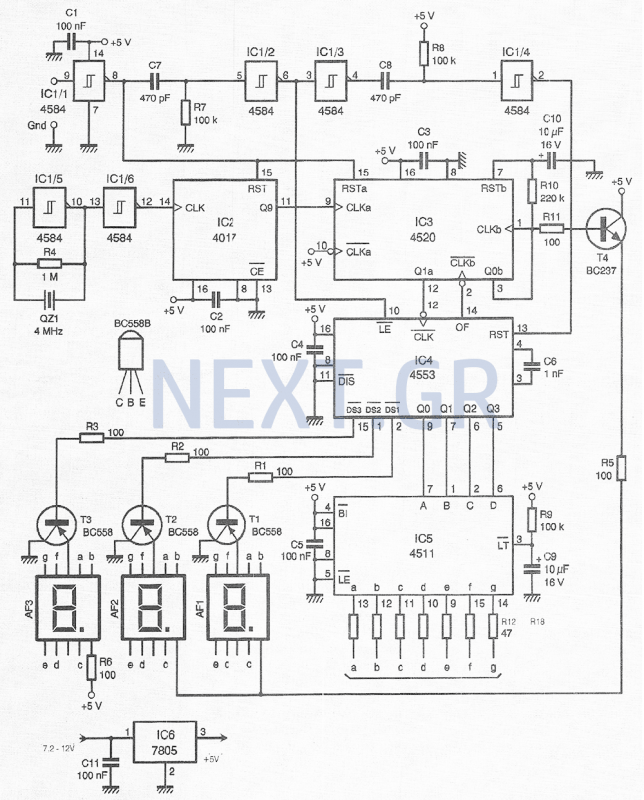
High Precision Digital Pulse Meter Circuit
This compact device, designed primarily for modelers, provides instantaneous readings of pulse duration in milliseconds (ms). It can measure servomotor positions, typically ranging from 1 ms to 2 ms, and can also perform repetitive or non-pulsed measurements, such as the...

Sensor Circuit Of Analog Line Follower Robot
The following circuit illustrates the sensor circuit of an analog line follower robot. Features include control by a microcontroller and a sensor circuit.
The sensor circuit for an analog line follower robot is designed to detect the presence of a line...
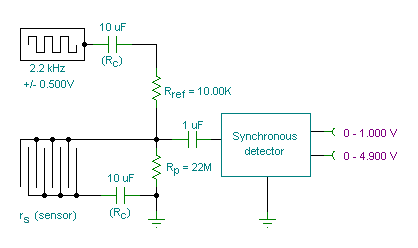
measurement conductance cell constant
A small transmitter board interfaces with a microcontroller and conductivity probe to measure liquid conductance and conductivity. Precise equations and measurements are provided for this microcontroller-controlled conductivity meter.
The described circuit consists of a compact transmitter board that serves as an...