


ADUC845 12MIPS 8052 Flash MCU + 10-Ch 24-Bit ADC + 12-Bit DAC
#8052
#Flash MCU
#24-Bit ADC
#12-Bit DAC
#Hall-effect sensor
#magnetic sensing
#amplifier
#comparator
#open-collector output
#regulator

Description: The AH1751 is a single digital output Hall-effect sensor designed for high-temperature operation. This device features an on-chip Hall voltage generator for magnetic sensing, an amplifier to enhance the Hall voltage, and a comparator that offers switching hysteresis to minimize noise interference. Additionally, it includes an open-collector output pre-driver and an internal band-gap regulator that supplies a temperature-compensated voltage for internal circuits, enabling a broad operational supply range. Manufactured by Diodes, Inc.
The AH1751 Hall-effect sensor is engineered for applications requiring robust performance in high-temperature environments. The Hall voltage generator operates by detecting the presence of a magnetic field, converting it into a corresponding voltage signal. This signal is then amplified by the integrated amplifier, ensuring that even weak magnetic fields can be effectively detected.
The comparator within the sensor plays a crucial role in enhancing the reliability of the output signal. By introducing hysteresis, it prevents false triggering due to noise or fluctuations in the magnetic field, thereby ensuring stable operation. The open-collector output pre-driver allows for versatile interfacing with various load types, enabling the sensor to drive different devices or systems depending on the application requirements.
The internal band-gap regulator is a significant feature of the AH1751, as it stabilizes the supply voltage across a wide range, compensating for temperature variations. This ensures that the sensor maintains consistent performance regardless of environmental conditions. The operational supply range allows for flexibility in design, making the AH1751 suitable for various applications, including automotive, industrial, and consumer electronics.
Overall, the AH1751 Hall-effect sensor combines advanced features that enhance its functionality and reliability, making it an ideal choice for applications that demand precise magnetic field sensing in challenging thermal environments.AH1751 is a single-digital-output Hall-effect Sensor for high temperature operation. The device includes an on-chip Hall voltage generator for magnetic sensing, an Amplifier to amplify Hall voltage, and a Comparator to provide switching hysteresis for noise rejection, and an open-collector output pre-driver. An internal band-gap Regulator is used to provide temperature compensated supply voltage for internal circuits and allows a wide operating supply range. By Diodes, Inc.
The AH1751 Hall-effect sensor is engineered for applications requiring robust performance in high-temperature environments. The Hall voltage generator operates by detecting the presence of a magnetic field, converting it into a corresponding voltage signal. This signal is then amplified by the integrated amplifier, ensuring that even weak magnetic fields can be effectively detected.
The comparator within the sensor plays a crucial role in enhancing the reliability of the output signal. By introducing hysteresis, it prevents false triggering due to noise or fluctuations in the magnetic field, thereby ensuring stable operation. The open-collector output pre-driver allows for versatile interfacing with various load types, enabling the sensor to drive different devices or systems depending on the application requirements.
The internal band-gap regulator is a significant feature of the AH1751, as it stabilizes the supply voltage across a wide range, compensating for temperature variations. This ensures that the sensor maintains consistent performance regardless of environmental conditions. The operational supply range allows for flexibility in design, making the AH1751 suitable for various applications, including automotive, industrial, and consumer electronics.
Overall, the AH1751 Hall-effect sensor combines advanced features that enhance its functionality and reliability, making it an ideal choice for applications that demand precise magnetic field sensing in challenging thermal environments.AH1751 is a single-digital-output Hall-effect Sensor for high temperature operation. The device includes an on-chip Hall voltage generator for magnetic sensing, an Amplifier to amplify Hall voltage, and a Comparator to provide switching hysteresis for noise rejection, and an open-collector output pre-driver. An internal band-gap Regulator is used to provide temperature compensated supply voltage for internal circuits and allows a wide operating supply range. By Diodes, Inc.
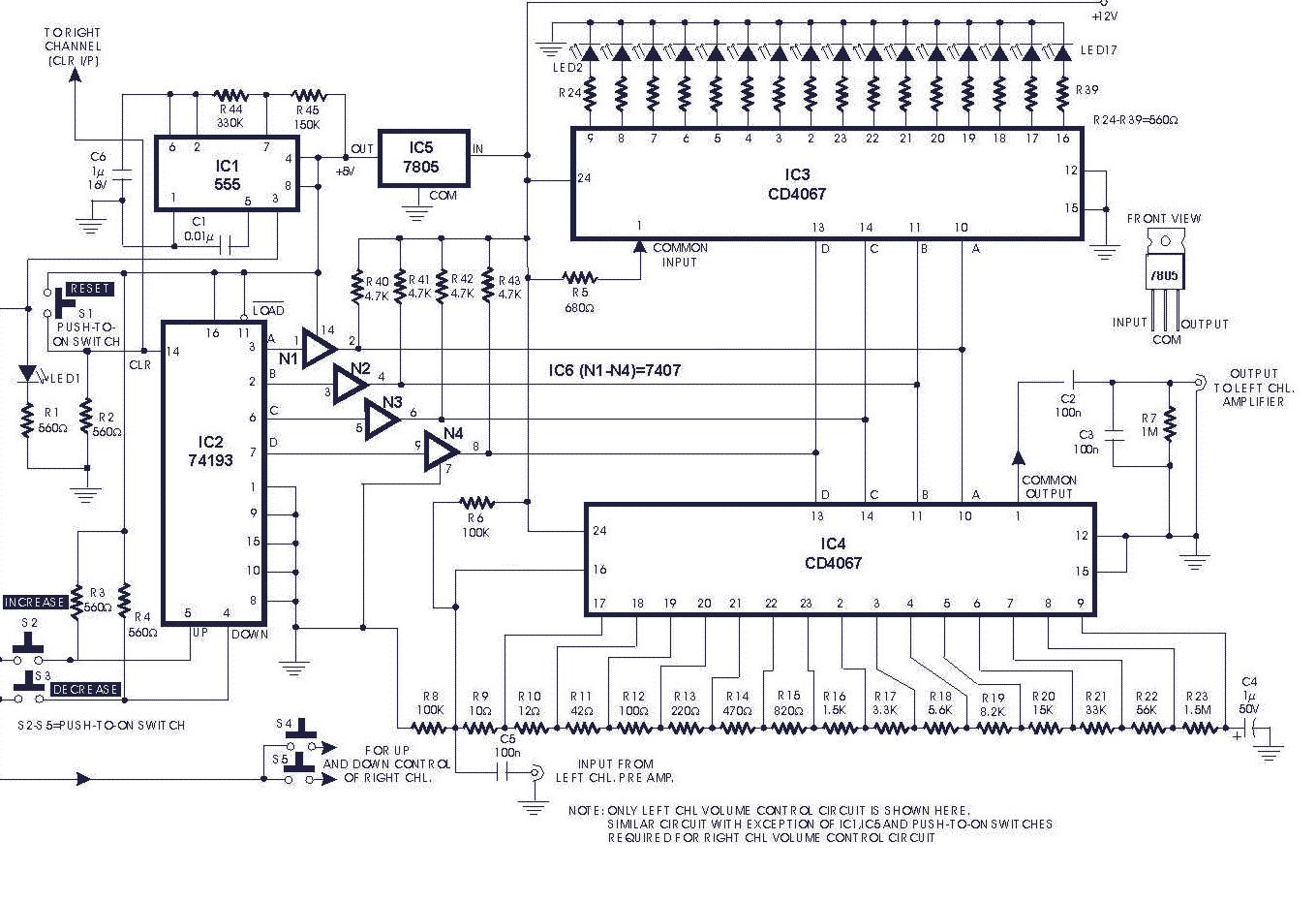
audio circuits 20
The gain of the single-stage virtual earth amplifier IC1 is determined by the drain-source resistance of the field-effect transistor (FET). Resistors R1, R2, and R3 linearize the FET's voltage-current characteristic. A control voltage is derived from the output signal using...
%2Busing%2Bop%2Bamp%2B741%2Bic%2B.png "Zero Crossing Detector ZCD Comparator circuit using 741 op amp circuit")
Zero Crossing Detector (ZCD): Comparator circuit using 741 op amp
A zero crossing detector (ZCD) is a voltage comparator that switches its output between +Vsat and -Vsat (where Vsat is the saturation voltage, approximately 14V) when the input crosses the zero reference voltage. Comparators are fundamental operational amplifier circuits that...

gated pulse descrambler
This circuit consists of an amplifier and a video detector with a second subcarrier detector for synchronization recovery purposes. A pulse-former circuit modulates the gain of the main channel, increasing it during synchronization intervals.
The circuit is designed to enhance video...

TrikiBoard 8052
The MAX232 integrated circuit (IC4) is utilized for connecting to a PC via a serial port. This connection facilitates debugging and controlling the robot by allowing commands to be issued through the PC keyboard. However, during the robot's actual autonomous...

Ears and Speakers Protector
Occasionally, the output volume of an amplifier can be excessively high, leading to discomfort and potential damage to both the listener's ears and the loudspeaker. The circuit...
Amplifiers are crucial components in audio systems, responsible for boosting audio signals to drive...
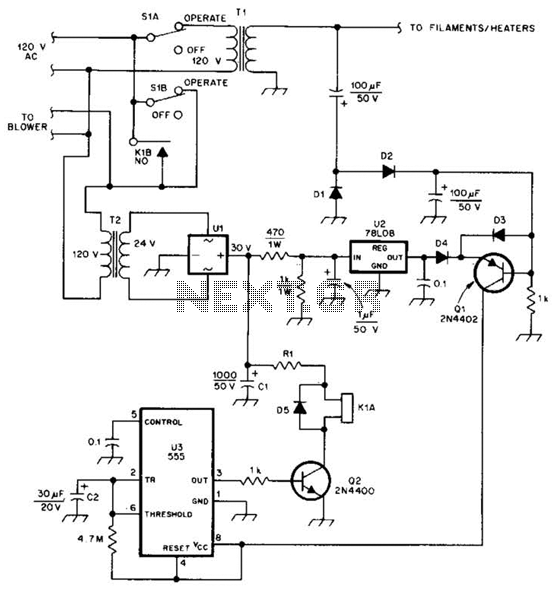
Amplifier Cool-Down Circuit Circuit
This cool-down relay circuit utilizes an integrated circuit (IC) timer to control a relay, which maintains the operation of the blower for a specified time delay determined by timer U3. The capacitance value of C2 can be adjusted to either...

Amplifier Bridging
The primary advantage of this method of bridging is that no additional components are needed, which means that it is cheap, and there is no signal degradation from additional opamps in the circuit path. The results are at least as...

Regulator-current-source
The circuit powers the load through the input of the regulator rather than its output. Due to the presence of a constant dummy load (R1) at the regulator's output, it attempts to draw a constant amount of current, regardless of...

High input comparator
The circuit utilizes both halves of the CA3290 BiMOS dual voltage comparator. The LED will be activated whenever the input signal is above the lower limit (VL) but below the upper limit (Vy).
The circuit design employs the CA3290 BiMOS dual...