


Advanced 1-Wire Network Driver
#1-Wire
#driver circuit
#microcontroller
#software flowchart
#scope traces
#network driver
#schematic
#large networks

Description: Schematic and operation of a microcontroller-based driver circuit for large 1-Wire networks; includes software flowcharts and scope traces.
The schematic details a microcontroller-driven circuit designed to manage extensive 1-Wire networks, which are commonly used for communication and control in various electronic applications. The circuit is engineered to facilitate the connection of multiple 1-Wire devices, enabling them to communicate with a central microcontroller.
The design typically includes a microcontroller unit (MCU) that acts as the primary control hub. This MCU interfaces with the 1-Wire bus, which allows for the connection of numerous 1-Wire devices, such as temperature sensors, memory chips, and other peripherals. The circuit may utilize pull-up resistors on the 1-Wire line to ensure proper signal integrity, as the 1-Wire protocol relies on a single wire for both power and data transmission.
The operation of the circuit is governed by a series of software flowcharts that outline the logic and sequence of operations the microcontroller follows when communicating with the 1-Wire devices. These flowcharts provide a visual representation of the program structure, including initialization routines, data reading and writing processes, and error handling mechanisms.
Additionally, the schematic may include scope traces that illustrate the timing and voltage levels of signals on the 1-Wire bus during operation. These traces are essential for debugging and optimizing the circuit's performance, ensuring that the timing requirements of the 1-Wire protocol are met.
Overall, this microcontroller-based driver circuit is a crucial component for effectively managing large-scale 1-Wire networks, providing the necessary infrastructure for robust communication and control in a variety of applications.Schematic and operation of a microcontroller-based driver circuit for large 1-Wire networks; includes software flowcharts and scope traces..
The schematic details a microcontroller-driven circuit designed to manage extensive 1-Wire networks, which are commonly used for communication and control in various electronic applications. The circuit is engineered to facilitate the connection of multiple 1-Wire devices, enabling them to communicate with a central microcontroller.
The design typically includes a microcontroller unit (MCU) that acts as the primary control hub. This MCU interfaces with the 1-Wire bus, which allows for the connection of numerous 1-Wire devices, such as temperature sensors, memory chips, and other peripherals. The circuit may utilize pull-up resistors on the 1-Wire line to ensure proper signal integrity, as the 1-Wire protocol relies on a single wire for both power and data transmission.
The operation of the circuit is governed by a series of software flowcharts that outline the logic and sequence of operations the microcontroller follows when communicating with the 1-Wire devices. These flowcharts provide a visual representation of the program structure, including initialization routines, data reading and writing processes, and error handling mechanisms.
Additionally, the schematic may include scope traces that illustrate the timing and voltage levels of signals on the 1-Wire bus during operation. These traces are essential for debugging and optimizing the circuit's performance, ensuring that the timing requirements of the 1-Wire protocol are met.
Overall, this microcontroller-based driver circuit is a crucial component for effectively managing large-scale 1-Wire networks, providing the necessary infrastructure for robust communication and control in a variety of applications.Schematic and operation of a microcontroller-based driver circuit for large 1-Wire networks; includes software flowcharts and scope traces..

Microcontroller and Motor Driver Circuit Board
Efforts were made to minimize the number of wire jumpers on this board, but space constraints arose due to the integration of the microcontroller and motor driver on a single board. The design would have been cleaner without the inclusion...

Exploring Microcontrollers
Many of today's appliances feature displays and buttons. Instead of relying on motors and gears, numerous household items now incorporate embedded microcontrollers. This exploration focuses on how to experiment with microcontrollers at home.
Microcontrollers serve as the central processing units for...
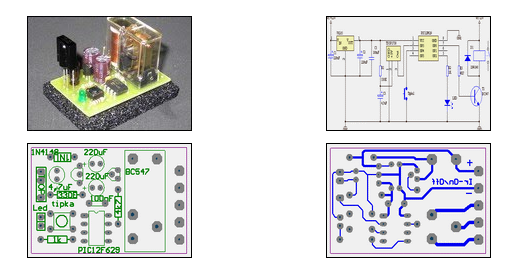
IR On/Off Switch Using Microcontroller
The ability to turn electrical devices ON or OFF using a remote control is a well-established concept, with numerous devices effectively performing this function.
To implement a remote control system for switching electrical devices, a typical schematic would include several key...

Protecting Microcontroller Input Pins from Soft Power Switch
A soft power switch for a microcontroller is designed such that a momentary switch can activate the circuit, including the microcontroller. When the switch is pressed a second time, the microcontroller is capable of shutting itself down after executing necessary...

Hum Circuit
The kit employs an off-the-shelf microcontroller based on the AtMega328P-PU Arduino, along with a simplified version designed for ease of replication and modification by collaborators and students. This initiative aims to enable the fabrication of simplified microcontrollers for DIY synthetic...
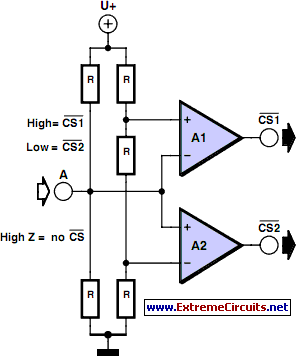
Multitasking Pins circuit
It is entirely logical that low-cost miniature microcontrollers have fewer pins than their larger counterparts, sometimes too few. Consideration has been given to how to economize on pins by making them perform the work of several. It was noted that...

Robo Atmega328p project
This project was designed to introduce a friend to microcontrollers and circuits using various functionalities and spare parts. A PS2 numpad was utilized as the key entry mechanism, which was found at a thrift store and included the necessary connector....

Sensor Circuit Of Analog Line Follower Robot
The following circuit illustrates the sensor circuit of an analog line follower robot. Features include control by a microcontroller and a sensor circuit.
The sensor circuit for an analog line follower robot is designed to detect the presence of a line...

Water Level controller
The microcontroller-based water level controller and motor protector manages the on and off states of the motor based on the water level in the overhead tank (OHT). It regulates the tank's water level through a microcontroller, thereby providing automatic protection...