


Dual Fan Controller
#ATtiny45
#ATMega168
#thermistor
#fan control
#temperature monitoring
#PC cooling
#kitchen cabinet
#resistance conversion
#Fahrenheit
#BC1482

Description: This project involves reading a thermistor using an Atmel ATtiny45 or ATMega168 microcontroller to control two fans for cooling a PC housed in a kitchen cabinet. A table is provided for converting the resistance of the BC1482 thermistor to Fahrenheit.
The circuit utilizes an Atmel ATtiny45 or ATMega168 microcontroller to monitor the temperature via a thermistor, specifically the BC1482 model. The thermistor's resistance varies with temperature, allowing the microcontroller to determine the current temperature by measuring this resistance. The microcontroller is programmed to activate two fans when the temperature exceeds a predefined threshold, ensuring effective cooling of the PC.
The thermistor is connected in a voltage divider configuration with a fixed resistor. The output voltage from the divider is fed into one of the analog input pins of the microcontroller. The microcontroller reads this voltage and converts it into a temperature value using a predefined conversion table that links resistance values to Fahrenheit temperatures. This conversion table is essential for accurately interpreting the thermistor readings.
The fans are connected to the microcontroller via a relay or a transistor switch, allowing the microcontroller to control their operation based on the temperature readings. The choice of using two fans provides redundancy and enhances airflow, which is particularly important in the confined space of a kitchen cabinet.
In summary, this circuit effectively combines temperature sensing with fan control to maintain optimal operating conditions for a PC in a potentially warm environment, such as a kitchen. The use of an Atmel microcontroller allows for flexible programming and integration of additional features, such as adjustable temperature thresholds or fan speed control.Describes reading a thermistor using an Atmel ATtiny45 or ATMega168 microcontroller to drive two fans to cool a PC installed in a kitchen cabinet. Include a table for converting the BC1482 resistance to Fahrenheit..
The circuit utilizes an Atmel ATtiny45 or ATMega168 microcontroller to monitor the temperature via a thermistor, specifically the BC1482 model. The thermistor's resistance varies with temperature, allowing the microcontroller to determine the current temperature by measuring this resistance. The microcontroller is programmed to activate two fans when the temperature exceeds a predefined threshold, ensuring effective cooling of the PC.
The thermistor is connected in a voltage divider configuration with a fixed resistor. The output voltage from the divider is fed into one of the analog input pins of the microcontroller. The microcontroller reads this voltage and converts it into a temperature value using a predefined conversion table that links resistance values to Fahrenheit temperatures. This conversion table is essential for accurately interpreting the thermistor readings.
The fans are connected to the microcontroller via a relay or a transistor switch, allowing the microcontroller to control their operation based on the temperature readings. The choice of using two fans provides redundancy and enhances airflow, which is particularly important in the confined space of a kitchen cabinet.
In summary, this circuit effectively combines temperature sensing with fan control to maintain optimal operating conditions for a PC in a potentially warm environment, such as a kitchen. The use of an Atmel microcontroller allows for flexible programming and integration of additional features, such as adjustable temperature thresholds or fan speed control.Describes reading a thermistor using an Atmel ATtiny45 or ATMega168 microcontroller to drive two fans to cool a PC installed in a kitchen cabinet. Include a table for converting the BC1482 resistance to Fahrenheit..

PC Fan Speed Controller - For a Low-Noise PC
The fan operates continuously in many PCs, which may not be necessary. A simple controller circuit can adjust the fan speed based on demand. This not only conserves energy but also minimizes noise irritation from the fan. Only three components...

Temperature-controuer
When power is applied, the thermistor, a negative temperature coefficient (NTC) device, exhibits a high resistance value. This condition causes operational amplifier A1 to saturate positively, which in turn drives the output of the LT3525A switching regulator low, thereby biasing...

Thermistor electronic thermometer circuit diagram
The thermistor RT, along with resistors R1, R2, R3, and variable resistor RP1, creates a temperature measurement bridge. At a temperature of 20°C, the configuration of R1, R3, and the adjustment of RP1 enables the bridge to maintain balance. As...

Boiler control
The purpose of this circuit is to control the water temperature in a hot-water heating system. It lowers the boiler temperature as the outside air temperature increases. An operational amplifier (op-amp) is utilized as a comparator. Thermistor TH2 and resistor...
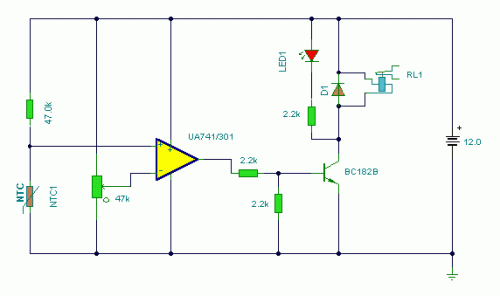
Temperature Monitor circuit
A thermistor positioned as indicated creates a heat-activated sensor. Variations in temperature will modify the output of the operational amplifier, triggering the relay and illuminating the LED. Reversing the placement of the thermistor and the 47k resistor converts the setup...

resistance Replicate thermistor behavior for second sensor
An R/C electric motor is equipped with a 10K thermistor sensor, which connects to a speed control unit that includes basic thermal protection. A secondary sensor board is intended to be developed to display the temperature on a segment display...

Zero degree Celsius alarm
This circuit is designed to trigger an alarm when the temperature drops below zero degrees Celsius. A thermistor is utilized to measure the temperature. The operational amplifier LM7215 is employed to compare the reference voltage with the voltage from the...

One circuit thermistor relay contacts to prevent competition
Competition among relay contacts in contactor control systems often leads to significant issues that can be cumbersome to address. In some cases, this requires the addition of numerous components. However, utilizing a negative temperature coefficient thermistor (NTC) for delay switching...

Heat sensor relay switch
The Thermistor, or NTC (Negative Temperature Coefficient) of 10K, is a standard type. Most types will work. The one in the diagram is a 10K model made by Fenwal (#197-103LAG-A01). The resistance lowers as the surrounding temperature increases, which affects...