


Intelligent Fan Controller
#PIC18F2550
#temperature control
#fan speed control
#PC cooling
#buck converter
#microcontroller
#computer fans
#noise reduction
#4-wire fan
#3-wire fan

Description: The Intelligent Fan Controller regulates the speed of computer fans according to the internal temperature of the computer, minimizing noise levels. It utilizes a 4-wire, 2-wire, and 3-wire fan configuration in conjunction with a PIC microcontroller, specifically the PIC18F2550. This circuit incorporates a buck converter to enhance PC cooling efficiency.
The Intelligent Fan Controller is designed to optimize the cooling of computer systems by dynamically adjusting fan speeds based on temperature readings. The core of the circuit is the PIC18F2550 microcontroller, which processes temperature data and controls the fan operation accordingly. The microcontroller can interface with various types of fans, including those with 4-wire, 3-wire, and 2-wire configurations, allowing for versatile application in different computer setups.
The 4-wire fans provide the most control, featuring a PWM (Pulse Width Modulation) signal for speed regulation, while the 3-wire and 2-wire fans rely on voltage-based control methods. The circuit employs a temperature sensor, which continuously monitors the internal temperature of the computer. When the temperature rises beyond a predefined threshold, the microcontroller increases the fan speed to enhance airflow and cooling. Conversely, when the temperature falls below the threshold, the microcontroller reduces the fan speed, thereby minimizing noise and power consumption.
In addition to the microcontroller, the circuit includes a buck converter, which efficiently steps down the voltage supplied to the fans, ensuring that they operate within their specified voltage range while maximizing energy efficiency. This converter allows the system to maintain performance without excessive power draw, contributing to the overall reliability and longevity of the computer components.
Overall, the Intelligent Fan Controller not only improves cooling performance but also contributes to a quieter computing experience, making it an essential component for high-performance and silent PC builds.The Intelligent Fan Controller will control the speed of computer fans based on the temperature inside your computer and reduce the noise made by your computer Intelligent Fan Controller 4-wire 2-wire 3-wire speed computer pic microchip PIC18F2550 18F2550 temperature media electronics silicon chip buck converter circuit PC cooling geoff graham..
The Intelligent Fan Controller is designed to optimize the cooling of computer systems by dynamically adjusting fan speeds based on temperature readings. The core of the circuit is the PIC18F2550 microcontroller, which processes temperature data and controls the fan operation accordingly. The microcontroller can interface with various types of fans, including those with 4-wire, 3-wire, and 2-wire configurations, allowing for versatile application in different computer setups.
The 4-wire fans provide the most control, featuring a PWM (Pulse Width Modulation) signal for speed regulation, while the 3-wire and 2-wire fans rely on voltage-based control methods. The circuit employs a temperature sensor, which continuously monitors the internal temperature of the computer. When the temperature rises beyond a predefined threshold, the microcontroller increases the fan speed to enhance airflow and cooling. Conversely, when the temperature falls below the threshold, the microcontroller reduces the fan speed, thereby minimizing noise and power consumption.
In addition to the microcontroller, the circuit includes a buck converter, which efficiently steps down the voltage supplied to the fans, ensuring that they operate within their specified voltage range while maximizing energy efficiency. This converter allows the system to maintain performance without excessive power draw, contributing to the overall reliability and longevity of the computer components.
Overall, the Intelligent Fan Controller not only improves cooling performance but also contributes to a quieter computing experience, making it an essential component for high-performance and silent PC builds.The Intelligent Fan Controller will control the speed of computer fans based on the temperature inside your computer and reduce the noise made by your computer Intelligent Fan Controller 4-wire 2-wire 3-wire speed computer pic microchip PIC18F2550 18F2550 temperature media electronics silicon chip buck converter circuit PC cooling geoff graham..

Temperature Controller
Wine doesn't like subzero temperatures, and during wintertime, my wine cellar got pretty cold. There was an electric heating element, but the thermostat was broken, so it was either full burn or nothing. That's how the temperature monitor/controller came to...

Three temperature switch circuits
Electronic temperature control circuit for imported car air conditioners. It utilizes operational amplifiers A1 and A2, specifically the LM393 model. An adjustment potentiometer (RP) is included, allowing modification of the temperature range. The adjustment range includes a power temperature setting...

Temperature Controller With Defrost Cycle
This temperature controller has a range of -50 to +150 °C and permits defrosting. R7, VR3, and R8 set the controller's trip point. SI initiates defrosting, and S2 cancels defrosting. VR1 and VR2 set the defrost temperature trip point. The...

delay circuit for photography
This article outlines the construction of a simple microcontroller-based delay circuit designed for photographic applications such as drop or high-speed photography. It can control the trigger lag of cameras and flash units, generate periodic trigger pulses, or manage magnetic valves....

The method of temperature controlling system of producing one-chip computer calorstat is analyzed
The primary principle of the system is to gather real-time temperature data from a temperature sensor using a microcontroller, which then compares this data with pre-defined thermostat values to maintain the desired temperature within a sample container. This text covers...

Flashflex Microcontroller Control Of Character Lcd Module
The FM497 is an integrated electronic ignition controller designed for breakerless ignition systems that utilize Hall effect sensors. This device operates an external NPN Darlington transistor to manage the coil current, thereby delivering the necessary stored energy while maintaining low...
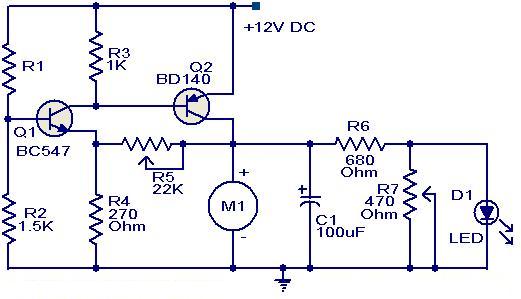
12 Volt DC Fan Temperature Control
This circuit utilizes two transistors to control the speed of a 12 V DC fan based on temperature variations. A thermistor (R1) is used to sense the temperature. As the temperature rises, the base current of Q1 (BC 547) increases,...

Temperature controller
Temperature control is accomplished using the REF-02 +5 V Reference/Thermometer in conjunction with the CMP-02 Precision Low Input Current Comparator. The CMP-02 activates a heating element driver (Q1) whenever the current temperature falls below a predetermined setpoint, which is established...

analog light dimmer circuit connected to microcontroller
Assistance is required to modify a light dimmer circuit connected to a PIC12C508 microcontroller. This circuit is designed for the...
The light dimmer circuit utilizing the PIC12C508 microcontroller serves to control the brightness of a light source through pulse width modulation...