


interface an LCD to 89c51 using 4 bit mode
#89c51
#LCD
#4-bit mode
#interface
#Lampex16200
#microcontroller programming
#embedded systems
#display
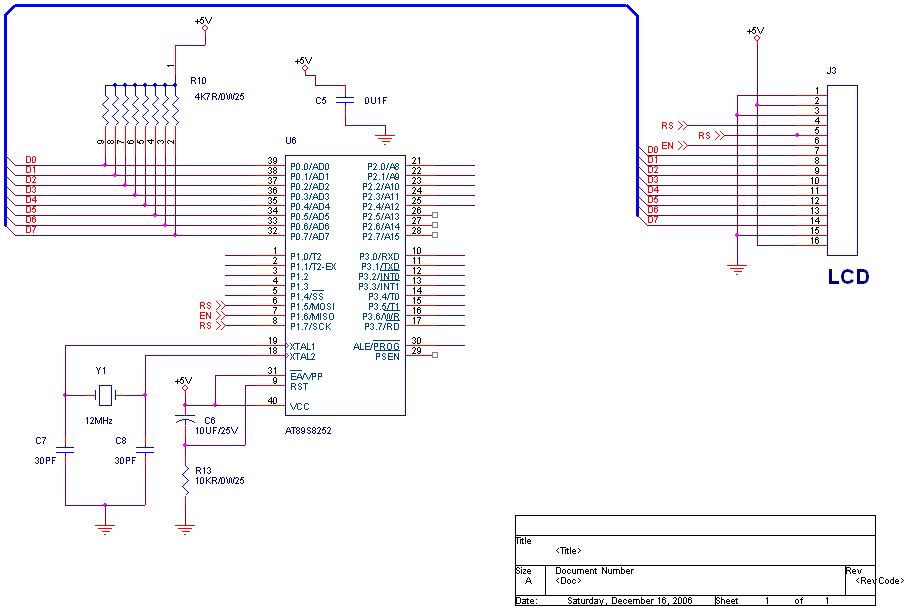
Description: How to interface an LCD to the 89C51 microcontroller using 4-bit mode. A Lampex 16200 controller is being used; please send the manual for this controller.
To interface an LCD with the 89C51 microcontroller using 4-bit mode, the following steps and components are typically involved:
1. **Components Required**:
- 89C51 Microcontroller
- Lampex 16200 LCD
- Resistors (for contrast adjustment)
- Capacitors (for power stabilization)
- Breadboard and connecting wires
- Power supply (typically 5V)
2. **Pin Configuration**:
The Lampex 16200 LCD typically has 16 pins. The relevant pins for 4-bit mode operation are:
- RS (Register Select)
- RW (Read/Write)
- E (Enable)
- D4 to D7 (Data Pins in 4-bit mode)
- VSS (Ground)
- VDD (Power Supply)
- V0 (Contrast adjustment)
3. **Wiring the LCD**:
- Connect VSS to ground and VDD to the +5V power supply.
- Connect the V0 pin to a potentiometer for contrast adjustment.
- Connect the RS pin to a designated GPIO pin on the 89C51 (e.g., P1.0).
- Connect the RW pin to ground for write-only mode.
- Connect the E pin to another GPIO pin (e.g., P1.1).
- Connect the D4, D5, D6, and D7 pins to four GPIO pins (e.g., P1.2 to P1.5).
4. **Initialization Sequence**:
The LCD must be initialized properly to function. The initialization sequence in 4-bit mode includes:
- Set the data length to 4 bits by sending the appropriate command.
- Configure the display settings (e.g., display on/off, cursor blinking).
- Set the entry mode for text display.
5. **Sending Commands and Data**:
To send commands or data to the LCD:
- Set RS to 0 for commands and 1 for data.
- Place the high nibble (D4-D7) on the data pins.
- Toggle the E pin to high and then back to low to latch the data.
- Repeat the process for the low nibble after a short delay.
6. **Programming**:
A simple program can be written in assembly or C to control the LCD. It should include functions for initializing the LCD, sending commands, and displaying characters.
7. **Manual Reference**:
The manual for the Lampex 16200 LCD controller should provide specific details regarding command sets, timing requirements, and electrical characteristics, which are essential for successful interfacing.
This comprehensive approach ensures that the LCD is effectively interfaced with the 89C51 microcontroller in 4-bit mode, allowing for efficient display operations.how to interface an lcd to 89c51 using 4 bit mode. am using lampex16200 pls send me manual of this controller..
To interface an LCD with the 89C51 microcontroller using 4-bit mode, the following steps and components are typically involved:
1. **Components Required**:
- 89C51 Microcontroller
- Lampex 16200 LCD
- Resistors (for contrast adjustment)
- Capacitors (for power stabilization)
- Breadboard and connecting wires
- Power supply (typically 5V)
2. **Pin Configuration**:
The Lampex 16200 LCD typically has 16 pins. The relevant pins for 4-bit mode operation are:
- RS (Register Select)
- RW (Read/Write)
- E (Enable)
- D4 to D7 (Data Pins in 4-bit mode)
- VSS (Ground)
- VDD (Power Supply)
- V0 (Contrast adjustment)
3. **Wiring the LCD**:
- Connect VSS to ground and VDD to the +5V power supply.
- Connect the V0 pin to a potentiometer for contrast adjustment.
- Connect the RS pin to a designated GPIO pin on the 89C51 (e.g., P1.0).
- Connect the RW pin to ground for write-only mode.
- Connect the E pin to another GPIO pin (e.g., P1.1).
- Connect the D4, D5, D6, and D7 pins to four GPIO pins (e.g., P1.2 to P1.5).
4. **Initialization Sequence**:
The LCD must be initialized properly to function. The initialization sequence in 4-bit mode includes:
- Set the data length to 4 bits by sending the appropriate command.
- Configure the display settings (e.g., display on/off, cursor blinking).
- Set the entry mode for text display.
5. **Sending Commands and Data**:
To send commands or data to the LCD:
- Set RS to 0 for commands and 1 for data.
- Place the high nibble (D4-D7) on the data pins.
- Toggle the E pin to high and then back to low to latch the data.
- Repeat the process for the low nibble after a short delay.
6. **Programming**:
A simple program can be written in assembly or C to control the LCD. It should include functions for initializing the LCD, sending commands, and displaying characters.
7. **Manual Reference**:
The manual for the Lampex 16200 LCD controller should provide specific details regarding command sets, timing requirements, and electrical characteristics, which are essential for successful interfacing.
This comprehensive approach ensures that the LCD is effectively interfaced with the 89C51 microcontroller in 4-bit mode, allowing for efficient display operations.how to interface an lcd to 89c51 using 4 bit mode. am using lampex16200 pls send me manual of this controller..

Ultra Low Power LCD
This circuit functions as an ultra-low power alternative to multiple LED on-off indicators. It is designed to be easily readable in full daylight conditions.
The described circuit employs a low-power microcontroller or a dedicated LED driver IC that manages the operation...
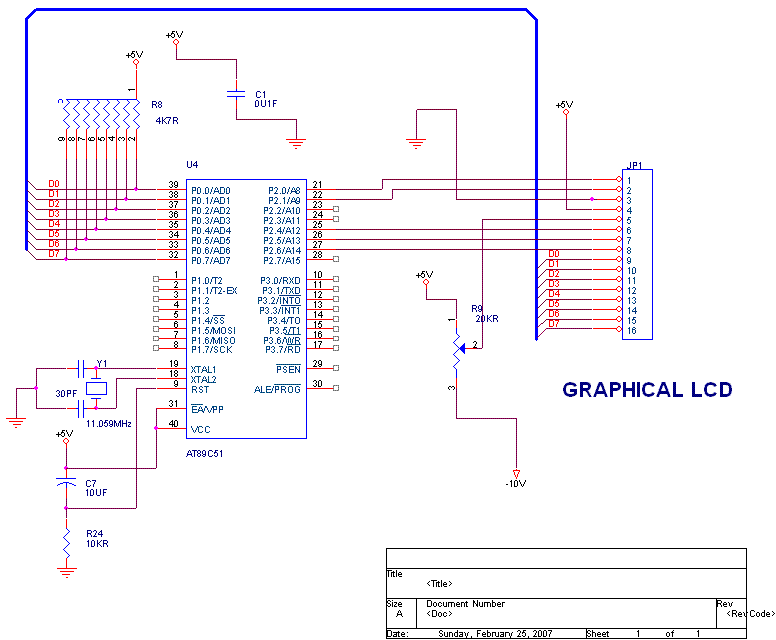
LCD contrast controlled by LCD
What is the recommended frequency for the Low Pass Filter used to control the contrast of an LCD? I want to adjust the contrast of an LCD using PWM.
To effectively control the contrast of an LCD using Pulse Width Modulation...

L7136 LCD Thermometer For Vehicle Engine
Function: Used to measure the voltage change minute by management before the temperature diodes. Component: IC, Diode, Resistor, 3-1/2 digit LCD (SP521PR).
The circuit described functions as a voltage measurement system designed to monitor minute voltage changes, particularly in relation to...

Interfacing LCD via SPI
Over time, microcontrollers have become increasingly powerful, cost-effective, and compact. A typical microcontroller from the past may have had 40 pins and lacked internal memory, whereas modern J-series PICs feature 96K of program memory and only 28 pins. This allows...

Simple Lcd Display Power Supply
Laptop computers frequently utilize large-screen LCDs that require both a variable and a negative supply to achieve maximum contrast. This circuit operates from the system's positive battery supply and generates a digitally variable negative voltage to drive the display. The...

4 Direct drive LCD display circuit diagram
Each part of the LCD has an individual counter, latch, decoder, and driver. The pumping signal is fed back to the motherboard of the LCD. When the display section is disconnected, the phase and amplitude of the motherboard and display...

LCD Backlight Electro luminescent Inverter
There are two primary types of backlights for LCDs: LEDs, which stands for light-emitting diodes, and EL, which stands for electroluminescent. EL backlights are generally more efficient and provide more uniform lighting compared to LED backlights, but they require complex...

direct driving LCD
The LCD in question has more pins than the microcontroller. It was not possible to expand the image for a better view. Unless there is a strong preference for using this display, it is recommended to obtain a Hitachi-compliant alphanumeric...
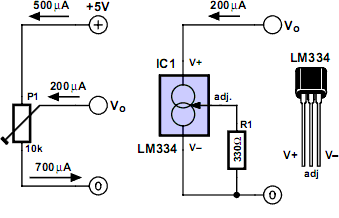
Contrast Control for LCDs
The adjustment control for the contrast of an LC-Display is typically a 10-k potentiometer. This functions effectively as long as the power supply voltage remains constant. However, in scenarios where the power supply voltage fluctuates, such as with battery-operated devices,...