


ISP Programmer for ATmega32 Microcontroller
#ISP programmer
#ATmega32
#AVR
#Pony programmer
#microcontroller
#burner circuit
#programming
#embedded systems
#electronics
#DIY

Description: ISP programmer with circuit diagram for AVR Atmega32 microcontroller. This ISP burner circuit is an adaptation of the Pony programmer and uses PonyProg software.
The ISP (In-System Programming) programmer designed for the AVR Atmega32 microcontroller allows for programming the microcontroller directly on the circuit board. This method eliminates the need for external programming devices and simplifies the development and debugging process. The circuit diagram typically includes essential components such as a microcontroller, a crystal oscillator for clock generation, and a series of resistors and capacitors that ensure stable operation.
The Pony programmer adaptation integrates a USB interface, enabling communication between a PC and the microcontroller. The PonyProg software is utilized for programming and uploading firmware to the Atmega32. This software supports various programming modes and provides a user-friendly interface for developers.
Key components of the circuit include the Atmega32 microcontroller, a 16 MHz crystal oscillator for timing, and several passive components such as resistors and capacitors that filter and stabilize the power supply. The ISP header connects to the microcontroller's programming pins, allowing for direct access to the programming interface.
The circuit design emphasizes simplicity and efficiency, making it suitable for hobbyists and professionals alike. Proper layout and grounding techniques are crucial to minimize noise and ensure reliable programming. Overall, this ISP programmer circuit serves as a valuable tool for developing and testing applications based on the Atmega32 microcontroller.ISP programmer with circuit diagram for AVR Atmega32 micro controller.This ISP burner circuit is an adaptation of Pony programmer and uses ponyprog software
The ISP (In-System Programming) programmer designed for the AVR Atmega32 microcontroller allows for programming the microcontroller directly on the circuit board. This method eliminates the need for external programming devices and simplifies the development and debugging process. The circuit diagram typically includes essential components such as a microcontroller, a crystal oscillator for clock generation, and a series of resistors and capacitors that ensure stable operation.
The Pony programmer adaptation integrates a USB interface, enabling communication between a PC and the microcontroller. The PonyProg software is utilized for programming and uploading firmware to the Atmega32. This software supports various programming modes and provides a user-friendly interface for developers.
Key components of the circuit include the Atmega32 microcontroller, a 16 MHz crystal oscillator for timing, and several passive components such as resistors and capacitors that filter and stabilize the power supply. The ISP header connects to the microcontroller's programming pins, allowing for direct access to the programming interface.
The circuit design emphasizes simplicity and efficiency, making it suitable for hobbyists and professionals alike. Proper layout and grounding techniques are crucial to minimize noise and ensure reliable programming. Overall, this ISP programmer circuit serves as a valuable tool for developing and testing applications based on the Atmega32 microcontroller.ISP programmer with circuit diagram for AVR Atmega32 micro controller.This ISP burner circuit is an adaptation of Pony programmer and uses ponyprog software

Driving circuit schematic
The driving circuit depicted in Figure 18-12 consists of a connection between the driving portion, the microcontroller, and the air conditioning operation components of the bridge. The microcontroller's digital signal levels from ports P4.0 to P4.3 (approximately 12 feet) and...
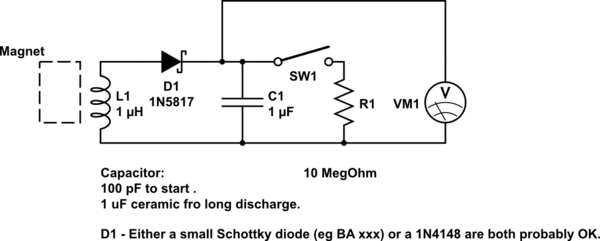
DIY kinetic energy harvester
A DIY kinetic energy harvester utilizing the electromagnetic method to generate electricity. The materials that will be used are currently known.
The project involves creating a kinetic energy harvester that converts mechanical energy from motion into electrical energy through electromagnetic induction....
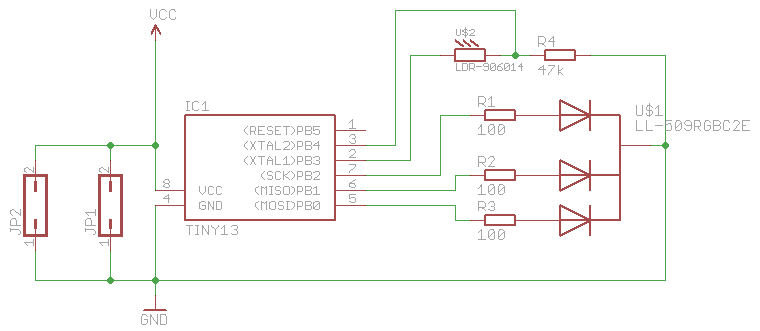
synchronizing fireflies ng
This is a remake of the fireflies project that was created a year ago. The concept revolves around the emergence of patterns, particularly the synchronization of hundreds or thousands of fireflies. Initially, they flash randomly, but over time, influenced by...

AVR terminal for serial port
The LCD display is represented by the connector X1. It has a HD44780 compatible LCD controller and is using the 4-bit interface to send data to the LCD controller. The LEDs are multiplexed. It is possible to connect 12 LEDs...
serial communication on atmega3216
A basic introduction to RS232-based serial communication on the ATmega32/16 using the USART hardware. It is recommended to have the ATmega32 datasheet available for reference. Serial communication involves transmitting data one bit at a time across a communication channel, in...

Multitasking Pins
It is entirely logical that low-cost miniature microcontrollers have fewer pins than their larger counterparts, sometimes too few. Consideration has been given to how to economize on pins by making them perform multiple functions. One approach is to exploit the...

Microcontroller Clapper Switch
For those who prefer convenience, it is possible to turn the bedroom light on or off without leaving the bed simply by clapping hands. This concept inspired the design of a clap-activated light control system. Various clap switch projects can...

avr ntp clock 2x.
The Network Time Protocol (NTP) has transformed global timekeeping, enabling accurate date and time retrieval from anywhere in the world. NTP is a straightforward UDP-based protocol that can be implemented in microcontrollers. The Tuxgraphics NTP clock has gained popularity over...

ATMEGA16 8-bit AVR Microcontroller with 16K Bytes In-System Programmable Flash
This simple AVR programmer is capable of transferring hex programs to most ATMEL AVR microcontrollers. It is more reliable than many other simple AVR programmers available and can be constructed in a very short amount of time. This programmer supports...