


large dancing robot using pic16f877a microcontroller

Description: Build a large dancing robot. This was intended to be a walking robot, but it ended up moving in a more rhythmic manner. A video is available in the last step.
The project involves the construction of a large dancing robot, which, while initially designed for walking, exhibits a unique and entertaining rhythmic movement. The robot's structure typically includes a robust chassis, servos for movement, and a microcontroller to manage its operations.
The chassis can be constructed from lightweight materials such as aluminum or plastic to facilitate easy movement and reduce energy consumption. The design should incorporate a stable base to support the robot's height and ensure balance during its dancing motions.
Servos or stepper motors are essential components for achieving the desired movement. These actuators should be strategically placed at the joints to allow for a range of motion that simulates dancing. The choice of servo motors will depend on the weight of the robot and the complexity of the movements intended.
A microcontroller, such as an Arduino or Raspberry Pi, serves as the brain of the robot, controlling the servos based on programmed dance sequences. The programming can be done using a simple coding environment where different movements can be defined and sequenced to create a choreographed routine.
For enhanced interactivity, sensors such as accelerometers or gyroscopes can be incorporated to allow the robot to respond to external stimuli, such as music or audience movements. This feature can enhance the robot's performance, making it more engaging to viewers.
Power supply components, including batteries or a power adapter, must be chosen to ensure sufficient energy for prolonged operation. Careful consideration should be given to power management to prevent overheating and ensure continuous functionality during performances.
Finally, an optional feature could include LED lights or sound modules to further enrich the robot's dancing capabilities, providing visual and auditory feedback as it performs. This comprehensive approach ensures the creation of a dynamic and entertaining large dancing robot.Large Dancing Robot Build a large dancing robot. This was supposed to be a walking robot, but it more kinda beebopped around. video on last step. Build a P..
The project involves the construction of a large dancing robot, which, while initially designed for walking, exhibits a unique and entertaining rhythmic movement. The robot's structure typically includes a robust chassis, servos for movement, and a microcontroller to manage its operations.
The chassis can be constructed from lightweight materials such as aluminum or plastic to facilitate easy movement and reduce energy consumption. The design should incorporate a stable base to support the robot's height and ensure balance during its dancing motions.
Servos or stepper motors are essential components for achieving the desired movement. These actuators should be strategically placed at the joints to allow for a range of motion that simulates dancing. The choice of servo motors will depend on the weight of the robot and the complexity of the movements intended.
A microcontroller, such as an Arduino or Raspberry Pi, serves as the brain of the robot, controlling the servos based on programmed dance sequences. The programming can be done using a simple coding environment where different movements can be defined and sequenced to create a choreographed routine.
For enhanced interactivity, sensors such as accelerometers or gyroscopes can be incorporated to allow the robot to respond to external stimuli, such as music or audience movements. This feature can enhance the robot's performance, making it more engaging to viewers.
Power supply components, including batteries or a power adapter, must be chosen to ensure sufficient energy for prolonged operation. Careful consideration should be given to power management to prevent overheating and ensure continuous functionality during performances.
Finally, an optional feature could include LED lights or sound modules to further enrich the robot's dancing capabilities, providing visual and auditory feedback as it performs. This comprehensive approach ensures the creation of a dynamic and entertaining large dancing robot.Large Dancing Robot Build a large dancing robot. This was supposed to be a walking robot, but it more kinda beebopped around. video on last step. Build a P..

Robo Atmega328p project
This project was designed to introduce a friend to microcontrollers and circuits using various functionalities and spare parts. A PS2 numpad was utilized as the key entry mechanism, which was found at a thrift store and included the necessary connector....

Multitasking Pins
It is entirely logical that low-cost miniature microcontrollers have fewer pins than their larger counterparts, sometimes too few. Consideration has been given to how to economize on pins by making them perform multiple functions. One approach is to exploit the...

Direction and speed control
This circuit functions similarly to the one depicted in Fig. 57-4. The key differences include the placement of the field across the rectified supply and the armature being positioned within the SCR bridge. Therefore, the field current is unidirectional while...
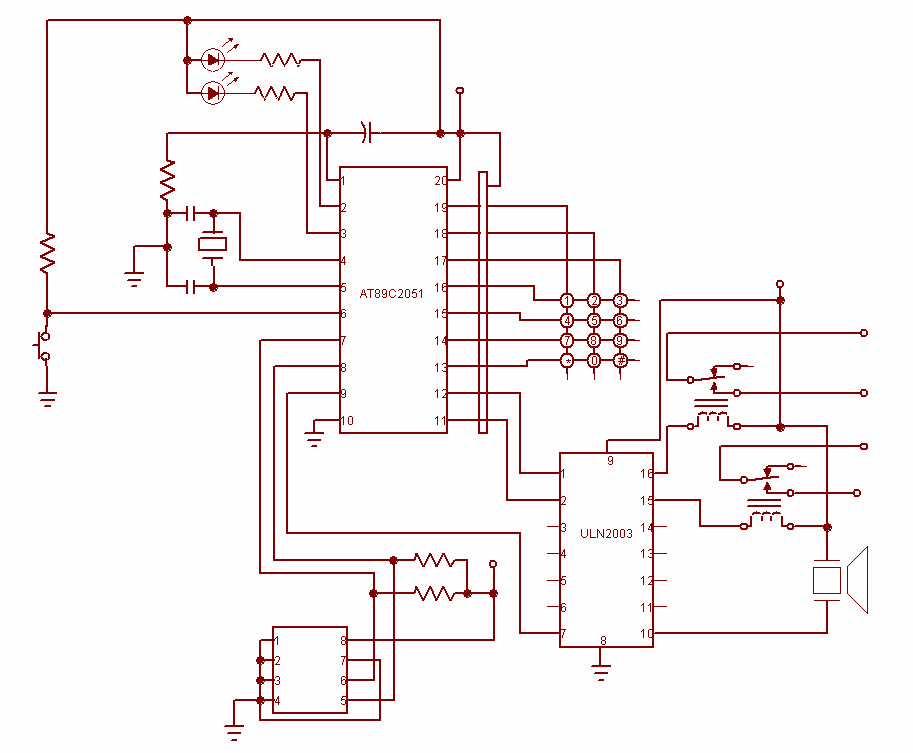
Password Based Door Locking
Security is a prime concern in our day-to-day life. Everyone wants to be as much secure as possible. An access control for doors forms a vital link in a security chain. The microcontroller based Door locker is an access control...

repair microcontroller circuit
The difference between these two ICs. A microcontroller is a specialized type of microprocessor designed to be self-sufficient and cost-effective, while a microprocessor is typically intended for general-purpose use, such as in personal computers (PCs). The microcontroller integrates several useful...

knight Rider
A light computer has been developed that simulates the scanning effect seen in the KITT car from the TV series Knight Rider. The design utilizes a microcontroller, specifically the PIC16F84A, instead of the commonly used CD4017 counter IC. This choice...

Microcontroller
The gap between TTL (Transistor-Transistor Logic) devices and personal computers can be effectively bridged with modern microcontrollers. These microcontrollers not only incorporate a central processing unit (CPU) but also include program and data memory, EEPROM, input/output (I/O) ports, timers, and...

PIC Stepper Motor Tester
Determining the identification of drive wires on a unipolar stepper motor, which is commonly found in surplus or salvaged equipment. The platform utilized is a PIC16F877A microcontroller programmed with BoostC, interfaced via RS232 to a PC running a terminal program....

Low Resource Microcontroller 3 Phase BLDC Motor Speed Controller
This article discusses a minimal resource microcontroller implementation for a three-phase Brushless DC (BLDC) motor, focusing on a closed-loop speed motor controller application based on a Microchip PIC12 device. It demonstrates how minimization techniques can reduce the number of I/O...