


lcd interfacing
#8051
#LCD
#Hitachi-44780
#SDCC
#4-bit interfacing
#microcontroller
#embedded systems
#C programming
#schematic
#display

Description: This document provides an example of how to interface with the standard Hitachi HD44780 LCD using an 8051 microcontroller and the SDCC C compiler. A standard 16-character by 2-line LCD module is utilized, as illustrated in the schematic below. The interfacing is accomplished using a 4-bit mode.
The Hitachi HD44780 LCD controller is widely used for displaying alphanumeric characters and is commonly interfaced with microcontrollers due to its simplicity and effectiveness. The 4-bit interfacing method allows for reduced pin usage, which is advantageous in microcontroller applications.
In this configuration, the 8051 microcontroller is connected to the LCD through a set of data and control lines. The data lines D4 to D7 are utilized for sending data in 4-bit mode, while the control lines include the Register Select (RS), Read/Write (R/W), and Enable (E) signals.
The RS line determines whether the data being sent is a command or character data. When RS is low, the microcontroller sends a command to the LCD. Conversely, when RS is high, character data is sent for display. The R/W line indicates the operation mode of the LCD; it is set low for writing data and high for reading data from the LCD. The Enable line is a strobe signal that triggers the LCD to read the data present on the data lines.
The initialization sequence for the HD44780 typically involves setting the display mode, clearing the display, and configuring the cursor. A typical sequence would involve sending a command to set the LCD to 4-bit mode, followed by commands to set the number of display lines and character font.
In conclusion, interfacing the Hitachi HD44780 LCD with the 8051 microcontroller using a 4-bit method is an efficient way to utilize the display capabilities of the LCD while conserving microcontroller I/O pins. The schematic represents the necessary connections and the sequence of operations required to achieve successful communication between the microcontroller and the LCD module.This is an example how to interface to the standard Hitachi-44780 LCD using an 8051 microcontroller and SDCC as C Compiler. I use a standard 16-character by 2-line LCD module, see schematic below. Here, I use 4-bit interfacing.
The Hitachi HD44780 LCD controller is widely used for displaying alphanumeric characters and is commonly interfaced with microcontrollers due to its simplicity and effectiveness. The 4-bit interfacing method allows for reduced pin usage, which is advantageous in microcontroller applications.
In this configuration, the 8051 microcontroller is connected to the LCD through a set of data and control lines. The data lines D4 to D7 are utilized for sending data in 4-bit mode, while the control lines include the Register Select (RS), Read/Write (R/W), and Enable (E) signals.
The RS line determines whether the data being sent is a command or character data. When RS is low, the microcontroller sends a command to the LCD. Conversely, when RS is high, character data is sent for display. The R/W line indicates the operation mode of the LCD; it is set low for writing data and high for reading data from the LCD. The Enable line is a strobe signal that triggers the LCD to read the data present on the data lines.
The initialization sequence for the HD44780 typically involves setting the display mode, clearing the display, and configuring the cursor. A typical sequence would involve sending a command to set the LCD to 4-bit mode, followed by commands to set the number of display lines and character font.
In conclusion, interfacing the Hitachi HD44780 LCD with the 8051 microcontroller using a 4-bit method is an efficient way to utilize the display capabilities of the LCD while conserving microcontroller I/O pins. The schematic represents the necessary connections and the sequence of operations required to achieve successful communication between the microcontroller and the LCD module.This is an example how to interface to the standard Hitachi-44780 LCD using an 8051 microcontroller and SDCC as C Compiler. I use a standard 16-character by 2-line LCD module, see schematic below. Here, I use 4-bit interfacing.
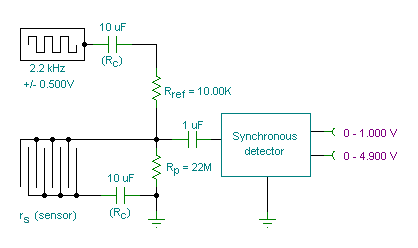
measurement conductance cell constant
A small transmitter board interfaces with a microcontroller and conductivity probe to measure liquid conductance and conductivity. Precise equations and measurements are provided for this microcontroller-controlled conductivity meter.
The described circuit consists of a compact transmitter board that serves as an...

pc based digital ic tester
Check the following ICs: 7400, 7402, 7404, 7408, 7432, 7486. A Visual Basic program is utilized to display the results on the PC. The microcontroller AT89S52 receives the IC number from the PC, verifies the logic gates with the truth...

Robot Motor Control Schematic
The schematic for controlling the motors is divided into three main sections, each serving a distinct function. The primary components featured in the schematic include the PIC 18F252 microcontroller, the SN754410 motor driver, and 2N2222 transistors. At the top of...

MICROCONTROLLER BASED AUTOMATIC ROOM LIGHT CONTROLLER
This project involves an automatic room light controller with a bidirectional visitor counter using a microcontroller. It is designed to manage room lighting and accurately count the number of individuals present. When a person enters the room, the counter increments...

µP-Controlled Oscillator Delivers Rock-Bottom Distortion
Function generators are essential in the design, testing, and operation of encoders, modulators, demodulators, and measurement instruments. This document presents an economical method to construct a bus-controlled sinewave oscillator that exhibits exceptionally low distortion. The circuit produces a sinusoidal output...

Classic 8051 Memory Layout
The CODE and CONST memory classes are generally stored in ROM, which can be either off-chip or on-chip. The CODE memory class is utilized for the actual program code, while the CONST memory class is designated for constant variables declared...

Microcontroller Based Telephone Remote Control Circuit
This device enables remote control of various appliances (up to eight with suitable add-on expansion boards) such as lights, water heaters, air conditioning, plant watering systems, alarms, etc., via a relay. It allows users to perform actions such as watering...

Serial LCD Library
This project utilizes a standard Hitachi HD44780 (or compatible) controller chip to operate an LCD display using only two wires. Various shapes and sizes are available, including standard line lengths of 8, 16, 20, 24, 32, and 40 characters in...

AirBorn Electronics project
Embedded system design engineers create examples of their work from the 1990s era.
Embedded systems have evolved significantly since the 1990s, and the design work from that period reflects the technological limitations and innovations of the time. Engineers in this field...