


microcontroller How can I measure battery voltage with my MCU
#PIC24FJ128GA010
#battery voltage measurement
#LiPo battery
#ADC
#analog comparator
#voltage monitoring
#microcontroller
#embedded systems

Description: Currently using the PIC24FJ128GA010, there is a plan to utilize an Input/Output port to connect a 4.2 V LiPo battery and monitor the voltage to ensure it does not drop below 3.7 V. It is advised to avoid digital methods. Two options are available: using an ADC or an analog comparator. The latter is preferable if the only requirement is to check if the voltage falls below the threshold.
The proposed circuit involves connecting a 4.2 V lithium polymer (LiPo) battery to the PIC24FJ128GA010 microcontroller, which will be responsible for monitoring the battery voltage. The monitoring can be achieved through either an Analog-to-Digital Converter (ADC) or an analog comparator. The ADC option allows for precise voltage readings, but since the requirement is simply to check if the voltage drops below a certain threshold, the analog comparator is the more efficient choice.
In this configuration, the analog comparator will continuously compare the voltage of the LiPo battery against a reference voltage set at 3.7 V. The reference voltage can be generated using a voltage divider or a dedicated reference IC to ensure accuracy. When the battery voltage falls below 3.7 V, the output of the comparator will change state, indicating that the battery is nearing its discharge limit.
To implement this circuit, the following components are necessary:
1. **PIC24FJ128GA010 Microcontroller**: This serves as the main control unit for processing signals and executing logic based on the comparator output.
2. **Analog Comparator**: Integrated into the microcontroller, this component will compare the battery voltage to the reference voltage.
3. **Voltage Reference**: A stable voltage reference or a resistor divider network to provide the 3.7 V reference level.
4. **LiPo Battery (4.2 V)**: The power source for the circuit.
5. **Resistors**: If using a voltage divider for the reference voltage, appropriate resistors will be needed to set the desired voltage.
The output of the comparator can be connected to a GPIO pin on the PIC24FJ128GA010, allowing the microcontroller to take action when the battery voltage drops below the specified threshold, such as triggering an alert or shutting down the system to prevent damage to the battery. This simple yet effective monitoring solution ensures the longevity and safety of the LiPo battery throughout its discharge cycle.Currently using the PIC24FJ128GA010 and I am planning to use Input/Output port to connect my 4. 2 V LiPo battery and to check if the voltage value doesn`t go below 3. 7 V. You should avoid digital. You have two options, use an ADC or use an Analog comparator. The last on one should be preferable if you only need to check if the voltage dropped bellow your threshold. Bruno Ferreira Sep 3 `12 at 15:22 @Mattew: Why 3. 7V If you stop at 3. 7V on the discharge curve, you`d be stopping after having used less than 50% of a LiPo`s capacity (depending on your current draw). See discharge curves for a Sanyo Li-ion battery
The proposed circuit involves connecting a 4.2 V lithium polymer (LiPo) battery to the PIC24FJ128GA010 microcontroller, which will be responsible for monitoring the battery voltage. The monitoring can be achieved through either an Analog-to-Digital Converter (ADC) or an analog comparator. The ADC option allows for precise voltage readings, but since the requirement is simply to check if the voltage drops below a certain threshold, the analog comparator is the more efficient choice.
In this configuration, the analog comparator will continuously compare the voltage of the LiPo battery against a reference voltage set at 3.7 V. The reference voltage can be generated using a voltage divider or a dedicated reference IC to ensure accuracy. When the battery voltage falls below 3.7 V, the output of the comparator will change state, indicating that the battery is nearing its discharge limit.
To implement this circuit, the following components are necessary:
1. **PIC24FJ128GA010 Microcontroller**: This serves as the main control unit for processing signals and executing logic based on the comparator output.
2. **Analog Comparator**: Integrated into the microcontroller, this component will compare the battery voltage to the reference voltage.
3. **Voltage Reference**: A stable voltage reference or a resistor divider network to provide the 3.7 V reference level.
4. **LiPo Battery (4.2 V)**: The power source for the circuit.
5. **Resistors**: If using a voltage divider for the reference voltage, appropriate resistors will be needed to set the desired voltage.
The output of the comparator can be connected to a GPIO pin on the PIC24FJ128GA010, allowing the microcontroller to take action when the battery voltage drops below the specified threshold, such as triggering an alert or shutting down the system to prevent damage to the battery. This simple yet effective monitoring solution ensures the longevity and safety of the LiPo battery throughout its discharge cycle.Currently using the PIC24FJ128GA010 and I am planning to use Input/Output port to connect my 4. 2 V LiPo battery and to check if the voltage value doesn`t go below 3. 7 V. You should avoid digital. You have two options, use an ADC or use an Analog comparator. The last on one should be preferable if you only need to check if the voltage dropped bellow your threshold. Bruno Ferreira Sep 3 `12 at 15:22 @Mattew: Why 3. 7V If you stop at 3. 7V on the discharge curve, you`d be stopping after having used less than 50% of a LiPo`s capacity (depending on your current draw). See discharge curves for a Sanyo Li-ion battery

The embedded microcontroller MC68HC912B32 background debugs the mode to design
The widespread application of Flash technology in microprocessors has led to significant advancements in the development and utilization of one-chip computers. Designers have transitioned from traditional in-circuit emulators (ICE) and JTAG interfaces to more cost-effective and user-friendly development methods. While...

doorbel
This smart doorbell system is designed for use in industrial environments. It is microcontroller-based and controls a horn and a flashlight.
The smart doorbell system utilizes a microcontroller to manage its operations, making it suitable for industrial applications where reliability and...

Microcontroller measures heart rate through fingertip
The reflected infrared (IR) signal detected by the photodiode is sent to a signal conditioning circuit, which filters out unwanted signals and amplifies the desired output.
The circuit begins with a photodiode that captures the reflected IR signals. The photodiode operates...

Dual-Slope Integrating ADC
A column-parallel analog-to-digital converter (ADC) has been developed for integration with CMOS active pixel sensors (APS). The design objectives focused on simplicity, compactness, moderate speed (greater than 10 kHz), current input, and acceptable accuracy (6 bits). The ADC is intended...
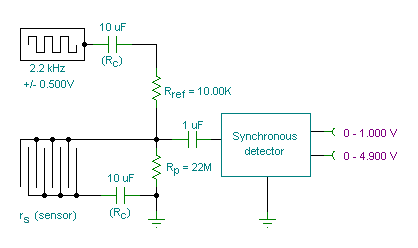
measurement conductance cell constant
A small transmitter board interfaces with a microcontroller and conductivity probe to measure liquid conductance and conductivity. Precise equations and measurements are provided for this microcontroller-controlled conductivity meter.
The described circuit consists of a compact transmitter board that serves as an...

DIAL ALARM-1
This is the lowest cost dialing alarm on the market and shows what can be done with an 8-pin microcontroller. The complete circuit is shown below. You cannot see all the features of this project by looking at the circuit...

Night Light Saver
A Microchip PIC12C508 8-pin CMOS microcontroller controls a night light, turning it on and off at preset times every day. It is designed to save energy, produce no electromagnetic interference (EMI), and operate without batteries, featuring a built-in lamp fixture...

analog to digital converter
This post discusses the interfacing and operation of Analog-to-Digital Converters (ADCs). An ADC is a device that converts the analog signals from transducers into digital signals, enabling computers to process the data. ADCs are essential for obtaining meaningful results when...

Handy Cricket Hardware Description
This document presents an overview of the hardware design of the Handy Cricket.
The Handy Cricket is a compact electronic device designed for educational and recreational purposes, primarily aimed at children. The hardware design incorporates various components that work together to...