


PIC 18 Explorer Board LCD Example Code With SPI Library

Description: Learn to use the LCD display on the PIC 18 Explorer board with the SPI library. The SPI library will be utilized to easily display characters on the LCD. Additionally, the operation of I/O expanders will be explored.
The PIC 18 Explorer board is a versatile development platform that allows for the integration of various peripherals, including LCD displays. The SPI (Serial Peripheral Interface) library is a crucial component for facilitating communication between the microcontroller and the LCD. By employing this library, users can efficiently send data to the LCD, enabling the display of characters and graphics with minimal complexity.
To begin, the SPI library must be included in the project. This library provides functions that simplify the process of initializing the SPI interface, sending data, and managing the timing of data transmissions. The LCD display typically requires initialization commands to set its operating mode, such as character mode or graphic mode, and to configure its display parameters.
The connection between the PIC microcontroller and the LCD involves several pins: the Serial Data Input (SDI), Serial Clock (SCK), Chip Select (CS), and Data/Command (DC) lines. The SPI library manages these connections, allowing the microcontroller to send commands and data to the LCD in a synchronized manner. Proper timing is essential for ensuring that the LCD interprets the received data correctly.
In addition to controlling the LCD, the exploration of I/O expanders is pertinent. I/O expanders are integrated circuits that allow for the expansion of the number of input/output pins available on a microcontroller. This is particularly useful when additional peripherals, such as buttons or sensors, need to be interfaced with the PIC 18 Explorer board. The communication with I/O expanders can also be facilitated through protocols like I2C or SPI, depending on the specific expander used.
In summary, utilizing the SPI library with the PIC 18 Explorer board enables effective control of an LCD display, while understanding I/O expanders enhances the board's capability to manage multiple peripherals. This combination provides a robust foundation for developing complex electronic projects that require user interaction through visual displays and additional input/output functionalities.Learn to use the LCD display on your pic 18 explorer board with the spi library. The spi library will be used to easily display characters on the LCD. You will also learn how io expanders work.
The PIC 18 Explorer board is a versatile development platform that allows for the integration of various peripherals, including LCD displays. The SPI (Serial Peripheral Interface) library is a crucial component for facilitating communication between the microcontroller and the LCD. By employing this library, users can efficiently send data to the LCD, enabling the display of characters and graphics with minimal complexity.
To begin, the SPI library must be included in the project. This library provides functions that simplify the process of initializing the SPI interface, sending data, and managing the timing of data transmissions. The LCD display typically requires initialization commands to set its operating mode, such as character mode or graphic mode, and to configure its display parameters.
The connection between the PIC microcontroller and the LCD involves several pins: the Serial Data Input (SDI), Serial Clock (SCK), Chip Select (CS), and Data/Command (DC) lines. The SPI library manages these connections, allowing the microcontroller to send commands and data to the LCD in a synchronized manner. Proper timing is essential for ensuring that the LCD interprets the received data correctly.
In addition to controlling the LCD, the exploration of I/O expanders is pertinent. I/O expanders are integrated circuits that allow for the expansion of the number of input/output pins available on a microcontroller. This is particularly useful when additional peripherals, such as buttons or sensors, need to be interfaced with the PIC 18 Explorer board. The communication with I/O expanders can also be facilitated through protocols like I2C or SPI, depending on the specific expander used.
In summary, utilizing the SPI library with the PIC 18 Explorer board enables effective control of an LCD display, while understanding I/O expanders enhances the board's capability to manage multiple peripherals. This combination provides a robust foundation for developing complex electronic projects that require user interaction through visual displays and additional input/output functionalities.Learn to use the LCD display on your pic 18 explorer board with the spi library. The spi library will be used to easily display characters on the LCD. You will also learn how io expanders work.

SPI Interface Big 7-Seg LED
The circuit is an easy-to-build and use general-purpose Big LED with SPI serial interfacing. It is expandable for multiple digits while utilizing only three wires to receive data from any microcontroller boards. The design incorporates a serial-in-parallel-out shift register, the...

IR On/Off Switch Using Microcontroller
Turning electrical devices ON or OFF using a remote control is a well-established concept, with numerous devices available that perform this function effectively. To create such a device, it is necessary to construct a receiver and a transmitter, as well...

Talking Yoda head
The talking Yoda head consists of a Yoda mask and a microcontroller system to achieve the desired operation/effect. The basic operation of the project was specified as follows: The head was to be placed inside a closed box. Upon opening...

How to use SPI (Serial Peripheral Interface) in AVR Microcontrollers
SPI stands for Serial Peripheral Interface, which is the simplest among all communication protocols. Eight-bit data registers in the devices are connected by wires. These data registers function as shift registers, with one device controlling the data exchange within the...

lcd
The most commonly used LCDs available in the market today include 1 Line, 2 Line, or 4 Line configurations, which utilize a single controller and can display a maximum of 80 characters. LCDs that support more than 80 characters employ...
Microcontroller Programming 2
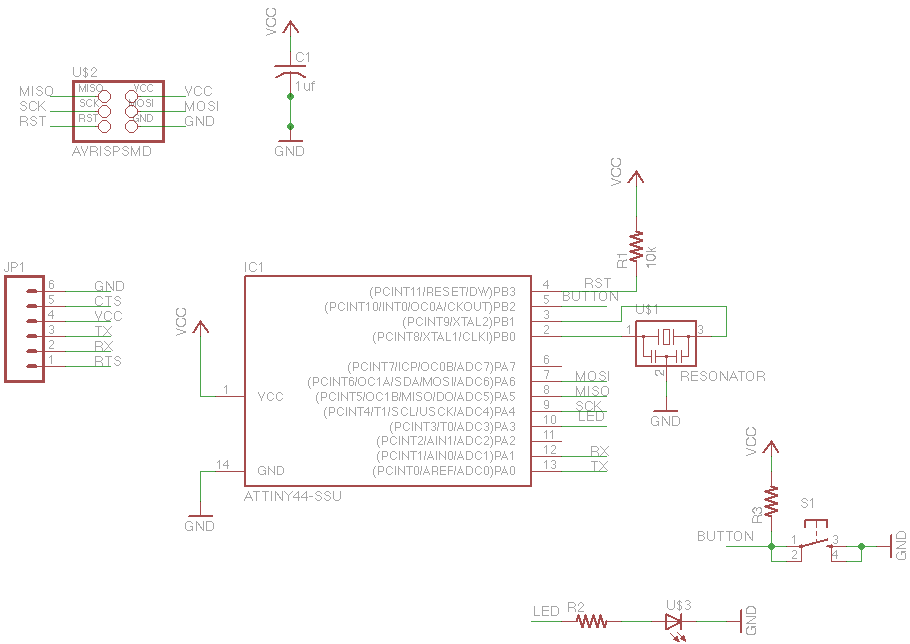
For this week's assignment, a chip design was provided, and the task was to incorporate a button and an LED (light-emitting diode). The objective was to fabricate the chip and program it to interact with the light and button. Given...

Cipher scheme of the module of infrared remote-control between two parties of intellectual family
This system is a control system based on a single-chip computer that allows for remote operation of lighting. The scheme primarily addresses the transmission and reception of signals, as well as program manipulation of various signals once they are processed...

Ultra Low Power LCD Indicator
This circuit serves as an ultra-low power replacement for multiple LED on-off indicators. It also has the advantage of being easy to read in full daylight. With the parts shown, it is possible to display four bits of information. The...

Microcontroller Programming
This page is a work in progress. The board and source files will soon be available for building and programming to play custom songs. After assembling the board, communication with the programmer was verified, and both the LED and switch...