


pic32mx220 tutorials
#PIC32
#ADC
#tutorial
#microcontroller
#configuration
#analog to digital
#embedded systems
#programming
#electronics education

Description: The PIC32's Analog to Digital Converter (ADC) can be challenging to configure for first-time users. The extensive range of configuration options available for the PIC peripherals can be overwhelming. This tutorial aims to assist users in navigating these complexities.
The PIC32 microcontroller features an integrated Analog to Digital Converter (ADC) that is capable of converting analog signals into digital data, allowing for the processing of real-world signals in embedded applications. The ADC in the PIC32 is designed to handle multiple input channels, providing flexibility for various sensor interfaces.
To set up the ADC, several key parameters must be configured, including the reference voltage, sampling time, and resolution. The reference voltage can be set to either the internal reference or an external voltage source, which determines the range of input signals that can be accurately converted. The sampling time is crucial as it affects the accuracy of the conversion; longer sampling times can improve accuracy at the cost of increased conversion time.
The resolution of the ADC in the PIC32 can be configured to various levels, typically up to 12 bits, allowing for a range of values from 0 to 4095 for a single channel. This resolution is important for applications requiring high precision in measurement.
In addition to basic configuration, the PIC32 ADC supports features such as interrupt-driven conversions and DMA (Direct Memory Access) for efficient data handling. This allows the microcontroller to perform other tasks while the ADC is processing, enhancing overall system performance.
To implement the ADC, users will typically initialize the ADC module, configure the desired settings, select the input channel, and start the conversion process. The results can be processed in real-time or stored for future analysis, making the ADC a versatile tool in various applications, including data acquisition, sensor interfacing, and control systems.
Overall, while the configuration of the PIC32 ADC may seem daunting at first, understanding the fundamental parameters and utilizing available resources can facilitate a successful implementation.The PIC32?s Analog to Digital Converter (ADC) is surprisingly difficult to set up if you re using it for the first time. Like so many of the PIC peripherals, the number of configuration options seem endless. This tutorial will help you..
The PIC32 microcontroller features an integrated Analog to Digital Converter (ADC) that is capable of converting analog signals into digital data, allowing for the processing of real-world signals in embedded applications. The ADC in the PIC32 is designed to handle multiple input channels, providing flexibility for various sensor interfaces.
To set up the ADC, several key parameters must be configured, including the reference voltage, sampling time, and resolution. The reference voltage can be set to either the internal reference or an external voltage source, which determines the range of input signals that can be accurately converted. The sampling time is crucial as it affects the accuracy of the conversion; longer sampling times can improve accuracy at the cost of increased conversion time.
The resolution of the ADC in the PIC32 can be configured to various levels, typically up to 12 bits, allowing for a range of values from 0 to 4095 for a single channel. This resolution is important for applications requiring high precision in measurement.
In addition to basic configuration, the PIC32 ADC supports features such as interrupt-driven conversions and DMA (Direct Memory Access) for efficient data handling. This allows the microcontroller to perform other tasks while the ADC is processing, enhancing overall system performance.
To implement the ADC, users will typically initialize the ADC module, configure the desired settings, select the input channel, and start the conversion process. The results can be processed in real-time or stored for future analysis, making the ADC a versatile tool in various applications, including data acquisition, sensor interfacing, and control systems.
Overall, while the configuration of the PIC32 ADC may seem daunting at first, understanding the fundamental parameters and utilizing available resources can facilitate a successful implementation.The PIC32?s Analog to Digital Converter (ADC) is surprisingly difficult to set up if you re using it for the first time. Like so many of the PIC peripherals, the number of configuration options seem endless. This tutorial will help you..

Driving circuit schematic
The driving circuit depicted in Figure 18-12 consists of a connection between the driving portion, the microcontroller, and the air conditioning operation components of the bridge. The microcontroller's digital signal levels from ports P4.0 to P4.3 (approximately 12 feet) and...
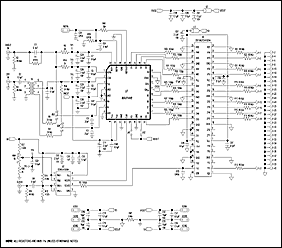
Dynamic Testing of High-Speed ADCs Part 2
The following article is a continuation of the application note titled "Defining and Testing Dynamic Parameters in High-Speed ADCs, Part 1." It outlines the test conditions and setup recommendations necessary for effectively measuring the dynamic performance parameters of high-speed analog-to-digital...

Industrial Building Automation System (IBAS) - 4
The two optical sensors will provide a count of individuals to the microcontroller, which will relay this value to MCU-II. The microcontroller will detect the entrance of any person through high-to-low pulse transitions on input pins A3 and A4.
The circuit...

Automatic Switch Project
Model railroad turnouts, often referred to as switches, can be controlled in various ways. The simplest method is manual control, operated by hand. Remote activation is typically achieved through pneumatic (air) or electrical means. The project discussed in these articles...
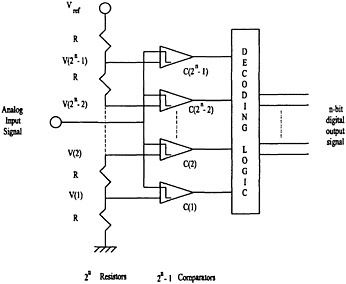
TYPES OF ANALOG-TO-DIGITAL CONVERTERS
Analog-to-digital converters are categorized into one-step architectures, including flash, folding, and interpolative topologies, as well as multi-step architectures, such as successive approximation and pipeline topologies. The flash architecture is considered the fastest type of analog-to-digital converter due to its parallel...
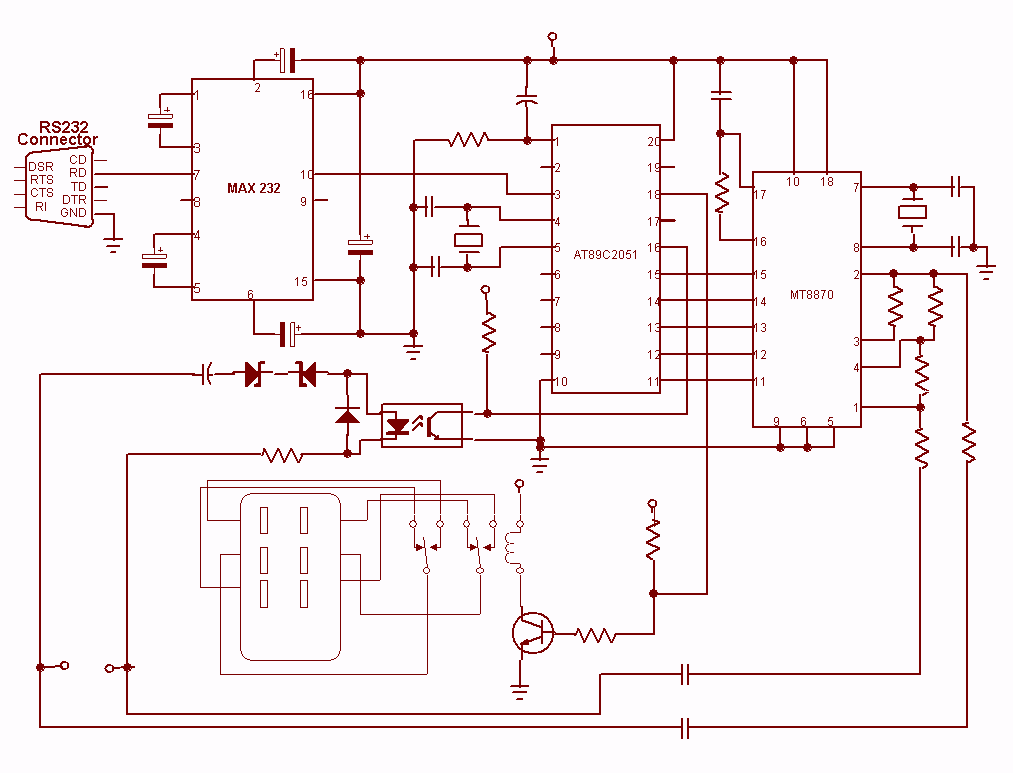
Interactive Voice Response System
Nowadays every institution needs automation. As a part of college automation, a project has been developed for a Voice Interactive System for College Automation. This project allows users to quickly access student attendance and marks through the telephone line without...

Augmenting a Microcontroller
Microcontrollers (MCUs) are versatile integrated circuits that enhance the functionality of electronics, robotics, and other projects. However, they...
Microcontrollers (MCUs) serve as the central processing unit in a variety of electronic applications, offering programmable control that allows for complex functionalities in...

Robo Atmega328p project
This project was designed to introduce a friend to microcontrollers and circuits using various functionalities and spare parts. A PS2 numpad was utilized as the key entry mechanism, which was found at a thrift store and included the necessary connector....

integrated circuit Improving absolute precision of ADC to balance battery voltage
Utilize a high-performance microcontroller (Piccolo TMS320F28035, 12-bit resolution, +/- 4 LSB offset, +/- 60 LSB gain) to measure the voltage across stacked battery cells and control related analog electronics for charge equalization. The microcontroller will also save data in EEPROM...