


RCEN fuse programmer with AT90S1200A
#AT90S1200A
#fuse programmer
#RC oscillator
#parallel programming
#stand-alone programmer
#microcontroller
#programming tool
#internal oscillator
#electronics DIY

Description: As you know the AT90S1200 microcontroller includes an internal RC oscillator that is disabled by default. If you want to change it (enable or disable) you must program it with parallel mode. Most programmers work with serial mode and it is not possible to program this fuse bit (RCEN). With this stand-alone programmer, you can now enable or disable the internal RC oscillator that is working at ~1MHz.
The AT90S1200 microcontroller is a low-power CMOS device that features a simple architecture suitable for a variety of applications. Its internal RC oscillator, typically operating at approximately 1 MHz, is an essential component for timing and clock generation. However, this oscillator is disabled by default, necessitating user intervention to enable it for operation.
To modify the state of the internal RC oscillator, the AT90S1200 must be programmed in parallel mode. This requirement arises because the fuse bit responsible for toggling the oscillator's state (RCEN) is not accessible through the more common serial programming mode. Serial programmers, which are widely used due to their convenience and simplicity, do not provide the capability to modify fuse bits, thus limiting their functionality in this context.
The introduction of a stand-alone programmer specifically designed for the AT90S1200 allows users to enable or disable the internal RC oscillator with ease. This programmer interfaces directly with the microcontroller's parallel programming pins, facilitating the necessary adjustments to the fuse bits. Users can configure the microcontroller to utilize the internal oscillator, thereby eliminating the need for an external clock source, which can simplify circuit design and reduce component count.
In practice, enabling the internal RC oscillator can result in a more compact and cost-effective design, particularly in battery-operated applications where minimizing power consumption is critical. Conversely, if a more precise clock is required, the ability to disable the internal oscillator and use an external clock source remains an option. The stand-alone programmer thus provides flexibility and control over the microcontroller's configuration, enhancing its usability in various electronic projects.As you know the AT90S1200 microcontroller include an internal RC oscillator that is disabled by default. If you want to change it (enable or disable) you must to program it with parallel mode. The most programmers working with serial mode and its not possible to program this fuse bit (RCEN). With this stand-alone programmer you can now enable or disable the internal RC oscillator that is working at ~1MHz.
The AT90S1200 microcontroller is a low-power CMOS device that features a simple architecture suitable for a variety of applications. Its internal RC oscillator, typically operating at approximately 1 MHz, is an essential component for timing and clock generation. However, this oscillator is disabled by default, necessitating user intervention to enable it for operation.
To modify the state of the internal RC oscillator, the AT90S1200 must be programmed in parallel mode. This requirement arises because the fuse bit responsible for toggling the oscillator's state (RCEN) is not accessible through the more common serial programming mode. Serial programmers, which are widely used due to their convenience and simplicity, do not provide the capability to modify fuse bits, thus limiting their functionality in this context.
The introduction of a stand-alone programmer specifically designed for the AT90S1200 allows users to enable or disable the internal RC oscillator with ease. This programmer interfaces directly with the microcontroller's parallel programming pins, facilitating the necessary adjustments to the fuse bits. Users can configure the microcontroller to utilize the internal oscillator, thereby eliminating the need for an external clock source, which can simplify circuit design and reduce component count.
In practice, enabling the internal RC oscillator can result in a more compact and cost-effective design, particularly in battery-operated applications where minimizing power consumption is critical. Conversely, if a more precise clock is required, the ability to disable the internal oscillator and use an external clock source remains an option. The stand-alone programmer thus provides flexibility and control over the microcontroller's configuration, enhancing its usability in various electronic projects.As you know the AT90S1200 microcontroller include an internal RC oscillator that is disabled by default. If you want to change it (enable or disable) you must to program it with parallel mode. The most programmers working with serial mode and its not possible to program this fuse bit (RCEN). With this stand-alone programmer you can now enable or disable the internal RC oscillator that is working at ~1MHz.

RC feedback oscillators
RC oscillators utilize resistors and capacitors to produce low or audio-frequency signals. Therefore, they are often referred to as audio-frequency (A.F) oscillators.
RC oscillators are fundamental circuit designs utilized in various applications for generating periodic waveforms, particularly in the audio frequency...

POWER LINE MODEM FOR COMPUTER CONTROL
This circuit employs an 87C57 microcontroller along with several peripherals to convert X-10 power-line carrier-code formats from a personal computer for use with an X-10 power-line interface in a home-control system. Software details can be found in the reference.
The circuit...

microcontroller How does this power supply circuit work? (MCU + LM317)
The filter consisting of resistors R1, R2, and capacitor C1 integrates the PWM waveform. The purpose of the operational amplifier appears to be that of a non-inverting amplifier, with the gain determined by resistors R6 and R7. However, the need...

Driving circuit schematic
The driving circuit depicted in Figure 18-12 consists of a connection between the driving portion, the microcontroller, and the air conditioning operation components of the bridge. The microcontroller's digital signal levels from ports P4.0 to P4.3 (approximately 12 feet) and...

Multitasking Pins
It is entirely logical that low-cost miniature microcontrollers have fewer pins than their larger counterparts, sometimes too few. Consideration has been given to how to economize on pins by making them perform multiple functions. One approach is to exploit the...

integrated circuit Improving absolute precision of ADC to balance battery voltage
Utilize a high-performance microcontroller (Piccolo TMS320F28035, 12-bit resolution, +/- 4 LSB offset, +/- 60 LSB gain) to measure the voltage across stacked battery cells and control related analog electronics for charge equalization. The microcontroller will also save data in EEPROM...

Microcontroller interfacing with RS 232
Standard serial interfacing of a microcontroller (TTL) with a PC or any RS232C standard device requires a TTL to RS232 level converter. A MAX232 is used for this purpose. It provides a 2-channel RS232C port and requires external 10µF capacitors.
The...

MCU controlled Bluetooth automation
The microcontroller used is 0822 zilog encore! 8k series (soic,28pin) as shown on the figure. Is a programmable microcontroller, the functions used are the GPIO and the UART of the chip. GPIO is used on led indicators, and the UART...
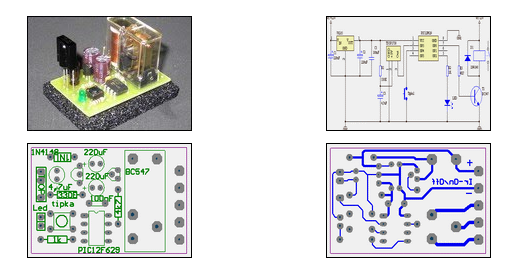
IR On/Off Switch Using Microcontroller
The ability to turn electrical devices ON or OFF using a remote control is a well-established concept, with numerous devices effectively performing this function.
To implement a remote control system for switching electrical devices, a typical schematic would include several key...