


Voting Machine circuit
#voting machine
#microcontroller
#electronic voting
#digital logic
#counting
#automation
#security
#election
#embedded systems
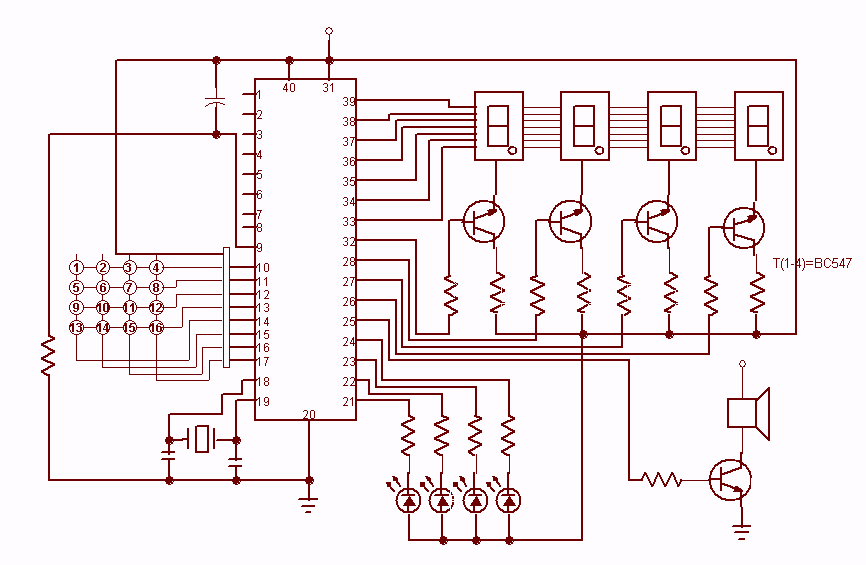
Description: Nowadays electronic voting machines are being used effectively. The confidence of the voter in its flawless working is gradually building up and these machines are thus becoming quite popular throughout the country. Features of the electronic voting machine include avoidance of invalid votes and reduction of counting time and the consequent expenditure incurred on manpower deployment. By using the microcontroller, the voting machine can be built up easily and it will make simple to operate.
Electronic voting machines (EVMs) are critical components in modern electoral systems, designed to ensure accuracy, security, and efficiency in the voting process. The typical architecture of an EVM consists of several key elements: a microcontroller, input devices, output displays, and a power supply.
The microcontroller acts as the central processing unit, managing the entire voting process. It is programmed to handle inputs from the voting interface, process the votes, and store the results securely. Commonly used microcontrollers in EVMs include those from the PIC or Arduino families, which offer sufficient processing power and ease of programming.
Input devices typically consist of a keypad or touchscreen interface that allows voters to select their preferred candidates. These input devices are designed to be user-friendly, ensuring that voters can easily navigate through the options without confusion. Additionally, to prevent invalid votes, the system is programmed to validate inputs, ensuring that only legitimate selections are registered.
Output displays are crucial for providing feedback to the voter. This can include visual indicators such as LEDs or LCD screens that confirm the successful registration of a vote. In some designs, audio feedback may also be included to assist voters with disabilities.
The power supply is another essential component, ensuring that the EVM operates reliably throughout the voting period. Many EVMs utilize rechargeable batteries to maintain operation, supplemented by power management circuits that optimize energy consumption.
To enhance security, EVMs are often equipped with features such as encryption for storing votes, tamper-proof seals, and audit trails that allow for verification of the voting process. These measures help to build voter confidence in the integrity of the election results.
Overall, the integration of microcontrollers in electronic voting machines simplifies the design and operation while significantly improving the efficiency and reliability of the voting process.Now-a-days Electronic voting machines are being used effectively. The confidence of the voter in its flawless working is gradually building up and these machines are thus becoming quite popular throughout the country. Features of the electronic voting machine include avoidance of invalid votes and reduction of counting time and the consequent expenditure incurred on manpower deployment.
By using the Microcontroller the voting machine can be built up easily and it will make simple to operate.
Electronic voting machines (EVMs) are critical components in modern electoral systems, designed to ensure accuracy, security, and efficiency in the voting process. The typical architecture of an EVM consists of several key elements: a microcontroller, input devices, output displays, and a power supply.
The microcontroller acts as the central processing unit, managing the entire voting process. It is programmed to handle inputs from the voting interface, process the votes, and store the results securely. Commonly used microcontrollers in EVMs include those from the PIC or Arduino families, which offer sufficient processing power and ease of programming.
Input devices typically consist of a keypad or touchscreen interface that allows voters to select their preferred candidates. These input devices are designed to be user-friendly, ensuring that voters can easily navigate through the options without confusion. Additionally, to prevent invalid votes, the system is programmed to validate inputs, ensuring that only legitimate selections are registered.
Output displays are crucial for providing feedback to the voter. This can include visual indicators such as LEDs or LCD screens that confirm the successful registration of a vote. In some designs, audio feedback may also be included to assist voters with disabilities.
The power supply is another essential component, ensuring that the EVM operates reliably throughout the voting period. Many EVMs utilize rechargeable batteries to maintain operation, supplemented by power management circuits that optimize energy consumption.
To enhance security, EVMs are often equipped with features such as encryption for storing votes, tamper-proof seals, and audit trails that allow for verification of the voting process. These measures help to build voter confidence in the integrity of the election results.
Overall, the integration of microcontrollers in electronic voting machines simplifies the design and operation while significantly improving the efficiency and reliability of the voting process.Now-a-days Electronic voting machines are being used effectively. The confidence of the voter in its flawless working is gradually building up and these machines are thus becoming quite popular throughout the country. Features of the electronic voting machine include avoidance of invalid votes and reduction of counting time and the consequent expenditure incurred on manpower deployment.
By using the Microcontroller the voting machine can be built up easily and it will make simple to operate.

Security Monitor
This circuit can be utilized in a garden setting to detect unusual sounds or wildlife noises. It can also monitor sounds around a car parked in a remote location. The cable used for the setup can either be visible or...
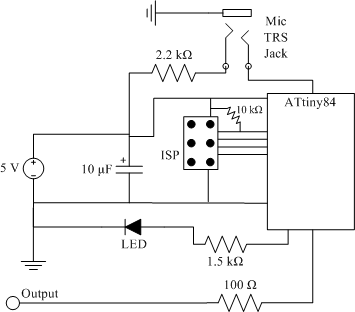
clap sensor construction
The clap sensor is a straightforward circuit that consists of a PC microphone, a microcontroller, and an output. The circuit design features the ATtiny84 microcontroller, chosen for familiarity with the AVR architecture and accessibility to necessary tools. The ATtiny84 is...

microcontroller Generate a reset signal from a falling edge trigger
The microcontroller design features the microcontroller (MCU) in hibernation mode, which can only be awakened by a pulse (high-low-high) signal on the reset pin (active low). An accelerometer or an external real-time clock (RTC) serves as the wake-up source. The...

integrated circuit Improving absolute precision of ADC to balance battery voltage
Utilize a high-performance microcontroller (Piccolo TMS320F28035, 12-bit resolution, +/- 4 LSB offset, +/- 60 LSB gain) to measure the voltage across stacked battery cells and control related analog electronics for charge equalization. The microcontroller will also save data in EEPROM...

Eight-digit-microprocessor-display
The display interface utilizes the ICM7218A/B in conjunction with an 8048 family microcontroller. An 8-bit data bus (DBO/DB7-IDO/ID7) facilitates the transfer of control and data information to the 7218 display interface during successive WRITE pulses. The mode input pins on...

knight Rider
A light computer has been developed that simulates the scanning effect seen in the KITT car from the TV series Knight Rider. The design utilizes a microcontroller, specifically the PIC16F84A, instead of the commonly used CD4017 counter IC. This choice...

Controlling high-current circuits
Digital output from a microcontroller is typically a low-amperage signal. For example, when a pin is set HIGH on the microcontroller (in Wiring/Arduino, it is digitalWrite(somePin, HIGH);), the voltage from that pin is usually +3.3V or +5V, with the current...
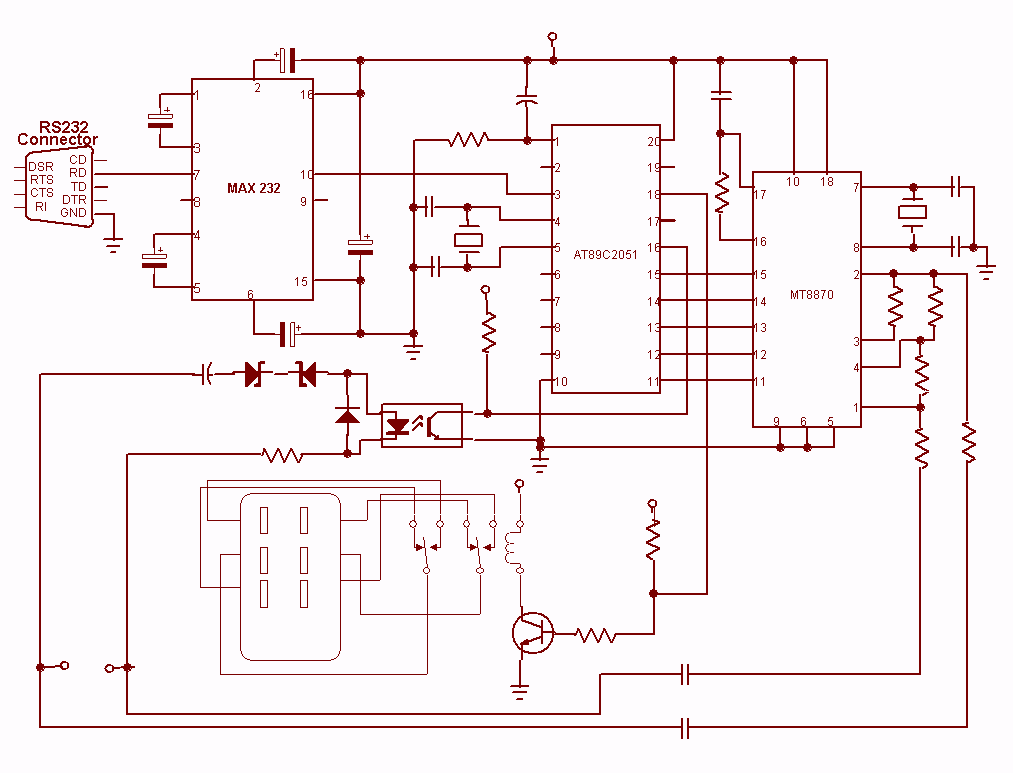
Interactive Voice Response System
Nowadays every institution needs automation. As a part of college automation, a project has been developed for a Voice Interactive System for College Automation. This project allows users to quickly access student attendance and marks through the telephone line without...

Microcontroller measures heart rate through fingertip
The reflected infrared (IR) signal detected by the photodiode is sent to a signal conditioning circuit, which filters out unwanted signals and amplifies the desired output.
The circuit begins with a photodiode that captures the reflected IR signals. The photodiode operates...