


Animatronic Mouths Circuit
#animatronic
#servo
#LCD
#custom characters
#eyebrows
#eyes
#articulated mouth
#electronic schematic

Description: The electronic designs for the two animatronic mouths are presented below. The first design is for the articulated mouth, with additional servos for the eyebrows and eyes. The second design is for the LCD mouth, which closely resembles the schematic for custom characters in an LCD tutorial. The key components in these two electronic schematics include the HS-485HB Servo, 7805 voltage regulator, PIC 18F452 microcontroller, and a 16x2 LCD display. The power supply circuit is implemented in two locations: one powers the PIC and most of the smaller HS-55 servos for the eyes and eyebrows, while the other powers the HS-485HB servo for the mouth articulation. This servo demands more power, necessitating the addition of a second regulator for safety. The PORTD of the PIC 18F452 is designated for controlling all servos, with each servo connected to a specific pin on the PIC, allowing for independent control of each servo's movement. In total, seven servos are employed to facilitate the movement of the animatronic face, with two servos for the eyebrows, four for the eyes, and one for the mouth. A standard +5V regulator circuit, commonly used in various projects, will supply power to the LCD and the PIC by converting the +12V from the battery to the +5V required for digital electronics. The PIC 18F452 microcontroller, frequently utilized in projects due to its ease of programming, will drive the LCD and manage the backlight. The interface between the microcontroller and the LCD utilizes PORTD for data transmission, PORTB for control signals, and PORTA for backlight control. Although this design necessitates more wiring to access the LCD's character arrays, it could be streamlined by employing the reduced 4-bit data bus option with the LCD.
The schematic for the animatronic mouth designs consists of two primary configurations: one for the articulated mouth and another for the LCD mouth, each serving distinct functions within the animatronic system. The articulated mouth design utilizes the HS-485HB servo, which is capable of providing robust motion for the mouth's articulation, while the additional servos for the eyebrows and eyes enhance the expressiveness of the animatronic face.
The HS-55 servos are employed for the smaller movements required by the eyebrows and eyes, ensuring a wide range of motion and responsive control. The choice of the 7805 voltage regulator is crucial, as it stabilizes the power supply to the microcontroller and servos, ensuring consistent operation. The dual regulator approach not only safeguards the system from potential overloads but also improves the reliability of the power supply to the more demanding HS-485HB servo.
The PIC 18F452 microcontroller is central to the control logic of the animatronic system. It processes inputs and generates outputs to control the servos. The use of PORTD for servo control allows for precise timing and coordination of movements, which is essential for creating realistic animations. The microcontroller's programming can be tailored to implement complex movement patterns, allowing for a wide range of expressions and behaviors.
The LCD display serves as a visual interface, providing feedback or information relevant to the animatronic's operation. The backlight control via PORTA enhances visibility and usability in various lighting conditions. While the design complexity increases with the wiring needed to access the LCD's character arrays, utilizing the 4-bit data bus option can significantly reduce the number of connections required, simplifying the overall design.
In summary, the electronic schematics for the animatronic mouths integrate various components and systems to create a responsive and expressive animatronic face. The careful selection of servos, voltage regulators, and microcontrollers, along with thoughtful design considerations for power management and control, culminates in a sophisticated and functional animatronic system.The electronic designs for the two animatronic mouths can be seen below. The first design is for the articulated mouth, the extra servos are for the eyebrows and eyes. The second design is for the LCD mouth. It is very similar to the custom characters on an LCD tutorial`s schematic. The most important parts seen in these two electronic schematics are the HS-485HB Servo, 7805, PIC 18F452 and 16x2 LCD Display. The power supply circuit is seen in two places. One for powering the PIC and most of the small HS-55 servos for the eyes and eyebrows. The second place, is powering the newly added HS-485HB servo for articulating the mouth. This servo requires more power from the regulator, so the easiest option was to add a second regulator for safety. The 18F452 PIC`s PORTD is used for controlling all of the servos. Each servo is driven by a specific pin on the PIC meaning we have independent control over every servo`s movement at any given time.
There are now a total of 7 servo motors used to actuate the movement seen in this animatronic face. 2 servos are used for the eyebrows, 4 servos for the two eyes and now one servo will be used to move the animatronic mouth up and down. The standard +5v regulator circuit seen in many of my tutorials and projects will be used to provide power to the LCD and the PIC.
This regulator converts the battery`s +12v down to +5v which our digital electronics require. To drive the LCD and control the backlight, a PIC 18F452 microcontroller will be used. This microcontroller is seen in many of my projects and is very easy to program for and to work with. The interface to the LCD from the Microcontroller uses PORTD for passing Data, PORTB for control signals and PORTA for backlight control.
This design requires more wiring in order to access the LCD`s character arrays, however it could be reduced if we used the reduced 4-bit data bus option with the LCD.
The schematic for the animatronic mouth designs consists of two primary configurations: one for the articulated mouth and another for the LCD mouth, each serving distinct functions within the animatronic system. The articulated mouth design utilizes the HS-485HB servo, which is capable of providing robust motion for the mouth's articulation, while the additional servos for the eyebrows and eyes enhance the expressiveness of the animatronic face.
The HS-55 servos are employed for the smaller movements required by the eyebrows and eyes, ensuring a wide range of motion and responsive control. The choice of the 7805 voltage regulator is crucial, as it stabilizes the power supply to the microcontroller and servos, ensuring consistent operation. The dual regulator approach not only safeguards the system from potential overloads but also improves the reliability of the power supply to the more demanding HS-485HB servo.
The PIC 18F452 microcontroller is central to the control logic of the animatronic system. It processes inputs and generates outputs to control the servos. The use of PORTD for servo control allows for precise timing and coordination of movements, which is essential for creating realistic animations. The microcontroller's programming can be tailored to implement complex movement patterns, allowing for a wide range of expressions and behaviors.
The LCD display serves as a visual interface, providing feedback or information relevant to the animatronic's operation. The backlight control via PORTA enhances visibility and usability in various lighting conditions. While the design complexity increases with the wiring needed to access the LCD's character arrays, utilizing the 4-bit data bus option can significantly reduce the number of connections required, simplifying the overall design.
In summary, the electronic schematics for the animatronic mouths integrate various components and systems to create a responsive and expressive animatronic face. The careful selection of servos, voltage regulators, and microcontrollers, along with thoughtful design considerations for power management and control, culminates in a sophisticated and functional animatronic system.The electronic designs for the two animatronic mouths can be seen below. The first design is for the articulated mouth, the extra servos are for the eyebrows and eyes. The second design is for the LCD mouth. It is very similar to the custom characters on an LCD tutorial`s schematic. The most important parts seen in these two electronic schematics are the HS-485HB Servo, 7805, PIC 18F452 and 16x2 LCD Display. The power supply circuit is seen in two places. One for powering the PIC and most of the small HS-55 servos for the eyes and eyebrows. The second place, is powering the newly added HS-485HB servo for articulating the mouth. This servo requires more power from the regulator, so the easiest option was to add a second regulator for safety. The 18F452 PIC`s PORTD is used for controlling all of the servos. Each servo is driven by a specific pin on the PIC meaning we have independent control over every servo`s movement at any given time.
There are now a total of 7 servo motors used to actuate the movement seen in this animatronic face. 2 servos are used for the eyebrows, 4 servos for the two eyes and now one servo will be used to move the animatronic mouth up and down. The standard +5v regulator circuit seen in many of my tutorials and projects will be used to provide power to the LCD and the PIC.
This regulator converts the battery`s +12v down to +5v which our digital electronics require. To drive the LCD and control the backlight, a PIC 18F452 microcontroller will be used. This microcontroller is seen in many of my projects and is very easy to program for and to work with. The interface to the LCD from the Microcontroller uses PORTD for passing Data, PORTB for control signals and PORTA for backlight control.
This design requires more wiring in order to access the LCD`s character arrays, however it could be reduced if we used the reduced 4-bit data bus option with the LCD.

4 Direct drive LCD display circuit diagram
Each part of the LCD has an individual counter, latch, decoder, and driver. The pumping signal is fed back to the motherboard of the LCD. When the display section is disconnected, the phase and amplitude of the motherboard and display...

servo mechanism
A servo mechanism is a feedback system that comprises a sensing element, an amplifier, and a servomotor, utilized in automatic control applications.
A servo mechanism operates by continuously monitoring and adjusting the position or speed of an output device, typically through...

hardware aspects of moving message
The moving message will be displayed on the LCD, which will be controlled through a microcontroller. The message will be sent by a computer using RS232. The circuit diagram of the moving message display is shown in this post, and...
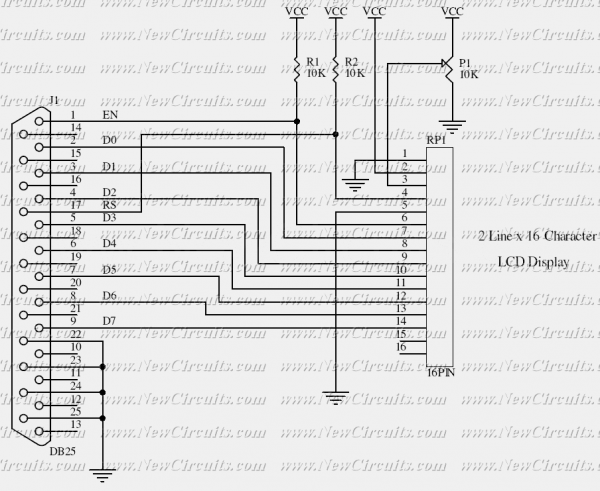
LCD Module Control with PC
This simple circuit controls a popular 2-line x 16-character LCD by a PC via printer port. It doesn't use the Bi-directional feature found on newer printer ports, thus it should work with most, if not all, Parallel Ports. These LCD...

how lcd display interface circuit works 20
An LCD (liquid crystal display) is an electronically modulated optical device composed of multiple pixels filled with liquid crystals, arranged in front of a light source (backlight) or reflector to generate images in either color or monochrome. The block diagram...
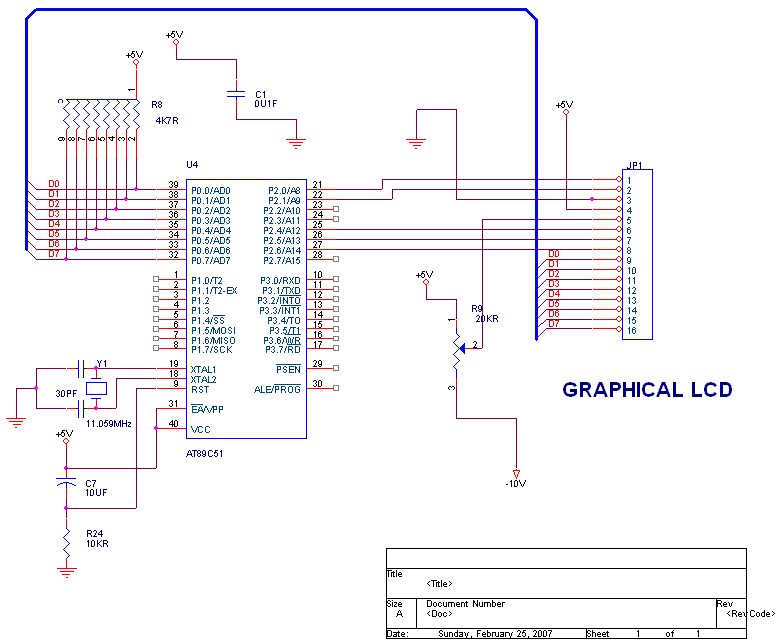
LCD contrast controlled by LCD
What is the recommended frequency for the Low Pass Filter used to control the contrast of an LCD? I want to adjust the contrast of an LCD using PWM.
To effectively control the contrast of an LCD using Pulse Width Modulation...

Wireless LCD Display (AT90S2313)
Its an adaptation of the 2X 16 LCD project, by adding a ferrite loop antenna, two resistors, and a capacitor. Here the display shows the output of the 10 bit scanning voltmeter with Minimum Mass Wireless Coupler. Both the ferrite...
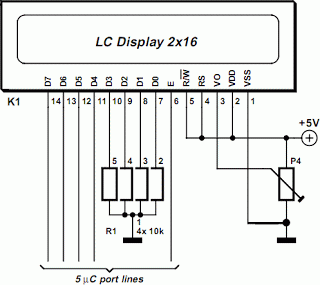
LCD Module in 4-bit Mode
In many projects, alphanumeric LCDs are utilized, which are internally driven by Hitachi's industry-standard HD44780 controller. These displays can be driven...
Alphanumeric LCDs that utilize the HD44780 controller are widely used in various electronic projects due to their reliability and ease...

Contrast Control for LCDs
The adjustment control for the contrast of an LC-Display is typically a 10-kilohm potentiometer. This functions adequately as long as the power supply voltage remains constant. However, in cases where the power supply is not stable (such as with battery...