


Bike Engine transplant Central
#bike engine
#kitcars
#automotive
#high power
#lightweight
#engine transplant
#custom vehicles
#performance tuning

Description: Bike Engine Transplant Central is a website dedicated to the integration of high-powered motorcycle engines into lightweight kit cars.
Bike Engine Transplant Central focuses on the innovative application of motorcycle engines in the construction and enhancement of lightweight kit cars. This approach not only leverages the high power-to-weight ratio of motorcycle engines but also allows for a unique driving experience characterized by agility and performance. The site serves as a resource hub for enthusiasts and builders, offering technical insights, tutorials, and community support for the conversion process.
Key components of a typical bike engine transplant include the selection of an appropriate engine, modifications to the vehicle’s chassis to accommodate the engine, and the integration of necessary electronic systems for optimal performance. This may involve wiring harness adaptations, fuel system adjustments, and the installation of compatible transmission systems.
The schematic design for such a project typically includes the following elements:
1. **Engine Mounting**: The design should specify custom engine mounts that securely attach the motorcycle engine to the kit car chassis, ensuring stability and alignment with the drivetrain.
2. **Wiring Diagram**: A comprehensive wiring diagram is essential for integrating the motorcycle engine's electrical components, including the ignition system, fuel injection, and any necessary sensors. This diagram must account for the power supply requirements and the compatibility of the motorcycle's ECU (Engine Control Unit) with the vehicle's electrical system.
3. **Fuel System Layout**: The schematic should outline the modifications required for the fuel system, including the routing of fuel lines from the tank to the engine, the installation of a fuel pump, and any necessary filters or regulators.
4. **Cooling System Design**: Effective cooling is critical for high-performance engines. The schematic must detail the placement of the radiator, coolant hoses, and any additional cooling components required to maintain optimal engine temperatures.
5. **Exhaust System Configuration**: A custom exhaust system may be necessary to optimize engine performance and meet noise regulations. The schematic should illustrate the routing of exhaust pipes and the placement of mufflers.
6. **Transmission Integration**: Depending on the chosen motorcycle engine, the schematic should include details on the transmission setup, whether it involves a direct connection to the rear axle or the use of an adapter plate for compatibility with the kit car's drivetrain.
By following these guidelines, builders can successfully transplant a motorcycle engine into a lightweight kit car, resulting in a unique vehicle that combines the best attributes of both worlds.Bike Engine transplant Central, a site devoted to the use of high powered bike engines in lightweight kitcars. Bike Engine transplant Central.
Bike Engine Transplant Central focuses on the innovative application of motorcycle engines in the construction and enhancement of lightweight kit cars. This approach not only leverages the high power-to-weight ratio of motorcycle engines but also allows for a unique driving experience characterized by agility and performance. The site serves as a resource hub for enthusiasts and builders, offering technical insights, tutorials, and community support for the conversion process.
Key components of a typical bike engine transplant include the selection of an appropriate engine, modifications to the vehicle’s chassis to accommodate the engine, and the integration of necessary electronic systems for optimal performance. This may involve wiring harness adaptations, fuel system adjustments, and the installation of compatible transmission systems.
The schematic design for such a project typically includes the following elements:
1. **Engine Mounting**: The design should specify custom engine mounts that securely attach the motorcycle engine to the kit car chassis, ensuring stability and alignment with the drivetrain.
2. **Wiring Diagram**: A comprehensive wiring diagram is essential for integrating the motorcycle engine's electrical components, including the ignition system, fuel injection, and any necessary sensors. This diagram must account for the power supply requirements and the compatibility of the motorcycle's ECU (Engine Control Unit) with the vehicle's electrical system.
3. **Fuel System Layout**: The schematic should outline the modifications required for the fuel system, including the routing of fuel lines from the tank to the engine, the installation of a fuel pump, and any necessary filters or regulators.
4. **Cooling System Design**: Effective cooling is critical for high-performance engines. The schematic must detail the placement of the radiator, coolant hoses, and any additional cooling components required to maintain optimal engine temperatures.
5. **Exhaust System Configuration**: A custom exhaust system may be necessary to optimize engine performance and meet noise regulations. The schematic should illustrate the routing of exhaust pipes and the placement of mufflers.
6. **Transmission Integration**: Depending on the chosen motorcycle engine, the schematic should include details on the transmission setup, whether it involves a direct connection to the rear axle or the use of an adapter plate for compatibility with the kit car's drivetrain.
By following these guidelines, builders can successfully transplant a motorcycle engine into a lightweight kit car, resulting in a unique vehicle that combines the best attributes of both worlds.Bike Engine transplant Central, a site devoted to the use of high powered bike engines in lightweight kitcars. Bike Engine transplant Central.

high power amplifier 300w circuit
There is no substitute for sheer power—low-efficiency speakers, outdoor sound systems, or perhaps the full dynamic range of a high-power amplifier. Whatever the requirement, this super power module should meet the needs. The amplifier can be divided into three distinct...
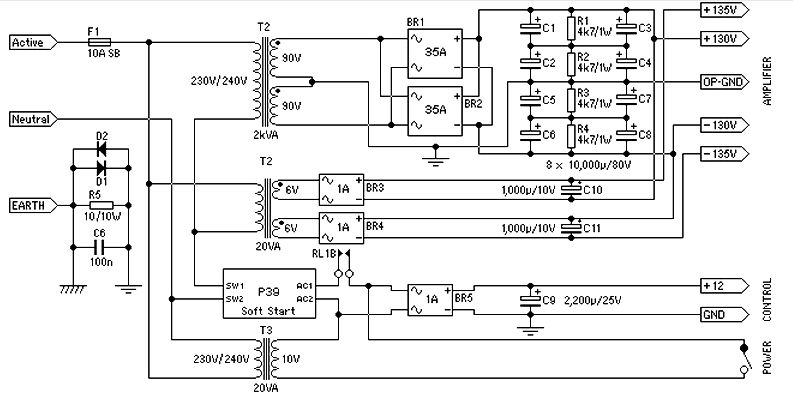
power supply for 1500 watt audio power amplifier
Power supply for a 1500-watt audio power amplifier. This power supply circuit is paired with a high-power audio amplifier rated at 1500 watts. A serious approach is required to design the power supply for the amplifier. First, a step-down transformer...
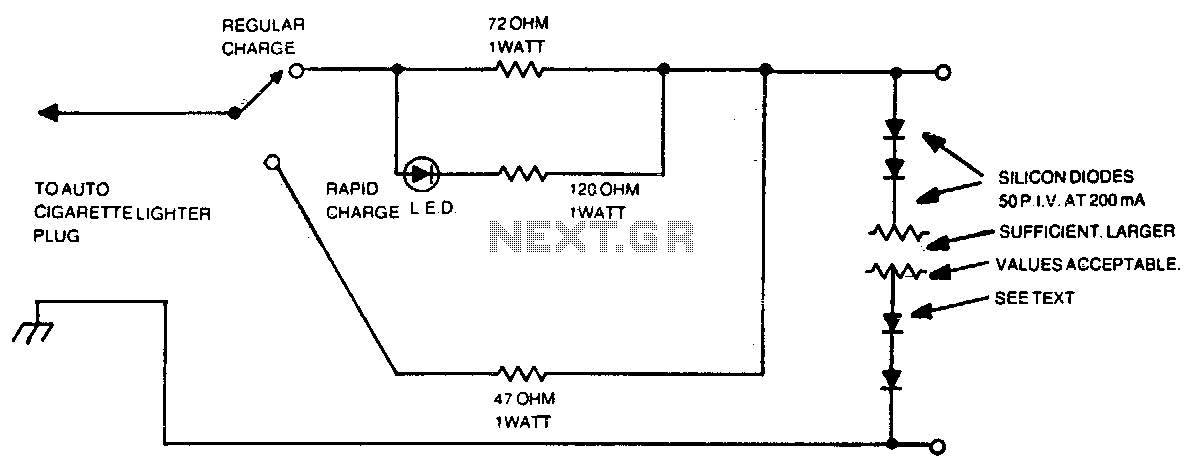
Automotive charger for ni-cad battery packs
The number of silicon diodes across the output is determined by the voltage of the battery pack. Each diode is considered at 0 volts. For example, a 10-volt pack would require 10/0 = 157, or 16 diodes.
In the context of...

2800w high power audio amplifier
The mono high power amplifier is rated at 1400 W. To create a stereo high power amplifier, which would require a total of 2800 W, the necessary components and PCB must be doubled. The schematic circuit diagram provided is incomplete....

simplest smf automotive battery charger
A simple battery charger circuit is described, utilizing a single transistor for voltage detection and automatically disconnecting the battery from the supply when fully charged. The circuit's high voltage trip point is set to switch off the charging voltage when...

Car battery charger Automative car and motorcycle schematics
The circuit is designed to operate with an external power supply, which is why it does not include a transformer, rectifier, or filter capacitors in the schematic. However, these components can be added if desired. To utilize the circuit, connect...

Automobile Lights-On Reminder
The circuit provides a visible or audible warning when the headlights are on. It utilizes a 2N1305 transistor as a switch to activate either a Sonalert tone generator or a small 12-V lamp. The operating current for the transistor is...

800W high power mosfet amplifier Schematic Diagram
This amplifier is suitable for various applications that demand high power, low noise, minimal distortion, and superior sound quality. Examples include subwoofer amplifiers, front-of-house (FOH) stage amplifiers, and individual channels of high-powered surround sound amplifiers. For a detailed explanation of...
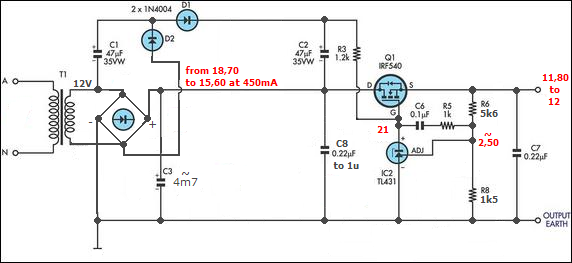
high power regulator
The half-linear design allows for reduced thermal considerations, as the linear regulator only needs to handle 1-5W instead of the full 75W per rail. MOSFETs operate in their linear region, just below the rated voltage for RDS(on), but they are...