


Electronic bio-wave therapy device
#bio-wave therapy
#frequency generator
#medical device
#electrical signals
#drug absorption
#therapy instrument
#electronic therapy
#healthcare
#frequency modulation
#patient treatment

Description: The electronic bio wave therapy instrument circuit is designed to generate a variety of complex frequency electrical signals. These signals can enhance the absorption of medication and provide direct therapeutic effects on specific body points.
The electronic bio wave therapy instrument circuit operates on the principle of applying electrical signals to the body to stimulate healing and improve drug absorption. The circuit typically includes several key components: a microcontroller or signal generator, which produces the desired frequency signals; an amplifier to boost these signals; and electrodes that interface with the patient's skin.
The microcontroller is programmed to generate a range of frequencies, which can be adjusted based on the specific treatment protocol. These frequencies may vary widely, allowing for customization depending on the patient's condition and the intended therapeutic effect. The amplifier ensures that the signals are strong enough to penetrate the skin and reach the underlying tissues effectively.
Electrodes are strategically placed on the body to target specific acupoints or areas of pain. The design of these electrodes may vary, with some being adhesive pads and others being more specialized for particular applications. The placement and type of electrodes used can significantly influence the treatment's effectiveness.
Safety features are also an essential aspect of the circuit design. Overcurrent protection, isolation mechanisms, and user interface controls are implemented to ensure that the device operates within safe parameters. Additionally, the circuit may include a feedback system to monitor the response of the patient, adjusting the frequency or intensity of the signals in real time for optimal therapeutic outcomes.
Overall, the electronic bio wave therapy instrument circuit represents a sophisticated approach to non-invasive treatment modalities, leveraging the principles of bioelectromagnetics to enhance patient care.Electronic bio wave therapy instrument circuit as shown, it can produce a variety of complex frequency electrical signals, the absorption of the drug can help patients affected area can also be a direct effect of treatment on the body points.
The electronic bio wave therapy instrument circuit operates on the principle of applying electrical signals to the body to stimulate healing and improve drug absorption. The circuit typically includes several key components: a microcontroller or signal generator, which produces the desired frequency signals; an amplifier to boost these signals; and electrodes that interface with the patient's skin.
The microcontroller is programmed to generate a range of frequencies, which can be adjusted based on the specific treatment protocol. These frequencies may vary widely, allowing for customization depending on the patient's condition and the intended therapeutic effect. The amplifier ensures that the signals are strong enough to penetrate the skin and reach the underlying tissues effectively.
Electrodes are strategically placed on the body to target specific acupoints or areas of pain. The design of these electrodes may vary, with some being adhesive pads and others being more specialized for particular applications. The placement and type of electrodes used can significantly influence the treatment's effectiveness.
Safety features are also an essential aspect of the circuit design. Overcurrent protection, isolation mechanisms, and user interface controls are implemented to ensure that the device operates within safe parameters. Additionally, the circuit may include a feedback system to monitor the response of the patient, adjusting the frequency or intensity of the signals in real time for optimal therapeutic outcomes.
Overall, the electronic bio wave therapy instrument circuit represents a sophisticated approach to non-invasive treatment modalities, leveraging the principles of bioelectromagnetics to enhance patient care.Electronic bio wave therapy instrument circuit as shown, it can produce a variety of complex frequency electrical signals, the absorption of the drug can help patients affected area can also be a direct effect of treatment on the body points.
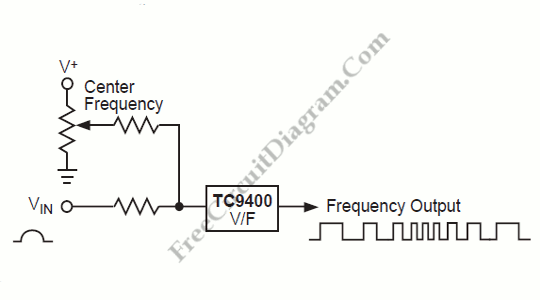
Superlinear FM (Frequency Modulator)
Designing various electronic circuit systems (synthesizer, modem, decoder, data converter, etc.) often requires a frequency modulator subsystem. An FM modulator is a crucial component in these systems.
An FM modulator is an electronic device that encodes information in a carrier wave...

XR-8038 precision frequency generator
The aim of this project is to visually demonstrate the interactions of frequencies with one another. By utilizing mirrors and magnets to reflect a laser beam, a visual representation of the mathematical principles inherent in electronics is created. The primary...
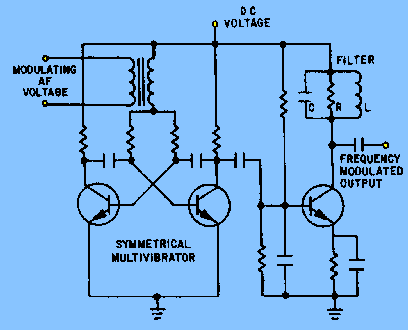
Methods of frequency modulation
The circuit depicted in figure 2-6 and discussed in previous sections serves illustrative purposes only and is not practical in real-world applications. Nevertheless, the fundamental principle involved—the variation in reactance of an oscillator circuit in response to modulating voltage—represents one...
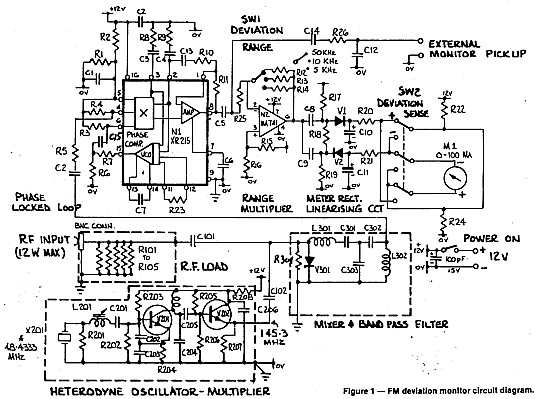
Deviation Meter
A deviation monitor can be constructed by connecting a frequency modulation (FM) detector to an AC voltmeter, calibrating the meter in units of frequency deviation. One method for detecting or demodulating the FM signal is via a phase-locked loop (PLL)....

oscillator
An oscillator is a circuit that generates a frequency source such as a sine wave, square wave, or pulse train. It combines a frequency-sensitive circuit, like an LC circuit or a crystal, with a negative resistance typically provided by an...

Frequency Generator:
Building your own Zapper. It requires one capacitor of 1 microfarad (C2), preferably unpolarized to eliminate concerns regarding positive and negative terminals. If a polarized capacitor is used, the longer leg indicates the positive side; refer to the schematic for...
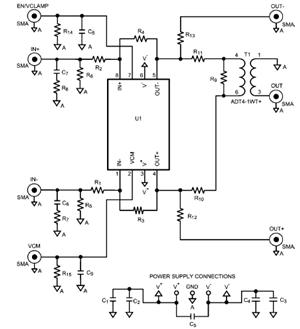
circuit diagram download
The transmitter's function is to modulate the original signal frequency of the message-carrying signal, a process known as modulation. The circuit realization of this function is referred to as a frequency modulation (FM) circuit. FM tuners are categorized into direct...

Frequency Generator circuit
This is a useful instrument for workshops. The standard of the produced frequencies is 10 to 1. The basic frequency is produced by a crystal with high accuracy. The circuit consists of the oscillator, around the crystal and the frequency...
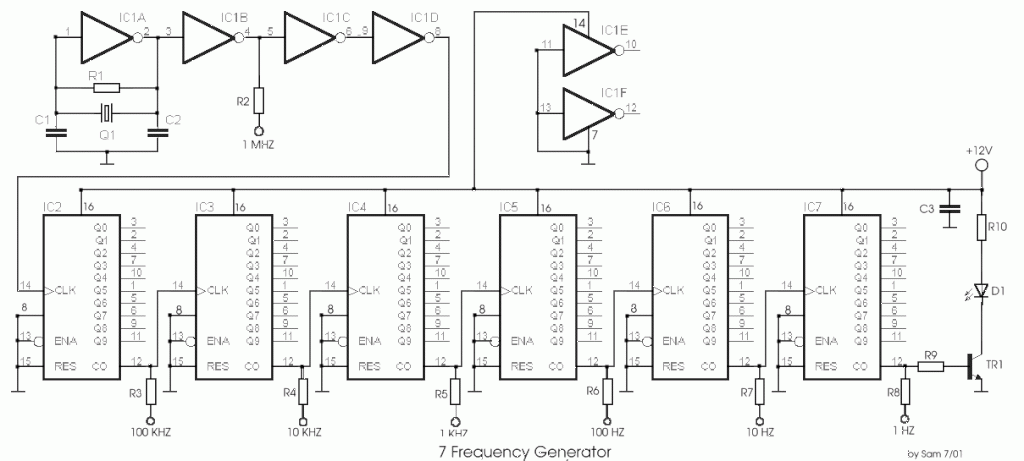
7 Standard Step Frequency from Frequency Generator
The circuit was designed to create a frequency generator that consists of seven steps during operation. It includes a crystal oscillator, which is an electronic circuit made of...
The frequency generator circuit operates through a series of seven distinct steps, each...