


Fast Symmetrical Zener Clipper
#zener
#clipper
#symmetrical
#voltage clamping
#diode
#signal conditioning
#circuit protection
#electronics

Description: The issue with utilizing two Zener diodes in series for symmetrical clamping is that the knee of the Zener characteristics is imprecise. Additionally, charge storage within the Zeners can lead to speed issues, and the Zeners may exhibit slightly different knee voltages, resulting in poor symmetry. This circuit addresses these challenges. By incorporating the Zener diode within a diode bridge, a consistent Zener voltage is maintained. The voltage discrepancies introduced by the diodes are significantly smaller than those associated with the Zener diodes. Furthermore, the charge storage associated with the bridge is considerably reduced. By keeping the Zener diode biased ON continuously, the knee of the voltage characteristic appears much sharper.
This circuit design effectively resolves the limitations associated with traditional Zener diode configurations for symmetrical clamping. The inclusion of a diode bridge allows for improved voltage regulation, as it ensures that the same Zener voltage is consistently applied across the load. This is particularly advantageous in applications where precise voltage control is critical.
The diode bridge consists of four diodes arranged in a configuration that allows for bidirectional current flow. This arrangement facilitates the rectification of AC signals and ensures that the Zener diode operates within its optimal voltage range, thus minimizing the impact of voltage drops across the diodes. The reduced charge storage in the diode bridge is a significant improvement, as it mitigates the potential for delays in response time, which can be critical in fast-switching applications.
Biasing the Zener diode ON continuously enhances the sharpness of the knee in the Zener voltage characteristic. This results in a more defined transition between the breakdown region and the normal operating region, which is essential for achieving reliable clamping performance. The overall circuit design not only addresses the issues of voltage discrepancies and charge storage but also enhances the speed and accuracy of voltage clamping, making it suitable for a variety of electronic applications where stability and precision are paramount. The problem with using two zeners back to back in series to get symmetrical clamping is that the knee of the zener characteristics is rather sloppy. Also, charge storage in the zeners causes speed problems and the zeners will have slightly different knee voltages, so the symmetry will not be all that good. This circuit overcomes these problems. By putting the zener inside a diode bridge, the same zener voltage is always experienced. The voltage errors caused by the diodes are much smaller than those caused by the zener. Also, the charge storage of the bridge is much less. By biasing the zener ON all the time, the knee appears to be much sharper.
This circuit design effectively resolves the limitations associated with traditional Zener diode configurations for symmetrical clamping. The inclusion of a diode bridge allows for improved voltage regulation, as it ensures that the same Zener voltage is consistently applied across the load. This is particularly advantageous in applications where precise voltage control is critical.
The diode bridge consists of four diodes arranged in a configuration that allows for bidirectional current flow. This arrangement facilitates the rectification of AC signals and ensures that the Zener diode operates within its optimal voltage range, thus minimizing the impact of voltage drops across the diodes. The reduced charge storage in the diode bridge is a significant improvement, as it mitigates the potential for delays in response time, which can be critical in fast-switching applications.
Biasing the Zener diode ON continuously enhances the sharpness of the knee in the Zener voltage characteristic. This results in a more defined transition between the breakdown region and the normal operating region, which is essential for achieving reliable clamping performance. The overall circuit design not only addresses the issues of voltage discrepancies and charge storage but also enhances the speed and accuracy of voltage clamping, making it suitable for a variety of electronic applications where stability and precision are paramount. The problem with using two zeners back to back in series to get symmetrical clamping is that the knee of the zener characteristics is rather sloppy. Also, charge storage in the zeners causes speed problems and the zeners will have slightly different knee voltages, so the symmetry will not be all that good. This circuit overcomes these problems. By putting the zener inside a diode bridge, the same zener voltage is always experienced. The voltage errors caused by the diodes are much smaller than those caused by the zener. Also, the charge storage of the bridge is much less. By biasing the zener ON all the time, the knee appears to be much sharper.

Signal Conditioners Information
Signal conditioning involves a series of operations applied to a signal to make it compatible for interfacing with other devices or systems. Signal conditioners are the devices that execute this operation, featuring both an input and an output. Typically, the...
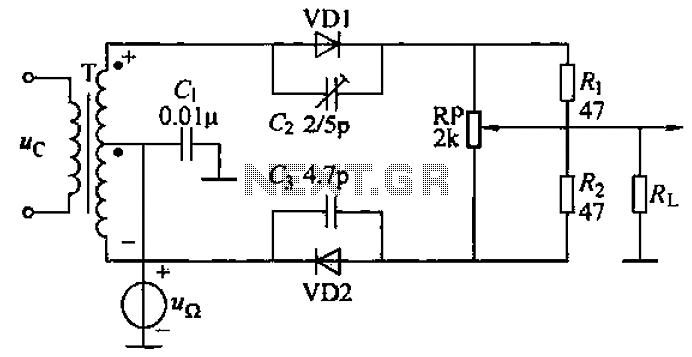
AM balanced diode circuit
A common diode balanced modulator circuit is illustrated. It comprises two identical performance diodes and a center-tapped transformer configuration. The diodes used are VD1 and VD2, specifically 2AP9 models. The parameters for the circuit elements are detailed in FIG. 21-37....
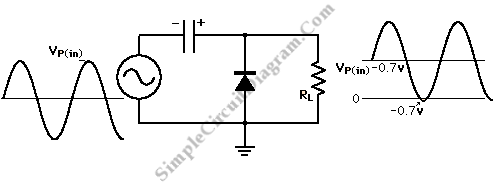
Signal Clamper Using Diode
A diode and capacitor can be utilized to clamp an AC signal, shifting the level into the positive region for all cycles. This condition is sometimes necessary to ensure a positive output.
In an electronic circuit, clamping is a technique used...

Four crystal diode switching circuit diagram of the IF filter
A 9-12V DC power supply is connected to control point A or point B for an amateur communication receiver IF amplifier, offering two distinct options. The power frequency is set at 455 kHz with a bandwidth of 500 Hz. The...
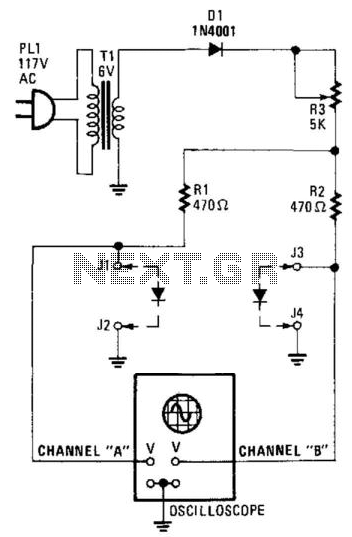
Simple Diode Curve Tracer
Suitable for matching diodes or examining the VI characteristics of two-terminal devices (such as diodes), this circuit is designed for laboratory use. Resistors R1 and R2 can be increased in value, and a higher voltage transformer can be utilized for...

Diode tester
The circuit tests whether a diode is open, shorted, or functioning correctly. If lamp A lights, the diode under test is functional. When lamp B is lit, the diode is good but connected backwards. When both lamps are lit, the...

analog How to analyze this diode circuit
The two diodes will fail. It is advisable to include series resistors for them. If the simulation is successful, the current through the diodes will be excessive. Both diodes do not necessarily need to fail; one may become a Smoke...

electronic circuit breaker
A circuit breaker is an automatically operated electrical switch designed to protect an electrical circuit from damage caused by overload or short circuit. Its basic function is to detect a fault condition and, by interrupting continuity, immediately discontinue electrical flow....

Meter check of a diode
Understanding the polarity (cathode versus anode) and basic functionality of a diode is an essential skill for electronics hobbyists or technicians. A diode acts like a one-way valve for electricity, and its one-way nature can be verified using a DC...