


Gray Tube Replication 91
#Teflon coated coax
#Gray Tube
#replication
#experimental
#high voltage
#DIY
#electronics project
#unconventional
#energy

Description: I have almost all of the components required for an initial assembly. Mr. Dollard mentions he utilized Teflon-coated coaxial cable, which is...
The project involves assembling a circuit that utilizes Teflon-coated coaxial cable, a material known for its excellent dielectric properties and high-temperature resistance. This type of cable is particularly advantageous in RF (radio frequency) applications due to its low loss and ability to maintain signal integrity over longer distances.
In this circuit, the coaxial cable will serve as the primary transmission line, connecting various components while minimizing signal degradation. The choice of Teflon coating enhances the cable's durability and makes it suitable for environments where temperature fluctuations may occur.
The schematic should include a detailed layout of the circuit, indicating the connections between the coaxial cable and other components such as resistors, capacitors, and any active devices like transistors or operational amplifiers. It is essential to specify the impedance of the coaxial cable used, typically 50 or 75 ohms, depending on the application.
Additionally, the circuit should incorporate proper grounding techniques to reduce noise and interference, ensuring optimal performance. The layout must also consider the physical arrangement of components to minimize inductance and capacitance that could affect high-frequency signals.
Overall, the assembly process will require careful attention to detail, particularly in soldering techniques and ensuring that all connections are secure to prevent signal loss. Proper testing and validation of the circuit will be necessary to confirm that it meets the desired specifications and functions as intended.Originally Posted by Spokane1 I have just about all of the parts needed for a first run. Mr. Dollard says he used Teflon coated coax, which is..
The project involves assembling a circuit that utilizes Teflon-coated coaxial cable, a material known for its excellent dielectric properties and high-temperature resistance. This type of cable is particularly advantageous in RF (radio frequency) applications due to its low loss and ability to maintain signal integrity over longer distances.
In this circuit, the coaxial cable will serve as the primary transmission line, connecting various components while minimizing signal degradation. The choice of Teflon coating enhances the cable's durability and makes it suitable for environments where temperature fluctuations may occur.
The schematic should include a detailed layout of the circuit, indicating the connections between the coaxial cable and other components such as resistors, capacitors, and any active devices like transistors or operational amplifiers. It is essential to specify the impedance of the coaxial cable used, typically 50 or 75 ohms, depending on the application.
Additionally, the circuit should incorporate proper grounding techniques to reduce noise and interference, ensuring optimal performance. The layout must also consider the physical arrangement of components to minimize inductance and capacitance that could affect high-frequency signals.
Overall, the assembly process will require careful attention to detail, particularly in soldering techniques and ensuring that all connections are secure to prevent signal loss. Proper testing and validation of the circuit will be necessary to confirm that it meets the desired specifications and functions as intended.Originally Posted by Spokane1 I have just about all of the parts needed for a first run. Mr. Dollard says he used Teflon coated coax, which is..

high voltage low current supply circuit diagram
A high voltage power supply is a valuable source that can be effectively used in various applications, such as biasing gas-discharge tubes and radiation detectors. This type of power supply can also serve as a protective measure, such as electrically...

Crescendo ampilifier elektor1982
The Elector Crescendo was the first DIY amplifier that was not a kit. The design was sourced from the Elector magazines available at a local library.
The Elector Crescendo is an innovative audio amplifier designed for DIY enthusiasts. It features a...

10000Vdc Supply
A CMOS oscillator (U1A) drives U1B through U1F, which in turn drives Q1, generating a 12-Vpp square wave across the primary of T1. This square wave is applied to a rectifier-multiplier circuit consisting of diodes D1 through D10 (each comprising...

The 25-30kV DC Generator
This High Voltage power supply is able to generate up to 25-30kV DC Output from a 12-24v DC input. With a fully adjustable DC input power supply (0-24V/4A), it is possible to adjust the HV output between 5 to 30kV....

High Voltage Inverter
This is a simple high-voltage inverter circuit. It uses an NPN transistor type 2N3055. This circuit is designed to invert low voltage to high voltage.
The high-voltage inverter circuit utilizing the 2N3055 NPN transistor serves as an effective means to convert...

how to convert a 9v battery to 3.7v
A regulator circuit is needed for this DIY project. Familiarity with electronic components, circuitry, the use of a multitester, and a soldering iron is essential. The schematic diagram provided can accept an input voltage ranging from 6 to 24 volts...
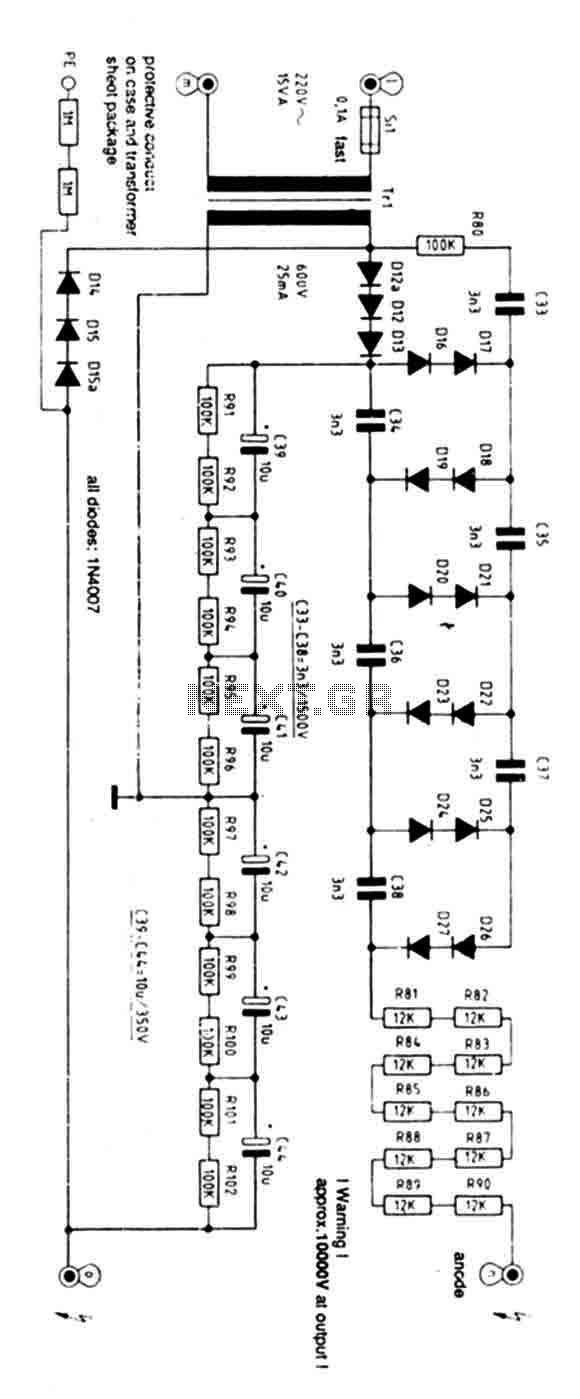
High Voltage Power Supply 10kV
Exercise caution with this power supply as it operates on 220V mains and has an output voltage of 10KV. Characteristics: Supply: 220V AC 50Hz mains, Power: 15 Watts, Ignition Voltage: 8KV.
The power supply operates on a standard 220V AC input...

Capacitor-discharge-high-voltage-generator
A step-down transformer T1 reduces the incoming line voltage to approximately 48 Vac, which is then rectified by diode D1. The resulting direct current charges capacitor C1 through a current-limiting resistor R1 to a voltage level set by R4. When...

High Voltage Power Supply for Geiger Tubes
These power supply circuits generate 500 volts, but they can be modified to supply several hundred to nearly 1000 volts by changing the zener diodes. These circuits produce high voltages and can cause dangerous shocks. Caution is advised; these devices...