


line following robot identifying the line
#line following
#robot
#LDR array
#light reflection
#black line detection
#white background
#sensor array
#automation
#educational
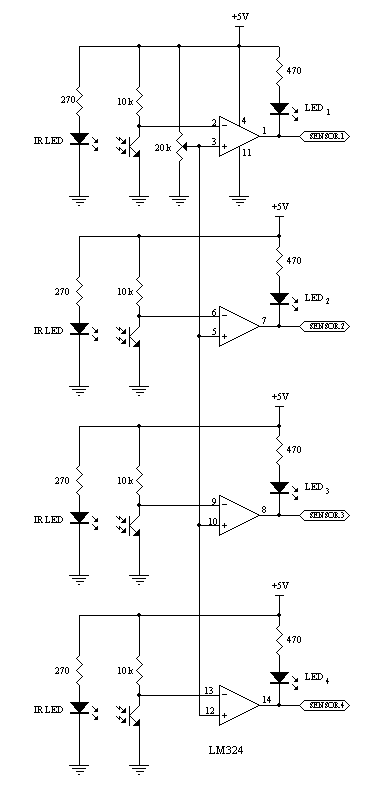
Description: To enable a line-following robot to identify the line, it is essential to first detect the line itself. Several methods can be employed to distinguish a black line on a white background, or vice versa. One effective approach is to utilize an array of Light Dependent Resistors (LDRs) to monitor the levels of light reflection. A black line will absorb more light and reflect less compared to a white surface.
The circuit for a line-following robot typically incorporates an array of LDRs configured in a way that allows for differential light sensing. The LDRs are arranged in a linear fashion along the front side of the robot. When the robot is positioned over the line, the LDRs that are directly over the black line will show a lower resistance due to reduced light reflection, while the LDRs over the white background will exhibit higher resistance due to increased light reflection.
To process the signals from the LDRs, a microcontroller is employed. The microcontroller reads the voltage levels from each LDR, which can be converted into digital signals using an Analog-to-Digital Converter (ADC) if necessary. Based on the input from the LDRs, the microcontroller can determine the position of the line relative to the robot. If the robot detects that the left LDRs are receiving less light than the right ones, it can adjust its movement to the right, and vice versa.
Additional components in the circuit may include operational amplifiers to amplify the LDR signals for better sensitivity, and a motor driver circuit to control the motors that steer the robot. The motor driver receives commands from the microcontroller based on the processed LDR data, allowing for precise maneuvers along the line.
For optimal performance, calibration of the LDRs may be necessary to account for varying ambient light conditions. This can be achieved by programming the microcontroller to establish baseline readings under different lighting conditions, thus allowing the robot to adapt its line-following behavior accordingly.
In summary, the line-following robot utilizes an LDR array for line detection, a microcontroller for processing the signals, and a motor driver for executing movement commands, forming an integrated system capable of navigating along predefined paths efficiently.To follow the line robot need to identify the line first. Well there are few things you can do to identify a black line on white background or vice versa. One way is use LDR array and tracks the light reflection level. Black line will not reflect the light as white color. Or you can..
The circuit for a line-following robot typically incorporates an array of LDRs configured in a way that allows for differential light sensing. The LDRs are arranged in a linear fashion along the front side of the robot. When the robot is positioned over the line, the LDRs that are directly over the black line will show a lower resistance due to reduced light reflection, while the LDRs over the white background will exhibit higher resistance due to increased light reflection.
To process the signals from the LDRs, a microcontroller is employed. The microcontroller reads the voltage levels from each LDR, which can be converted into digital signals using an Analog-to-Digital Converter (ADC) if necessary. Based on the input from the LDRs, the microcontroller can determine the position of the line relative to the robot. If the robot detects that the left LDRs are receiving less light than the right ones, it can adjust its movement to the right, and vice versa.
Additional components in the circuit may include operational amplifiers to amplify the LDR signals for better sensitivity, and a motor driver circuit to control the motors that steer the robot. The motor driver receives commands from the microcontroller based on the processed LDR data, allowing for precise maneuvers along the line.
For optimal performance, calibration of the LDRs may be necessary to account for varying ambient light conditions. This can be achieved by programming the microcontroller to establish baseline readings under different lighting conditions, thus allowing the robot to adapt its line-following behavior accordingly.
In summary, the line-following robot utilizes an LDR array for line detection, a microcontroller for processing the signals, and a motor driver for executing movement commands, forming an integrated system capable of navigating along predefined paths efficiently.To follow the line robot need to identify the line first. Well there are few things you can do to identify a black line on white background or vice versa. One way is use LDR array and tracks the light reflection level. Black line will not reflect the light as white color. Or you can..

Line Following Robot Sensor
This line-following robot sensor, also known as a surface scanner for robots, is a compact, stamp-sized infrared proximity detector designed for short-range detection, typically within 5 to 10 mm.
The line-following robot sensor operates using infrared light to detect the presence...

JavaBot1
The JavaBot1 is a small line following robot designed to follow a black line drawn on a dry erase board. It is designed to follow very tight curves. The software still has lots of room for improvement but works well...
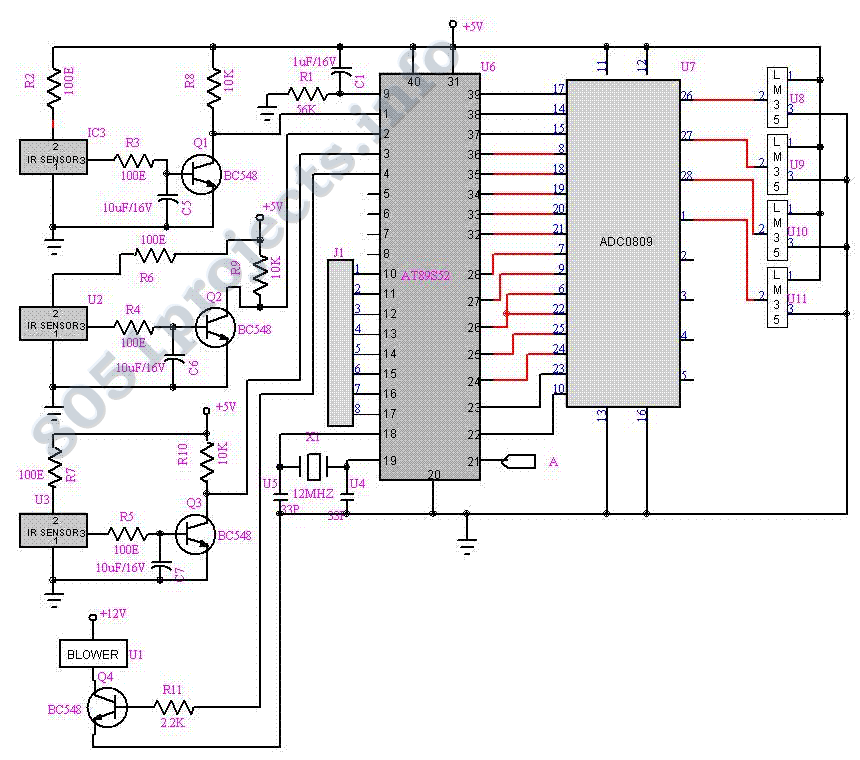
Fighting Robot circuit
The need for a device that can detect and extinguish a fire on its own is long past due. Many house fires originate when someone is either sleeping or not home. With the invention of such a device, people and...
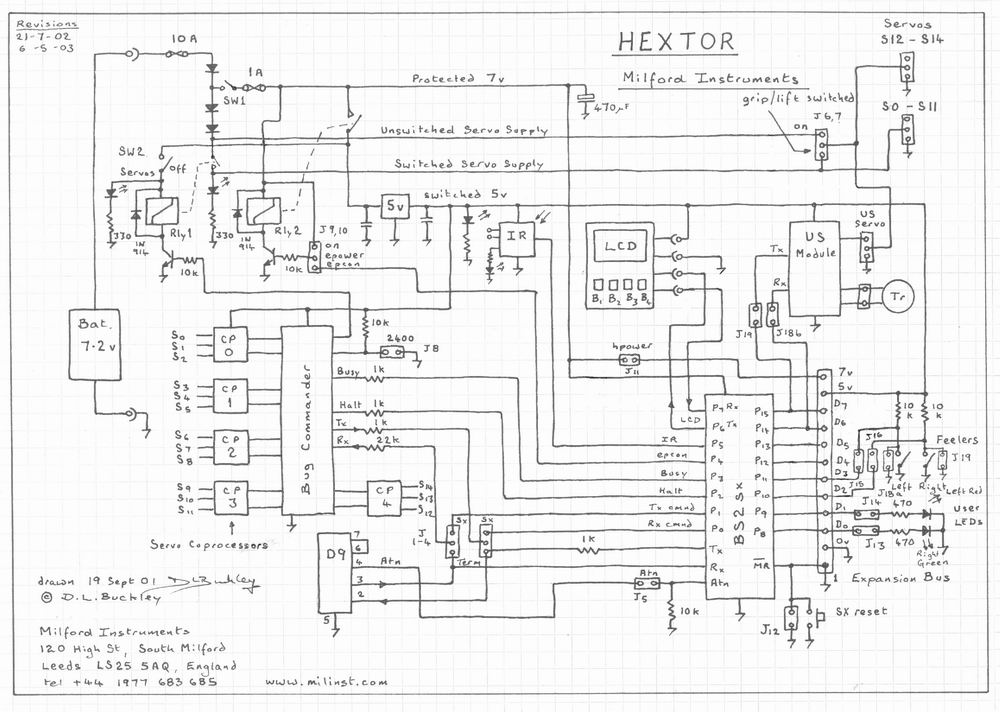
Hextor Hexapod Robot
The circuit includes multiple connections for a BOS (Basic Operating System) processor. It has a serial connection for transmitting data to the BOS processor (pin 0) and receiving data from it (pin 1). Pin 2 is used to supply power...

robot circuits
For a robot to perform its assigned tasks, a controller is necessary. This controller may be mechanical, electrical, electronic, or a combination of these. It acts as the brain of the entire system, providing the robot with its intelligence. The...

automatic pet feeder
An automatic feeder dispenses food based on the activation of a series of buttons, which interface with a system controller and a food dispenser. The system is designed for intelligent processing of inputs and outputs, allowing dynamic configuration of button...

Roverbot circuit
1. A robot may not injure a human being or, through inaction, allow a human being to come to harm. 2. A robot must obey the orders given to it by human beings, except where such orders would conflict with...

Robot eyes circuit
Robot eyes circuit of Service. A simple circuit to simulate a man appointed to it. It consists of a dual-lamp working in an unsteady manner. Circuit diagram.
The robot eyes circuit is designed to create a visual effect that simulates the...

ColonBlow robot
The strategy focused on efficiently navigating complex terrain with superior speed. The objective was to score in the lowest scoring goal by acting quickly to limit the opposing team's points. The mechanical and electrical designs prioritized speed, resulting in an...