


Salt bath resistance furnace temperature control circuit
#resistance furnace
#temperature control
#high power
#fast start
#salt bath
#80kW
#industrial
#heating
#thermostat
#power electronics

Description: 80 kW resistance salt bath furnace control circuit. The salt bath resistance furnace is a high-power device that employs fast start and temperature control technology to significantly save energy. The circuit includes a single-junction transistor (VTi) used as a relaxation oscillator, a manual adjustment potentiometer (RPz), an automatic time adjustment potentiometer (RPi), and thyristors (V3, V4) whose conduction angles can be modified, which in turn alters the conduction angles of Vi and Vz.
The 80 kW resistance salt bath furnace control circuit is designed to efficiently manage the heating process of a salt bath furnace, which is commonly utilized in industrial applications for heat treatment processes. The circuit architecture is centered around a relaxation oscillator, implemented using a single-junction transistor (VTi). This oscillator generates a pulsed output that controls the firing of the thyristors (V3 and V4).
The manual adjustment potentiometer (RPz) allows for user-defined settings, enabling operators to tailor the circuit's response to specific operational requirements. This is particularly useful in varying thermal conditions or when different types of materials are processed in the furnace. The automatic time adjustment potentiometer (RPi) complements this by providing an automated means to fine-tune the timing of the heating cycles, enhancing the furnace's efficiency and responsiveness.
Thyristors V3 and V4 play a crucial role in controlling the power delivered to the heating elements of the furnace. By adjusting the conduction angles of these thyristors, it is possible to modulate the effective power output and, consequently, the temperature of the salt bath. This modulation is critical for achieving precise temperature control, which is essential for the quality of the heat treatment.
In summary, the control circuit integrates advanced features such as manual and automatic adjustments, along with robust power management through thyristor control, making it a sophisticated solution for energy-efficient operation of high-power salt bath resistance furnaces.80kW resistance to salt bath furnace controlled circuit. Salt bath resistance furnace is a big power device, the circuit using fast start, temperature-controlled technology, ca n greatly save energy. From single-junction transistor VTi etc. relaxation oscillator, adjust the potentiometer RPz manual, automatic time adjustment potentiometer RPi, can be changed thyristor V3, V4 conduction angle, that change Vi, vz conduction angle.
The 80 kW resistance salt bath furnace control circuit is designed to efficiently manage the heating process of a salt bath furnace, which is commonly utilized in industrial applications for heat treatment processes. The circuit architecture is centered around a relaxation oscillator, implemented using a single-junction transistor (VTi). This oscillator generates a pulsed output that controls the firing of the thyristors (V3 and V4).
The manual adjustment potentiometer (RPz) allows for user-defined settings, enabling operators to tailor the circuit's response to specific operational requirements. This is particularly useful in varying thermal conditions or when different types of materials are processed in the furnace. The automatic time adjustment potentiometer (RPi) complements this by providing an automated means to fine-tune the timing of the heating cycles, enhancing the furnace's efficiency and responsiveness.
Thyristors V3 and V4 play a crucial role in controlling the power delivered to the heating elements of the furnace. By adjusting the conduction angles of these thyristors, it is possible to modulate the effective power output and, consequently, the temperature of the salt bath. This modulation is critical for achieving precise temperature control, which is essential for the quality of the heat treatment.
In summary, the control circuit integrates advanced features such as manual and automatic adjustments, along with robust power management through thyristor control, making it a sophisticated solution for energy-efficient operation of high-power salt bath resistance furnaces.80kW resistance to salt bath furnace controlled circuit. Salt bath resistance furnace is a big power device, the circuit using fast start, temperature-controlled technology, ca n greatly save energy. From single-junction transistor VTi etc. relaxation oscillator, adjust the potentiometer RPz manual, automatic time adjustment potentiometer RPi, can be changed thyristor V3, V4 conduction angle, that change Vi, vz conduction angle.

Day / Night Electronic Thermostat
This design was created at the request of an individual to operate a 240V AC heater in an orchid box, maintaining a higher temperature during daylight hours than at night. A simple regulator is employed to achieve a stabilized 12V...

Adjustable thermostat controller circuit diagram created REF01E
An adjustable thermostat controller circuit is widely used in everyday applications, such as for maintaining a constant temperature in soldering irons. The circuit utilizes the TMP17 sensor along with the REF01E voltage reference to ensure a stable 10V supply voltage....
high power regulator
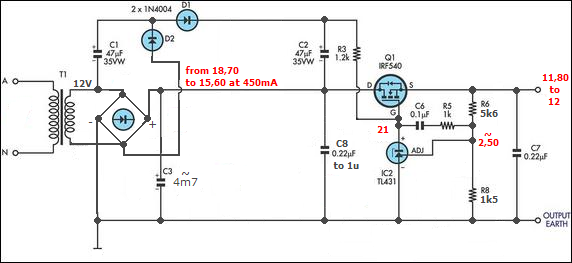
The half-linear design allows for reduced thermal considerations, as the linear regulator only needs to handle 1-5W instead of the full 75W per rail. MOSFETs operate in their linear region, just below the rated voltage for RDS(on), but they are...

Automatic temperature control circuit
An automatic temperature control circuit is designed for climate control thermostats. Its primary function is to maintain a constant internal temperature using an electric heater (EH). The control mechanism utilizes a negative temperature coefficient thermistor as the temperature sensing element,...

Temperature-controlling circuit
The circuit switches the current to an electrical heater on and off to maintain the temperature of a room at 25 ±0.5°C. The temperature sensor is a thermistor that provides a differential input (for reduced noise) to an operational amplifier....

Burst-power-control
Industrial applications sometimes require that power be briefly applied to a load following the closure of a switch, such as a microswitch or foot switch. The load could be a heating element used for sealing plastic bags, a DC motor...

Greenhouse Heater Temperature Control Project
This circuit consists of four 1N4148 diodes connected in series with a thermal anticipation resistor (R1) heat-shrunk together at the end of a three-wire signal cable, which is visible in some photos. The thermal anticipation resistor is an old HVAC...

Temperature Controler switch
This circuit controls a load (in this case a DC brushless fan) based on a temperature compared with a setpoint. The transducer is a diode in the forward polarization regime. In fact, when forward biased, the forward voltage drop across...

Temperature Controller With Defrost Cycle
This temperature controller has a range of -50 to +150 °C and permits defrosting. R7, VR3, and R8 set the controller's trip point. SI initiates defrosting, and S2 cancels defrosting. VR1 and VR2 set the defrost temperature trip point. The...