


3 Phase AC Motor Speed Control
#3 phase
#AC motor
#speed control
#frequency control
#power line
#synchronized motor
#industrial
#variable frequency drive
#motor driver

Description: Controlling the speed of a three-phase AC motor is achieved by regulating the frequency of the power supply, as the motor operates in synchronization with the line.
To control the speed of a three-phase AC motor, it is essential to utilize a variable frequency drive (VFD). The VFD adjusts the frequency and voltage supplied to the motor, allowing for precise control over its speed and torque characteristics. In a typical setup, the VFD receives input from a control system, which can include sensors and user interfaces for setting desired operational parameters.
The VFD comprises several key components: a rectifier, a DC bus, and an inverter. The rectifier converts the incoming AC voltage from the power line into DC voltage. This DC voltage is then smoothed and stored in the DC bus. The inverter takes this DC voltage and converts it back into AC voltage at the desired frequency and amplitude, which is then supplied to the motor.
To achieve effective speed control, the VFD employs pulse-width modulation (PWM) techniques. By varying the width of the pulses in the output waveform, the effective voltage and frequency delivered to the motor can be adjusted. This method not only allows for smooth acceleration and deceleration but also enhances energy efficiency by reducing power consumption during low-load conditions.
Additionally, feedback mechanisms, such as encoders or tachometers, can be integrated into the system to provide real-time data on motor speed and position. This feedback can be utilized by the VFD to make dynamic adjustments, ensuring optimal performance and stability of the motor under varying load conditions.
Overall, the implementation of a variable frequency drive for controlling a three-phase AC motor facilitates enhanced operational flexibility, energy savings, and improved performance in various industrial applications.Controlling the speed of three phase ac motor is done by controlling the frequency of the power line supply,? since the motor is synchronized with the line.
To control the speed of a three-phase AC motor, it is essential to utilize a variable frequency drive (VFD). The VFD adjusts the frequency and voltage supplied to the motor, allowing for precise control over its speed and torque characteristics. In a typical setup, the VFD receives input from a control system, which can include sensors and user interfaces for setting desired operational parameters.
The VFD comprises several key components: a rectifier, a DC bus, and an inverter. The rectifier converts the incoming AC voltage from the power line into DC voltage. This DC voltage is then smoothed and stored in the DC bus. The inverter takes this DC voltage and converts it back into AC voltage at the desired frequency and amplitude, which is then supplied to the motor.
To achieve effective speed control, the VFD employs pulse-width modulation (PWM) techniques. By varying the width of the pulses in the output waveform, the effective voltage and frequency delivered to the motor can be adjusted. This method not only allows for smooth acceleration and deceleration but also enhances energy efficiency by reducing power consumption during low-load conditions.
Additionally, feedback mechanisms, such as encoders or tachometers, can be integrated into the system to provide real-time data on motor speed and position. This feedback can be utilized by the VFD to make dynamic adjustments, ensuring optimal performance and stability of the motor under varying load conditions.
Overall, the implementation of a variable frequency drive for controlling a three-phase AC motor facilitates enhanced operational flexibility, energy savings, and improved performance in various industrial applications.Controlling the speed of three phase ac motor is done by controlling the frequency of the power line supply,? since the motor is synchronized with the line.

Mixer or Sewing Machine Motor Speed Control
A simple half-wave motor speed control circuit is effective for small universal AC/DC motors, with a maximum current capability of two amps RMS.
The half-wave motor speed control circuit utilizes a diode to allow current to flow in only one direction,...

ceiling fan regulator motor speed
This is a simple ceiling fan regulator circuit diagram used to control the speed of a ceiling fan. In other words, it is an AC motor speed controller circuit that regulates the speed of an AC motor (Ceiling Fan). This...

simple 3 phase power supply
The supply generates a low voltage (less than 18 Volts) low current three-phase sinusoidal waveform. This waveform is utilized to switch high-power MOSFETs on and off, producing a three-phase high current square wave output. It is acknowledged that driving a...
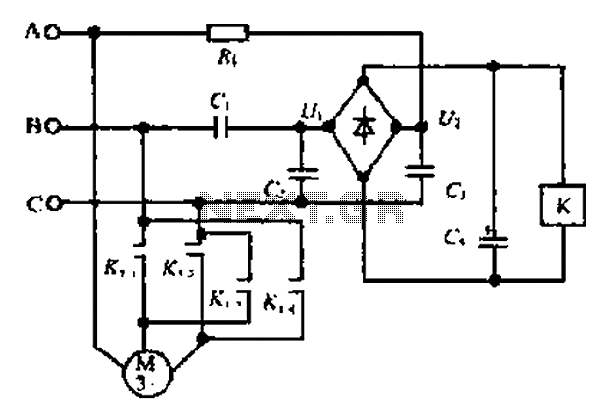
A motor reversing automatic adjustment circuit
Composition ratio circuit. The circuit consists of resistors and capacitors that form a shift register circuit with diodes VD1 to VD4, creating a bridge for electric current. Capacitor C4 is utilized for filtering applications and for eliminating instantaneous relay energization...

Constant-speed-motor-driver
When the torque load on the motor increases, its current also rises. This increase in current is detected across Rs, and positive feedback is applied to the noninverting terminal of the LH0101, which in turn raises the motor voltage to...

Speed-Control Switch Circuit
The speed-control switch provides effective control and stability across its entire operating range. This circuit utilizes two SCR devices arranged in a full-wave configuration to manage the DC power supplied to a motor. A center-tapped transformer is employed to provide...
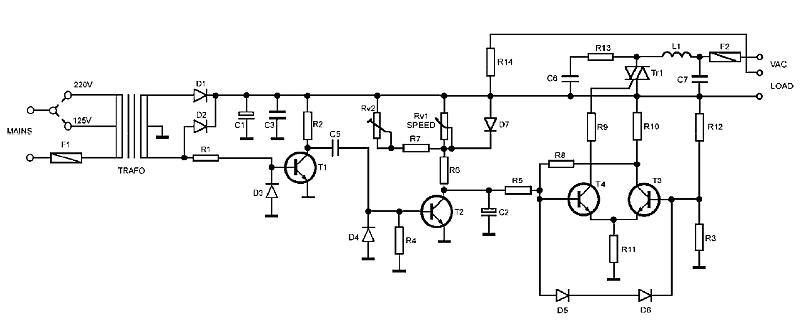
AC Motor Speed Controller
The AC Motor Speed Controller is designed to regulate the speed of AC motors with carbon brushes, applicable to devices such as drills, saws, and vacuum cleaners.
The AC Motor Speed Controller operates by adjusting the voltage and current supplied to...

Simple AC Motor Speed Controller
This circuit will allow you to control the speed of an AC motor, for example an electric drill. The way that this circuit works is as follows. The bridge rectifier produces dc voltage from the 120vac line. A portion on...

Forward and reverse speed control circuit can be integrated with a brake function
Figure 3173 illustrates a control circuit for a wound rotor induction motor that enables mechanical braking, dynamic braking, and reverse braking functions. The circuit includes various components such as relays, contactors, and time relays to manage the motor's speed in...