


PTC phase asynchronous motor circuit protection one
#PTC
#thermal resistor
#overload protection
#alarm
#asynchronous motor
#motor protection
#circuit protection
#thermal protection

Description: The circuit illustrated in Figure 4-2 employs two thermal resistors. One, designated as Rc, functions as overload protection, while the other, labeled Rt, serves as an alarm.
The circuit in question integrates two thermal resistors to monitor temperature changes and provide protective and alert functions. The first thermal resistor, Rc, is designed to activate when excessive current or temperature is detected, thereby protecting the circuit from potential damage due to overload conditions. This resistor is typically connected in series with the load, allowing it to sense the thermal rise caused by increased current flow. When the temperature exceeds a predetermined threshold, Rc triggers a mechanism, such as a relay or a circuit breaker, to disconnect the load and prevent overheating.
The second thermal resistor, Rt, is utilized as an alarm system. It is calibrated to respond to different temperature levels than Rc, allowing it to signal when the system is approaching critical operational limits. This can be achieved by connecting Rt to a microcontroller or an alarm circuit that activates a visual or audible alert when the temperature reaches a specific set point. The alarm provides an early warning to operators, enabling timely intervention before any damage occurs.
In terms of configuration, both thermal resistors should be selected based on their resistance-temperature characteristics, ensuring they respond accurately to the expected temperature range of the application. The placement of these resistors within the circuit is crucial; they should be positioned where they can effectively sense the thermal variations without being influenced by external factors. Proper calibration and testing of the thresholds for both Rc and Rt are essential for reliable operation.
Overall, this circuit design effectively combines overload protection with an alarm system, enhancing the safety and reliability of the electronic device it serves. Circuit shown in Figure 4-2. It uses two thermal resistors, a (Rc,) is used as overload protection, another (Rt :) used as an alarm.
The circuit in question integrates two thermal resistors to monitor temperature changes and provide protective and alert functions. The first thermal resistor, Rc, is designed to activate when excessive current or temperature is detected, thereby protecting the circuit from potential damage due to overload conditions. This resistor is typically connected in series with the load, allowing it to sense the thermal rise caused by increased current flow. When the temperature exceeds a predetermined threshold, Rc triggers a mechanism, such as a relay or a circuit breaker, to disconnect the load and prevent overheating.
The second thermal resistor, Rt, is utilized as an alarm system. It is calibrated to respond to different temperature levels than Rc, allowing it to signal when the system is approaching critical operational limits. This can be achieved by connecting Rt to a microcontroller or an alarm circuit that activates a visual or audible alert when the temperature reaches a specific set point. The alarm provides an early warning to operators, enabling timely intervention before any damage occurs.
In terms of configuration, both thermal resistors should be selected based on their resistance-temperature characteristics, ensuring they respond accurately to the expected temperature range of the application. The placement of these resistors within the circuit is crucial; they should be positioned where they can effectively sense the thermal variations without being influenced by external factors. Proper calibration and testing of the thresholds for both Rc and Rt are essential for reliable operation.
Overall, this circuit design effectively combines overload protection with an alarm system, enhancing the safety and reliability of the electronic device it serves. Circuit shown in Figure 4-2. It uses two thermal resistors, a (Rc,) is used as overload protection, another (Rt :) used as an alarm.

Eight PTC phase asynchronous motor protection circuit
The thyristor control circuit includes a bridge circuit designed to regulate the temperature in the contactor coil KM, along with a secondary winding that functions as a power protection device. It comprises a thermistor (R:., Rt3) and a resistor (Rz,...

Simple Alarm Circuit Keeps Wandering Children
The receiver circuit in Figure 1 activates an audio alarm when the transmitter (Figure 2) moves beyond a specified perimeter. The transmitter functions as a voltage-controlled oscillator, operating at approximately 915 MHz within the unlicensed ISM (industrial/scientific/medical) band. It features...
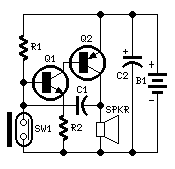
Personal Alarm
This circuit, enclosed in a small plastic box, can be placed into a bag or handbag. A small magnet is placed close to the reed switch and connected to the hand or the clothes of the person carrying the bag...

Menci alarm produced schematic circuit diagram
The alarm circuit operates as follows: When the power switch SW1 is turned on, the alarm system becomes active. If a magnet is brought close to the spring, the magnetic field attracts the spring, causing the dynamic and static switch...
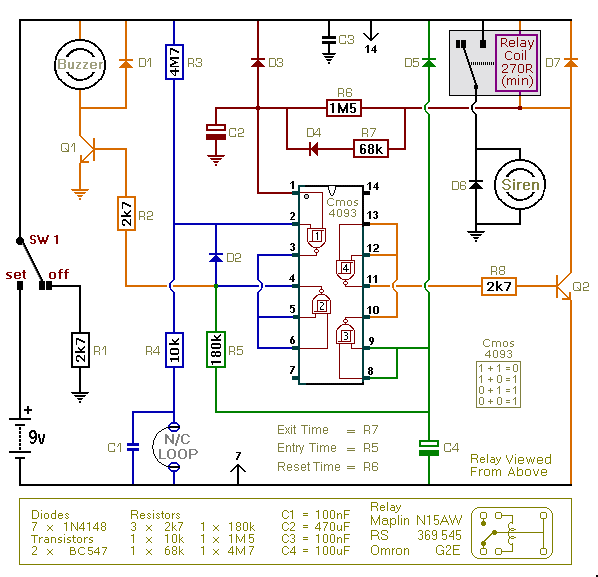
Enhanced Alarm
This is an enhanced version of the simple Garage/Shed Alarm. The entry and exit delays have been increased to approximately 30 seconds, and a timed siren cut-off and automatic reset have been added. The LED has been replaced with an...
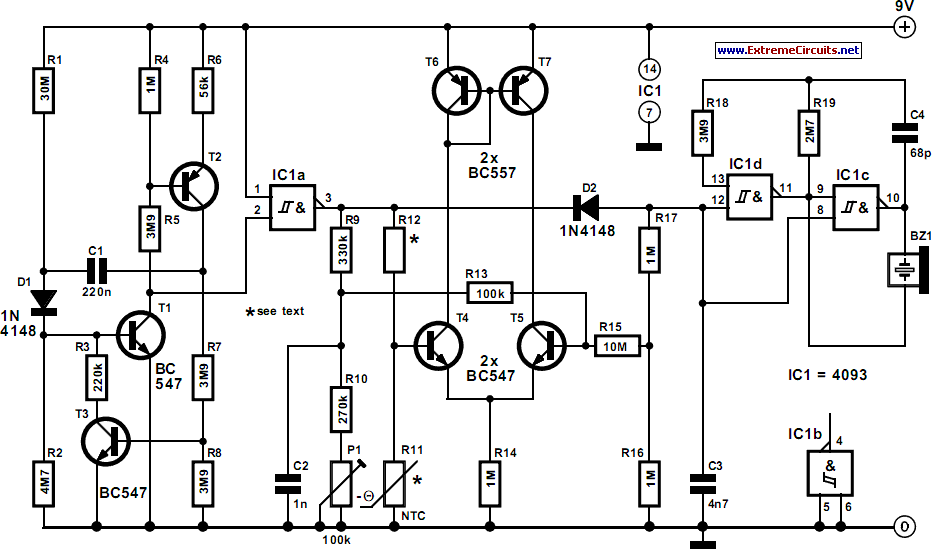
general purpose alarm
The alarm can be utilized for various applications, including frost monitoring and room temperature monitoring. In its quiescent state, the circuit consumes only a few microamperes, allowing a 9 V dry battery (PP3, 6AM6, MN1604, 6LR61) to potentially last up...

5 Zone Alarm Circuit
The objective is to enhance information transmission through the use of articles. Please contact us via email at [email protected] within 15 days if there are any issues related to article content, copyright, or other concerns. Prompt action will be taken...

Direct start without power compensation circuit
Asynchronous motor reactive power compensation involves directly connecting a capacitor to the stator windings of the asynchronous motor to enhance its power factor. This method is particularly effective for synchronous motors, as it reduces energy consumption related to reactive power....
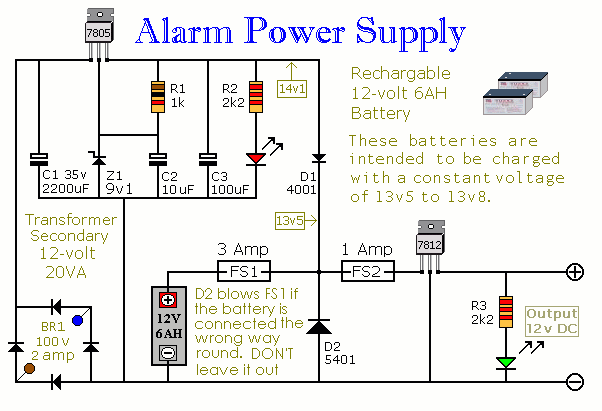
Alarm Power Supply
This power supply is suitable for a modular burglar alarm but can also serve other applications. It is designed to provide a 12-volt output with a current capacity of up to 1 amp. In case of mains failure, the backup...