


Pwm Motor-Drive Circuit Circuit
#PWM
#DC motor
#speed control
#duty cycle
#motor drive
#stall prevention
#electronic control
#small motor

Description: This circuit will drive a small DC motor over a wide range of speeds without stalling by controlling the duty cycle of the motor, rather than the supply voltage.
The described circuit utilizes pulse width modulation (PWM) to effectively control the speed of a small DC motor. By varying the duty cycle of the PWM signal, the average voltage applied to the motor can be adjusted, allowing for precise speed control without the need to alter the supply voltage. This method is advantageous as it minimizes power loss and heat generation compared to linear voltage regulation methods.
The circuit typically consists of a microcontroller or a dedicated PWM controller that generates the PWM signal. This signal is fed into a transistor or a MOSFET, which acts as a switch to control the flow of current to the motor. The duty cycle, defined as the ratio of the on-time to the total cycle time, can be adjusted programmatically or through a variable resistor, enabling a smooth transition between different speeds.
In addition to the motor, the circuit may include protective elements such as diodes to prevent back EMF from damaging the switching components and capacitors for filtering the PWM signal to reduce electrical noise. Feedback mechanisms, such as tachometers or encoders, can also be integrated to provide real-time speed monitoring and closed-loop control, ensuring optimal performance and preventing stalling under varying load conditions.
Overall, this circuit design effectively balances efficiency and performance, making it suitable for applications requiring variable speed control of small DC motors in robotics, automation, and other electronic systems. This circuit will drive a small dc motor over a wide range of speeds without stalling by controlling the duty cycle of the motor, rather than the supply voltage.
The described circuit utilizes pulse width modulation (PWM) to effectively control the speed of a small DC motor. By varying the duty cycle of the PWM signal, the average voltage applied to the motor can be adjusted, allowing for precise speed control without the need to alter the supply voltage. This method is advantageous as it minimizes power loss and heat generation compared to linear voltage regulation methods.
The circuit typically consists of a microcontroller or a dedicated PWM controller that generates the PWM signal. This signal is fed into a transistor or a MOSFET, which acts as a switch to control the flow of current to the motor. The duty cycle, defined as the ratio of the on-time to the total cycle time, can be adjusted programmatically or through a variable resistor, enabling a smooth transition between different speeds.
In addition to the motor, the circuit may include protective elements such as diodes to prevent back EMF from damaging the switching components and capacitors for filtering the PWM signal to reduce electrical noise. Feedback mechanisms, such as tachometers or encoders, can also be integrated to provide real-time speed monitoring and closed-loop control, ensuring optimal performance and preventing stalling under varying load conditions.
Overall, this circuit design effectively balances efficiency and performance, making it suitable for applications requiring variable speed control of small DC motors in robotics, automation, and other electronic systems. This circuit will drive a small dc motor over a wide range of speeds without stalling by controlling the duty cycle of the motor, rather than the supply voltage.

Reversing motor drive dc control
This is a positioning servo drive that includes adjustments for balance, gain, and deadband. In addition to receiving control from a DC signal, a mechanical input can be utilized for the balance control. Alternatively, this balance control can be substituted...

PWM to vary the light intensity of a 220V bulb
A 220V bulb is connected such that one end of the relay is linked to a 220V DC source and the other end is connected to ground. The switching between these two points is controlled by a PWM output as...

DC 2 speed Motor Controller
The simplest of all motor controllers (besides a straight on/off switch) is the contactor controller. I designed this contactor controller for use in my electric scooter project. It is based around three 12V relays, two 12V batteries, two switches and...

PWM circuit
An electric scooter and E-Bike PWM speed controller circuit has been constructed. However, the oscillator is not functioning as intended. The printed circuit board has been checked and is confirmed to be in good condition, including all resistors.
The electric scooter...

Two motor speed control circuit and the main level indicating circuit
The circuit illustrated in Figure 3-178 is designed for controlling the speed and torque of a motor used in a continuous casting machine. It consists of the main circuit, a trigger circuit, and both manual and automatic control signal circuits,...

Switching inverter for 12v systems
This PWM control circuit generates control pulses for the DMOS power switch in the flyback circuit. The PWM output produces a pulse width that is proportional to the input control voltage, with the repetition rate governed by an external clock...
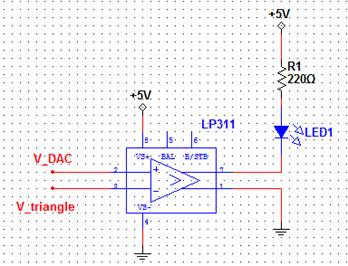
PWM Generator
A pulse-width modulated (PWM) signal can be generated using a triangle wave and a comparator. The digital-to-analog converter (DAC) serves as the input signal, and the resulting output signal's duty cycle will be proportional to the input voltage. This PWM...

dc motor control circuit
S1 and S2 are normally open, push-to-close, momentary switches. The diodes can be red or green and serve solely as indicators for direction. The TIP31 transistors may need to be adjusted based on the motor specifications. It is important to...

DC motor 12V speed controller circuit with explanation
A simple encoder circuit for a DC motor can be constructed using this circuit diagram. The system consists of the HA-2542, a small 12-V DC motor, and a position encoder. During operation, the encoder generates a series of constant-width pulses...