


Y- buck can be manual and automatic control of the starting circuit
#buck converter
#manual control
#automatic control
#starting circuit
#motor driver
#switching
#power supply
#voltage regulator
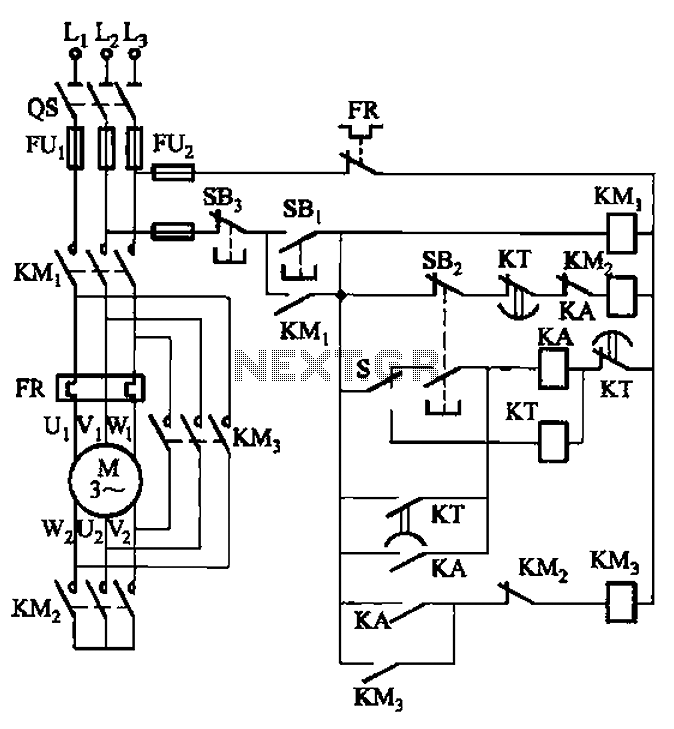
Description: The circuit is depicted. It is capable of both manual and automatic control.
The circuit in question is designed to facilitate dual modes of operation: manual and automatic control. This versatility allows users to engage with the system according to their specific needs.
In manual mode, operators can directly interact with the circuit using physical controls such as switches or potentiometers. This mode is ideal for situations requiring immediate adjustments or when precise control over the circuit's operation is necessary.
In automatic mode, the circuit can autonomously manage its functions based on predetermined parameters or sensor inputs. This is typically achieved through the integration of microcontrollers or programmable logic devices that process input signals and execute predefined algorithms to control output devices. Sensors may include temperature sensors, light sensors, or motion detectors, enabling the circuit to respond dynamically to environmental changes.
The schematic may include various components such as resistors, capacitors, diodes, and transistors, which work in conjunction to ensure reliable operation in both modes. The design should also consider power supply requirements, signal conditioning, and potential feedback loops that enhance the circuit's performance and stability.
Overall, the circuit's ability to operate in both manual and automatic modes makes it suitable for a wide range of applications, from simple home automation systems to complex industrial control systems. Proper attention to component selection and circuit layout will ensure optimal functionality and reliability in both operational modes. Circuit is shown. It can not only manually, but automatic control.
The circuit in question is designed to facilitate dual modes of operation: manual and automatic control. This versatility allows users to engage with the system according to their specific needs.
In manual mode, operators can directly interact with the circuit using physical controls such as switches or potentiometers. This mode is ideal for situations requiring immediate adjustments or when precise control over the circuit's operation is necessary.
In automatic mode, the circuit can autonomously manage its functions based on predetermined parameters or sensor inputs. This is typically achieved through the integration of microcontrollers or programmable logic devices that process input signals and execute predefined algorithms to control output devices. Sensors may include temperature sensors, light sensors, or motion detectors, enabling the circuit to respond dynamically to environmental changes.
The schematic may include various components such as resistors, capacitors, diodes, and transistors, which work in conjunction to ensure reliable operation in both modes. The design should also consider power supply requirements, signal conditioning, and potential feedback loops that enhance the circuit's performance and stability.
Overall, the circuit's ability to operate in both manual and automatic modes makes it suitable for a wide range of applications, from simple home automation systems to complex industrial control systems. Proper attention to component selection and circuit layout will ensure optimal functionality and reliability in both operational modes. Circuit is shown. It can not only manually, but automatic control.

Automatic light control one lamp lighting circuit b
An automatic light control circuit is designed to illuminate a lamp when it is dark and to turn off the light at daybreak. The circuit, as shown in Figure 2-86, employs bidirectional thyristor tubes and features a straightforward design. In...

5 A stabilized power supply
This is a simple but powerful nutrition that less than 5 A can deliver. The circuit works by using a normal type 78xx voltage regulator and a buffer transistor. When the output current over 200 mA, then take over the...

Switching Improves Regulator Efficiency
In this circuit, a full-wave bridge is switched to a full-wave center tap to reduce regulator dissipation. SCR D6 switches between configurations. When D6 is off, the circuit is an FWCT rectifier using D1, D2, and D5. It applies 17...

FSP107-2PS01 two-in-one power panel circuit analysis
The main component is the LG26 one-inch screens integrated with the FSP107-2PS01 two-in-one electrical power package, which utilizes a direct drive CCFL modulator tube. This setup is compatible with screens from other manufacturers, such as Samsung and AU, but requires...

Thrifty Voltage Regulator
One of the drawbacks of a three-pin voltage regulator is that the input voltage needs to be 2.5 to 3 V higher than the output voltage. This makes these integrated regulators unsuitable for battery power supplies. For instance, if the...
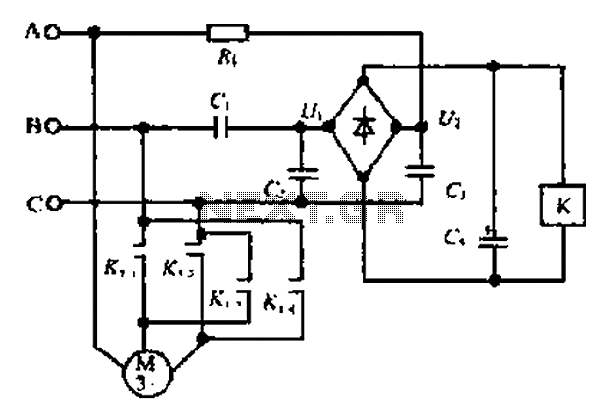
A motor reversing automatic adjustment circuit
Composition ratio circuit. The circuit consists of resistors and capacitors that form a shift register circuit with diodes VD1 to VD4, creating a bridge for electric current. Capacitor C4 is utilized for filtering applications and for eliminating instantaneous relay energization...

-15 V 1-A Regulated Power Supply
The supply receives -20 V from the rectifier/filter which is fed to the collector of the Darlington pnp pass transistor, a TIP105. The base drive to the TIP105 is supplied through resistor R5. The base of the TIP is driven...

90Vrms voltage regulator
The circuit is an open-loop RMS voltage regulator designed to deliver 500 watts of power at 90 V RMS, maintaining good regulation within an input voltage range of 110-130 V RMS. When the input voltage is applied, capacitor C1 charges...

Power Supply for P.A. Class40
For its maximum result, the final stage of the amplifier should have the proper power supply, as the flowing currents are very high. A Class A amplifier requires attention. These are the rules for the power supply for the Class...