


Constituted by the PGA103 programmable gain instrumentation amplifier circuit diagram
#PGA103
#programmable gain
#instrumentation amplifier
#PGA205
#cascading
#amplifier circuit
#gain control
#signal conditioning

Description: The circuit depicted in the figure comprises a PGA103 programmable gain instrumentation amplifier. This design utilizes the PGA205 and PGA103 in a cascading configuration, resulting in a total gain for the amplifier. The gain is determined by the product of the gains of the two amplifiers, denoted as G = G1 * G2. The gain settings for G1 are 1, 2, 4, and 8, while G2 can be set to 1, 10, or 100. By selecting different logic inputs, various gain levels can be achieved, with a maximum gain of up to 800. Other available gain configurations include 1, 2, 4, 8, 10, 20, 40, 80, 100, 200, and 400.
The PGA103 is a high-performance programmable gain amplifier designed for use in precision applications. It features low noise and low distortion characteristics, making it suitable for amplifying weak signals in instrumentation systems. The cascading arrangement of the PGA205 and PGA103 enhances flexibility in gain selection, allowing for a wide range of amplification tailored to specific application requirements.
In this configuration, the PGA205 serves as the first stage of amplification, providing initial gain settings through its selectable options. The output from the PGA205 feeds into the PGA103, which further amplifies the signal based on its own gain settings. This method of cascading amplifiers not only increases the overall gain but also improves the linearity and bandwidth of the system.
The gain selection is controlled through digital logic inputs, enabling quick and precise adjustments based on the needs of the application. This feature is particularly beneficial in dynamic environments where signal levels may fluctuate, requiring real-time gain adjustments to maintain optimal performance.
Overall, the PGA103 and PGA205 combination offers a versatile solution for applications requiring programmable gain amplification, such as medical instrumentation, industrial sensors, and audio processing systems. The ability to achieve a maximum gain of 800 while maintaining signal integrity makes this circuit an excellent choice for high-fidelity amplification tasks. As shown in FIG constitute grounds PGA103 programmable gain instrumentation amplifier. This circuit uses the PGA205 and PGA103 cascading manner, the total gain of the amplifier gain is the product of two amplifiers, namely G G1G2. G1 1,2,4,8, G2 1,10,100, choose different logic inputs can choose different gain, maximum gain of up to 800 (other gains were 1,2,4,8,10,20, 40,80,100,200,400).
The PGA103 is a high-performance programmable gain amplifier designed for use in precision applications. It features low noise and low distortion characteristics, making it suitable for amplifying weak signals in instrumentation systems. The cascading arrangement of the PGA205 and PGA103 enhances flexibility in gain selection, allowing for a wide range of amplification tailored to specific application requirements.
In this configuration, the PGA205 serves as the first stage of amplification, providing initial gain settings through its selectable options. The output from the PGA205 feeds into the PGA103, which further amplifies the signal based on its own gain settings. This method of cascading amplifiers not only increases the overall gain but also improves the linearity and bandwidth of the system.
The gain selection is controlled through digital logic inputs, enabling quick and precise adjustments based on the needs of the application. This feature is particularly beneficial in dynamic environments where signal levels may fluctuate, requiring real-time gain adjustments to maintain optimal performance.
Overall, the PGA103 and PGA205 combination offers a versatile solution for applications requiring programmable gain amplification, such as medical instrumentation, industrial sensors, and audio processing systems. The ability to achieve a maximum gain of 800 while maintaining signal integrity makes this circuit an excellent choice for high-fidelity amplification tasks. As shown in FIG constitute grounds PGA103 programmable gain instrumentation amplifier. This circuit uses the PGA205 and PGA103 cascading manner, the total gain of the amplifier gain is the product of two amplifiers, namely G G1G2. G1 1,2,4,8, G2 1,10,100, choose different logic inputs can choose different gain, maximum gain of up to 800 (other gains were 1,2,4,8,10,20, 40,80,100,200,400).

Instrumentation amplifier
A three-amplifier circuit consumes only 135 µW of power from a ±1 V power supply. With a gain of 101, the instrumentation amplifier is ideal for sensor interface and biomedical preamplifier applications. The first stage provides all of the gain,...

Signal Conditioners Information
Signal conditioning involves a series of operations applied to a signal to make it compatible for interfacing with other devices or systems. Signal conditioners are the devices that execute this operation, featuring both an input and an output. Typically, the...

Extended common mode range of the instrumentation amplifier (INA101) circuit
This document describes the extended common mode input voltage range of an instrument amplifier circuit. The circuit consists of three precision instrument amplifiers, A1, A2, and A3, which can be INA101 or INA102 models. The figure illustrates that A1, A2,...

Signal Conditioning Analog Front-end for Microcontrollers
The I/O board incorporates 16-bit resolution voltage analog inputs and outputs, along with a 4-20mA current loop transmitter and receiver for microcontroller applications. The document discusses amplifier circuits and schematics, including a signal conditioning variable gain amplifier, analog filter, and...

Based CNC programming gain instrumentation amplifier PGA202 203 schematic
Based on the CNC programming, a gain instrumentation amplifier circuit diagram utilizing the PGA202/203 is presented.
The PGA202/203 series of programmable gain amplifiers are designed for high-performance applications requiring precise signal amplification. These integrated circuits offer a wide range of programmable...

ADT70 internal functional block diagram
The ADI I70 is a signal conditioning integrated circuit designed for RTD/PRTD applications, particularly suitable for 1K and 100Ω platinum RTDs (PRTDs). The ADT70 features an integrated instrumentation amplifier, an operational amplifier, a 2.5V reference power supply, and a matching...

Signal Conditioning Circuit for KMI 15/x Rotation Speed Sensor
A modulated current is supplied by the integrated rotational speed sensor KMI 15/x. This current signal needs to be converted into a ground-referenced voltage signal.
The KMI 15/x sensor operates by generating a modulated current proportional to the rotational speed of...

DC Instrumentation Amplifier Circuit
A common challenge for experimenters is increasing the gain of a low-level DC voltage for recording or analysis. Most instrumentation circuits require building a complicated project with dual power supplies and high-accuracy components. A simple solution is to use an...
instrumentation amplifiers
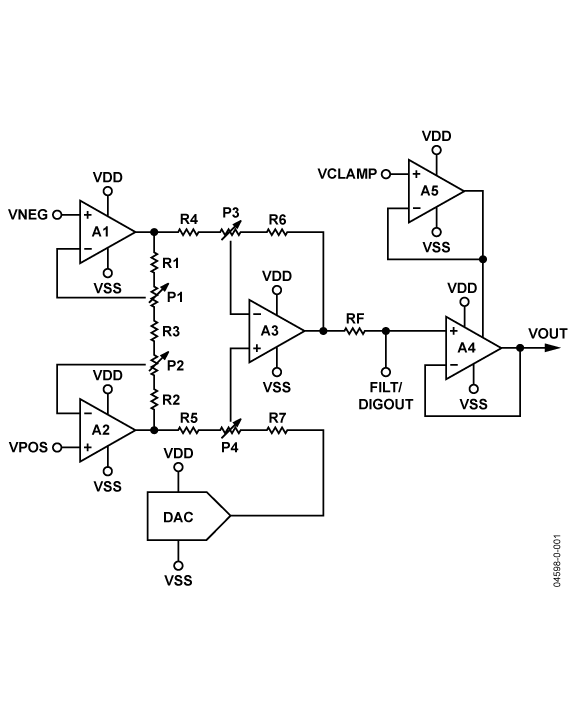
The AD8555 is a zero-drift sensor signal amplifier featuring digitally programmable gain and output offset. It is designed to effectively and accurately convert variable pressure sensor and strain bridge outputs into a well-defined output voltage range. Additionally, the AD8555 can...