


Digitally-programmable-precision-amplifier
#precision amplifier
#op amp
#high input impedance
#feedback divider
#DG419
#DG441
#programmable gain
#analog circuit
#signal conditioning
#instrumentation

Description: The DG419 considers the high input impedance of the operational amplifier, making the effects of Rvs negligible. The DG441 is also connected in series with RIN and is not included in the feedback dividers, thereby contributing negligible error to the overall gain. Additionally, since the DG419 and DG441 can handle ±15 V, the unity gain follower connection, X1, is capable of utilizing the full op-amp output range of ±12 V.
The DG419 and DG441 are integrated circuits designed for precision analog switching applications. The DG419 features a high input impedance, which minimizes the loading effect on preceding stages, ensuring that the signal integrity is maintained. This characteristic is particularly important in applications where signal fidelity is critical, such as in sensor interfacing or data acquisition systems.
In this circuit configuration, the DG441 is employed in series with RIN, which acts as an input resistor. By not being included in the feedback network, the DG441 does not affect the feedback ratio, thereby ensuring that the gain remains stable and predictable. This configuration allows for the maintenance of high accuracy in the signal processing chain, as the negligible error introduced by the DG441 does not significantly impact the overall performance.
The unity gain follower connection, designated as X1, leverages the capabilities of both the DG419 and DG441 to handle supply voltages of ±15 V. This allows the output of the operational amplifier to swing fully between ±12 V, providing a robust output range that can drive various loads effectively. The ability to maintain this output range is essential for applications requiring precise control and rapid response times.
Overall, the combination of the DG419 and DG441 in this configuration ensures high performance with minimal distortion, making it suitable for high-fidelity audio applications, instrumentation, and other sensitive electronic circuits. The careful selection of components and their configuration within the circuit enhances the reliability and accuracy of the system as a whole.The DG419looks into the high input impedance of the op amp, so the effects of Rvs(o"l are negligible. The DG441 is also connected in series with RIN and is not included in the feedback dividers, thus contributing negligible
Because the DG419 and DG441 can handle ±15 V, the unity gain follower connection, Xl, is capable of the full op-amp output range of ± 12 V.
The DG419 and DG441 are integrated circuits designed for precision analog switching applications. The DG419 features a high input impedance, which minimizes the loading effect on preceding stages, ensuring that the signal integrity is maintained. This characteristic is particularly important in applications where signal fidelity is critical, such as in sensor interfacing or data acquisition systems.
In this circuit configuration, the DG441 is employed in series with RIN, which acts as an input resistor. By not being included in the feedback network, the DG441 does not affect the feedback ratio, thereby ensuring that the gain remains stable and predictable. This configuration allows for the maintenance of high accuracy in the signal processing chain, as the negligible error introduced by the DG441 does not significantly impact the overall performance.
The unity gain follower connection, designated as X1, leverages the capabilities of both the DG419 and DG441 to handle supply voltages of ±15 V. This allows the output of the operational amplifier to swing fully between ±12 V, providing a robust output range that can drive various loads effectively. The ability to maintain this output range is essential for applications requiring precise control and rapid response times.
Overall, the combination of the DG419 and DG441 in this configuration ensures high performance with minimal distortion, making it suitable for high-fidelity audio applications, instrumentation, and other sensitive electronic circuits. The careful selection of components and their configuration within the circuit enhances the reliability and accuracy of the system as a whole.The DG419looks into the high input impedance of the op amp, so the effects of Rvs(o"l are negligible. The DG441 is also connected in series with RIN and is not included in the feedback dividers, thus contributing negligible
Because the DG419 and DG441 can handle ±15 V, the unity gain follower connection, Xl, is capable of the full op-amp output range of ± 12 V.

Non-diode rectifier
When utilizing a single-supply operational amplifier in a bipolar signal environment, achieving simple functions can be challenging. This often necessitates the inclusion of additional operational amplifiers and other electronic components. The advantages of this configuration can be observed in the...

Averager and Peak Hold/Extender Signal Conditioner
A signal averager circuit can be formed by an amplifier and active signal rectifier, which is implemented using two operational amplifiers in this circuit.
The signal averager circuit utilizes two operational amplifiers (op-amps) to achieve signal averaging through amplification and rectification....

Peak Reading Audio Level Meter
This simple circuit, designed with a minimal component count, indicates peak audio response on an analog meter, similar to a tape recorder's meter. It employs an operational amplifier configured as a non-inverting amplifier, with the addition of a diode in...

op amp monostable multivibrator
This is a monostable multivibrator circuit that utilizes a single operational amplifier. The primary component of this circuit is the 741, a general-purpose operational amplifier. A monostable multivibrator is a timing circuit that changes its output state when triggered and...

Variable Voltage Regulator
The operational amplifier (op amp) is configured as a non-inverting DC amplifier with a gain determined by the ratio of resistors R3 and R2. The input voltage to the op amp can vary between 0 and 15 V through resistor...

Signal Conditioning Circuit for KMI 15/x Rotation Speed Sensor
A modulated current is supplied by the integrated rotational speed sensor KMI 15/x. This current signal needs to be converted into a ground-referenced voltage signal.
The KMI 15/x sensor operates by generating a modulated current proportional to the rotational speed of...

Versatile Op Amps Need No Resistors
One of the challenges faced by power supply designers today is the need to create a switching power supply that can function across various power systems in international markets. Forward mode switching power supplies typically operate within a limited voltage...
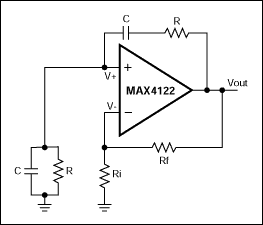
Nodal Analysis of Op Amp Circuits
This application note explains how the transfer function of most operational amplifier circuits can be derived through a straightforward process of nodal analysis.
The transfer function of operational amplifier (op amp) circuits is a critical aspect for understanding their behavior in...

Extended-play-circuit
A single operational amplifier, one of four included in the widely used LM324, is functioning within a variable pulse-width, free-running square wave oscillator circuit. Its output drives two transistors that manage the on/off cycle of the tape-drive motor. The oscillator's...