


INA321 322 input current protection circuit diagram
#INA321
#INA322
#current protection
#ESD protection
#input voltage
#circuit diagram
#protection diodes
#analog circuit

Description: The input current protection circuit for the INA321/322 is illustrated. The INA321/322 features input terminal electrostatic discharge (ESD) protection diodes that become conductive when the input voltage exceeds the supply voltage by 500mV. The protection diodes will conduct, and the resistor RLIM will limit the input current to a maximum of 10mA, thereby serving its purpose in the protection circuit. Several input signals inherently possess limiting functions, and in such cases, the flow resistance RLIM may not be effective.
The INA321/322 integrated circuits are designed for precision applications requiring low offset voltages and low noise. The input current protection circuit is critical for safeguarding the device from overvoltage conditions. The ESD protection diodes are typically connected from the input pins to the power supply rails, allowing them to clamp any excess voltage to a safe level. When the input voltage exceeds the supply voltage by 500mV, these diodes become forward-biased and begin to conduct.
The resistor RLIM serves a dual purpose in this configuration. Firstly, it limits the input current to a maximum of 10mA, which is crucial for preventing damage to both the ESD protection diodes and the internal circuitry of the INA321/322. Secondly, RLIM helps to maintain the integrity of the input signal by preventing excessive current draw that could distort the signal.
In scenarios where the input signal itself has a built-in limiting function, RLIM may not be necessary or effective. This is often the case with signals that are inherently designed to operate within specific voltage ranges. In such instances, the input protection mechanism relies primarily on the characteristics of the signal itself to prevent overcurrent conditions.
Overall, the design of the input current protection circuit for the INA321/322 ensures reliable operation in various applications, providing essential safeguards against voltage spikes and excessive current that could compromise the performance and longevity of the device. As shown by INA321/322 input current protection circuit shown. INA321/322 has the input end of the inner electrostatic discharge (ESD) protection diodes when the input voltage exceeds the supply voltage 500mV, protection diodes will conduct case RLIM will limit the input current (maximum 10mA), play a role in the protection circuit. Many of the input signal itself limiting function, and this time the flow resistance RLIM can not.
The INA321/322 integrated circuits are designed for precision applications requiring low offset voltages and low noise. The input current protection circuit is critical for safeguarding the device from overvoltage conditions. The ESD protection diodes are typically connected from the input pins to the power supply rails, allowing them to clamp any excess voltage to a safe level. When the input voltage exceeds the supply voltage by 500mV, these diodes become forward-biased and begin to conduct.
The resistor RLIM serves a dual purpose in this configuration. Firstly, it limits the input current to a maximum of 10mA, which is crucial for preventing damage to both the ESD protection diodes and the internal circuitry of the INA321/322. Secondly, RLIM helps to maintain the integrity of the input signal by preventing excessive current draw that could distort the signal.
In scenarios where the input signal itself has a built-in limiting function, RLIM may not be necessary or effective. This is often the case with signals that are inherently designed to operate within specific voltage ranges. In such instances, the input protection mechanism relies primarily on the characteristics of the signal itself to prevent overcurrent conditions.
Overall, the design of the input current protection circuit for the INA321/322 ensures reliable operation in various applications, providing essential safeguards against voltage spikes and excessive current that could compromise the performance and longevity of the device. As shown by INA321/322 input current protection circuit shown. INA321/322 has the input end of the inner electrostatic discharge (ESD) protection diodes when the input voltage exceeds the supply voltage 500mV, protection diodes will conduct case RLIM will limit the input current (maximum 10mA), play a role in the protection circuit. Many of the input signal itself limiting function, and this time the flow resistance RLIM can not.

A third harmonic current phase protection circuits
Figure 4-27 (b) line demonstrates a configuration that enhances the output current waveform DC voltage compared to the line in Figure 4-27 (a). This configuration can be utilized for motors with larger capacities.
The circuit illustrated in Figure 4-27 (b) incorporates...

INA321 322 a direct drive capacitive input of the A D converter Figure
The INA321/322 is configured to directly drive the capacitive input of an A/D converter. Due to its low output resistance, the INA321/322 can effectively handle high frequency signals and directly drive capacitive loads. The input voltage is amplified by the...

Advanced Simulation for ESD Protection Elements
A series of current pulses are applied to the simulated structure, and average currents of the 70% to 90% section of each curve are calculated. Voltage versus time curves are obtained from the simulation, and the average voltage of the...

INA155 156 input current protection circuit diagram
The input current protection circuit is illustrated in FIG, utilizing INA155/156. The INA155 features internal electrostatic discharge (ESD) protection diodes that become active when the input voltage exceeds the supply voltage by 500mV. In this scenario, the protection diodes will...
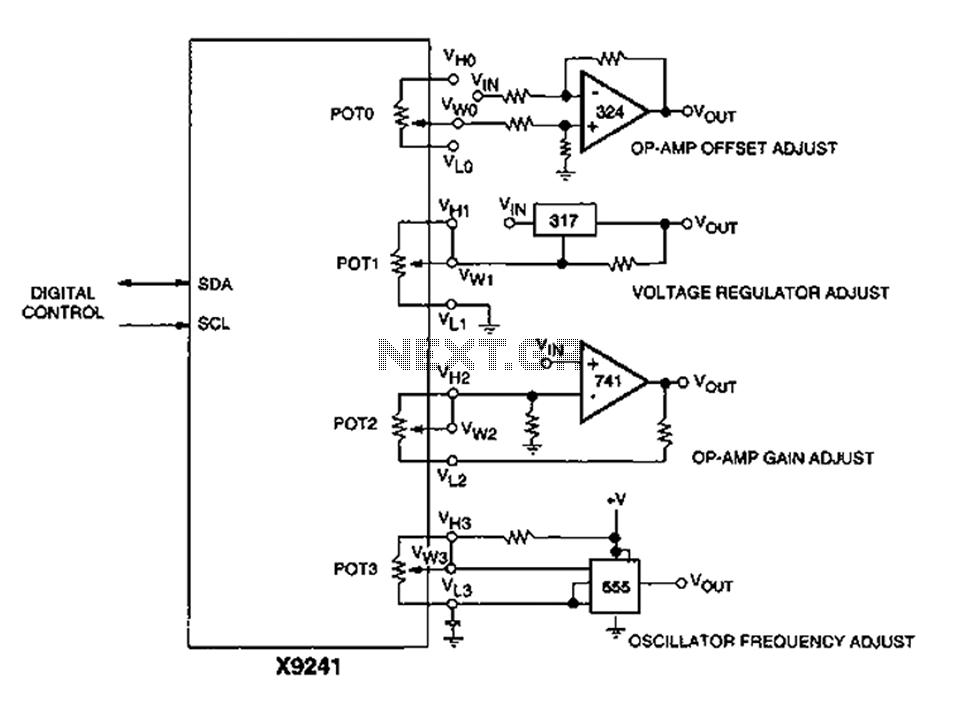
Corrector circuit diagram of an analog circuit
A XICOR X9241 POT IC module can be utilized to modify the four digital analog circuits, as depicted in the schematic.
The XICOR X9241 is a digital potentiometer integrated circuit designed for precise adjustment of analog signal levels in various electronic...

Analog circuit enforces slow servo response
The all-analog circuit presented controls the rate at which a miniature turbojet engine can be throttled. Increasing or decreasing the throttle too quickly on a miniature turbojet engine, or any jet engine, can lead to quick failure in flight, causing...