


ISO122 / 124 and PGA102, isolated channel has a programmable gain circuit diagram
#isolation amplifier
#programmable gain
#ISO122
#ISO124
#PGA102
#ISO150
#signal conditioning
#analog circuit
#precision amplifier

Description: The circuit features grounds ISO122/124 and PGA102, with ISO150 forming a gain programmable channel isolation circuit. The input signal VIN is amplified by the instrumentation amplifier PGA102 to ISO122P, which then outputs VOUT from the isolation amplifier ISO102P. Two gain selection signals, A0 and A1, are used after the isolation provided by ISO150, allowing the gain of PGA102 to be set to 1, 10, or 100. The complete isolation of the signal, power, ground, and gain control select pin contributes to the circuit's excellent anti-interference performance.
The described circuit integrates multiple components to achieve programmable gain and signal isolation, making it suitable for sensitive applications where noise immunity is crucial. The ISO122 and ISO124 are precision isolation amplifiers that provide high voltage isolation while maintaining signal integrity. These amplifiers are particularly useful in applications where ground loops or common-mode voltages can distort the signal.
The PGA102 is a programmable gain amplifier that allows for precise gain settings, which can be adjusted via digital control signals A0 and A1. This flexibility enables the circuit to adapt to various signal levels, ensuring optimal performance across a range of input conditions. The gain options of 1, 10, or 100 allow for versatility in applications, accommodating both low-level and higher-level signals.
The isolation provided by ISO150 enhances the circuit's robustness against electromagnetic interference (EMI) and radio frequency interference (RFI), which are common challenges in electronic systems. By isolating the input from the output, the circuit minimizes the risk of noise coupling, thus preserving the fidelity of the amplified signal.
In summary, this circuit design effectively combines gain programmability with high-performance isolation, making it well-suited for precision measurement systems, medical instrumentation, and industrial applications where signal integrity and noise immunity are paramount. The careful arrangement of components ensures that the circuit operates reliably under varying environmental conditions and input signal characteristics.As shown in FIG grounds ISO122 / 124 and PGA102, ISO150 constituted with a gain programmable channel isolation circuit. After the input signal VIN is amplified by instrumentation amplifier PGA102 to ISO122P, after ISO102P isolation amplifier output VOUT. Two gain selection signals A0, A1 by the isolation after ISO150 added PGA102, PGA102 gain is set to (1, 10 or 100).
Because the signal, power, ground and the output of the input signal, power, ground and gain control select pin completely isolated, so a good anti-interference performance of the circuit.
The described circuit integrates multiple components to achieve programmable gain and signal isolation, making it suitable for sensitive applications where noise immunity is crucial. The ISO122 and ISO124 are precision isolation amplifiers that provide high voltage isolation while maintaining signal integrity. These amplifiers are particularly useful in applications where ground loops or common-mode voltages can distort the signal.
The PGA102 is a programmable gain amplifier that allows for precise gain settings, which can be adjusted via digital control signals A0 and A1. This flexibility enables the circuit to adapt to various signal levels, ensuring optimal performance across a range of input conditions. The gain options of 1, 10, or 100 allow for versatility in applications, accommodating both low-level and higher-level signals.
The isolation provided by ISO150 enhances the circuit's robustness against electromagnetic interference (EMI) and radio frequency interference (RFI), which are common challenges in electronic systems. By isolating the input from the output, the circuit minimizes the risk of noise coupling, thus preserving the fidelity of the amplified signal.
In summary, this circuit design effectively combines gain programmability with high-performance isolation, making it well-suited for precision measurement systems, medical instrumentation, and industrial applications where signal integrity and noise immunity are paramount. The careful arrangement of components ensures that the circuit operates reliably under varying environmental conditions and input signal characteristics.As shown in FIG grounds ISO122 / 124 and PGA102, ISO150 constituted with a gain programmable channel isolation circuit. After the input signal VIN is amplified by instrumentation amplifier PGA102 to ISO122P, after ISO102P isolation amplifier output VOUT. Two gain selection signals A0, A1 by the isolation after ISO150 added PGA102, PGA102 gain is set to (1, 10 or 100).
Because the signal, power, ground and the output of the input signal, power, ground and gain control select pin completely isolated, so a good anti-interference performance of the circuit.

Digital Controlled Precision Amplifier Circuit PCB
This circuit is a precision amplifier with digital control, designed for signal conditioning of low-output transducers operating in the millivolt range. The resistors R3 to R6 can be user-selected, with values ranging from 1 kilo-ohm to 1 mega-ohm, allowing for...

Analog circuit enforces slow servo response
The all-analog circuit presented controls the rate at which a miniature turbojet engine can be throttled. Increasing or decreasing the throttle too quickly on a miniature turbojet engine, or any jet engine, can lead to quick failure in flight, causing...

ISO122P / 124 power supply has a three-port isolation amplifier circuit diagram
Power isolation is demonstrated for the ISO122P / 124, which features a three-port amplifier. The circuit also utilizes precision analog isolation amplifiers. The ISO122P / 124 isolation amplifier is a cost-effective solution, and the HPR117 DC/DC converter component provides the...
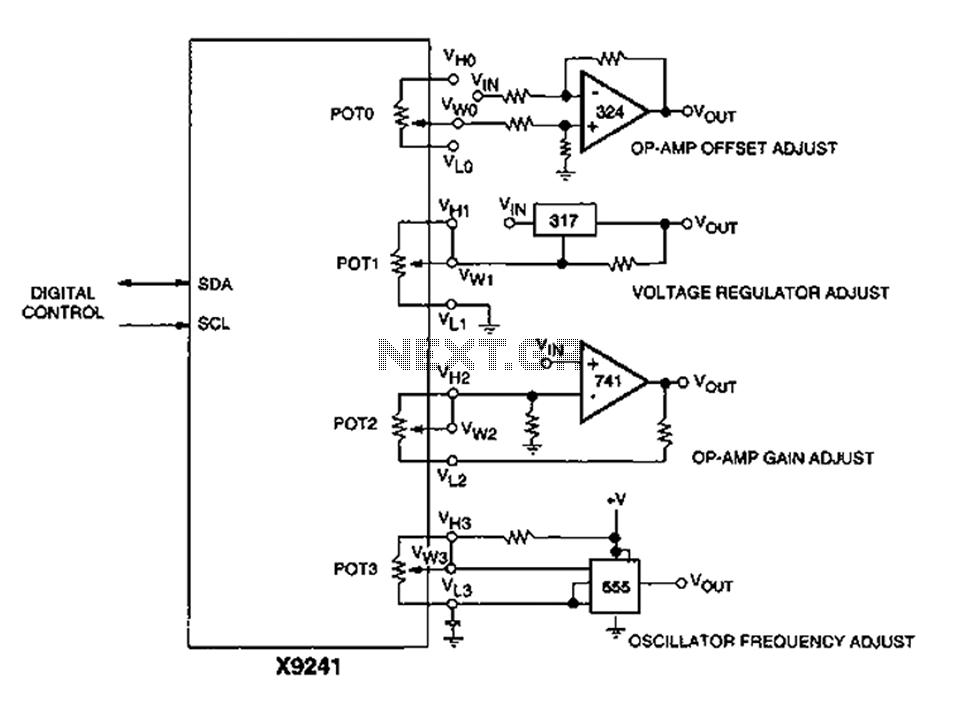
Corrector circuit diagram of an analog circuit
A XICOR X9241 POT IC module can be utilized to modify the four digital analog circuits, as depicted in the schematic.
The XICOR X9241 is a digital potentiometer integrated circuit designed for precise adjustment of analog signal levels in various electronic...

Signal Conditioning Circuit for KMI 15/x Rotation Speed Sensor
A modulated current is supplied by the integrated rotational speed sensor KMI 15/x. This current signal needs to be converted into a ground-referenced voltage signal.
The KMI 15/x sensor operates by generating a modulated current proportional to the rotational speed of...

ISO122 124 filter circuit diagram
The ISO122/124-type filter circuit is designed to address noise suppression from the DC/DC converter. The internal oscillator frequency of the ISO122/124 modem is set to 500 kHz. The circuit employs inductors and capacitors for filtering to mitigate any beat frequency...

Available units selected from 10 to 10dB 90dB programmable gain amplifier
Although the basic amplifier circuit phase AC amplifier remains unchanged, the selection of the correct gain requires the use of series resistors. The circuit does not include a 9kΩ resistor. The input amplifier Ai selected is the OP37, which maintains...

ADT70 internal functional block diagram
The ADI I70 is a signal conditioning integrated circuit designed for RTD/PRTD applications, particularly suitable for 1K and 100Ω platinum RTDs (PRTDs). The ADT70 features an integrated instrumentation amplifier, an operational amplifier, a 2.5V reference power supply, and a matching...

Averager and Peak Hold/Extender Signal Conditioner
A signal averager circuit can be formed by an amplifier and active signal rectifier, which is implemented using two operational amplifiers in this circuit.
The signal averager circuit utilizes two operational amplifiers (op-amps) to achieve signal averaging through amplification and rectification....