


On/Off Touch Switch
#touch switch
#CA3240
#BiMOS op amp
#sensing circuit
#on/off switch
#low current
#touch plate
#electronic switch

Description: This circuit employs a CA3240 dual BiMOS operational amplifier to detect small currents that flow between the contact points on a touch plate. The high input impedance of the CA3240 enables the use of 1-megaohm resistors in series with the touch plates to ensure user safety. A positive output from either pin 7 (ON) or pin 1 (OFF) of the CA3240 activates the CA3059 zero-voltage switch, which subsequently latches the triac on or turns it off. The internal power supply of the CA3059 provides power to the CA3240.
The circuit design features a CA3240 dual BiMOS op-amp, which is characterized by its high input impedance and low output distortion, making it well-suited for sensing small currents. The op-amp is configured in a non-inverting mode to amplify the minute voltage changes occurring across the touch plate due to user interaction. The touch plate is connected to the op-amp inputs via high-value resistors (1 MΩ). This configuration not only enhances the sensitivity of the circuit but also ensures that the current flowing through the touch plate remains at a safe level for users.
When a user touches the plate, a small current flows through the resistors, generating a corresponding voltage at the op-amp inputs. The CA3240 processes this input signal and, depending on the detected voltage level, provides a positive output signal on either pin 7 or pin 1. The output from the op-amp is then used to control the CA3059 zero-voltage switch, which is designed to switch on or off without causing voltage spikes, thus protecting downstream components.
The CA3059 is a specialized switch that can latch a triac in the on state or turn it off based on the signals received from the CA3240. This capability is critical for applications where electrical isolation and control of AC loads are necessary. The internal power supply of the CA3059 powers the CA3240, ensuring that the entire circuit operates efficiently without requiring additional external power sources.
Overall, this circuit effectively combines the high sensitivity of the CA3240 op-amp with the robust switching capabilities of the CA3059, resulting in a reliable touch-sensitive control mechanism suitable for various electronic applications. This circuit uses a CA3240 dual BiMOS op amp to sense small currents flowing between the contact points on a touch plat e. The high input impedance of the CA3240 allows the use of 1- resistors in series with the touch plates to ensure user safety. A positive output on either pin 7 (ON) or pin 1 (OFF) of the CA3240 actuates the CA3059 zero-voltage switch, which then latches the triac on or turns it off.
The internal power supply of the CA3059 powers the CA3240.
The circuit design features a CA3240 dual BiMOS op-amp, which is characterized by its high input impedance and low output distortion, making it well-suited for sensing small currents. The op-amp is configured in a non-inverting mode to amplify the minute voltage changes occurring across the touch plate due to user interaction. The touch plate is connected to the op-amp inputs via high-value resistors (1 MΩ). This configuration not only enhances the sensitivity of the circuit but also ensures that the current flowing through the touch plate remains at a safe level for users.
When a user touches the plate, a small current flows through the resistors, generating a corresponding voltage at the op-amp inputs. The CA3240 processes this input signal and, depending on the detected voltage level, provides a positive output signal on either pin 7 or pin 1. The output from the op-amp is then used to control the CA3059 zero-voltage switch, which is designed to switch on or off without causing voltage spikes, thus protecting downstream components.
The CA3059 is a specialized switch that can latch a triac in the on state or turn it off based on the signals received from the CA3240. This capability is critical for applications where electrical isolation and control of AC loads are necessary. The internal power supply of the CA3059 powers the CA3240, ensuring that the entire circuit operates efficiently without requiring additional external power sources.
Overall, this circuit effectively combines the high sensitivity of the CA3240 op-amp with the robust switching capabilities of the CA3059, resulting in a reliable touch-sensitive control mechanism suitable for various electronic applications. This circuit uses a CA3240 dual BiMOS op amp to sense small currents flowing between the contact points on a touch plat e. The high input impedance of the CA3240 allows the use of 1- resistors in series with the touch plates to ensure user safety. A positive output on either pin 7 (ON) or pin 1 (OFF) of the CA3240 actuates the CA3059 zero-voltage switch, which then latches the triac on or turns it off.
The internal power supply of the CA3059 powers the CA3240.

Touch light switch delay circuit
This circuit is a touch-sensitive lamp delay switch characterized by minimal static power consumption. It utilizes an external switch terminal, which can directly replace a standard switch. The circuit features a novel precision voltage regulator integrated circuit, such as T1.43...

Optionally extended charging pulse count switch circuit diagram
The count switching circuit consists of an electronic switch and a pulse delay circuit for control.
The count switching circuit is designed to manage the switching of signals in a controlled manner. The electronic switch serves as the primary component for...

Touch Switch with relay
A simple circuit with which we have the possibility of opening and closing the RL1 contacts. It becomes active by touching a small metal surface. The status of RL1 is indicated by the LED D3. The supply voltage for the...

Low current touch switch
Touching the on contacts with a finger brings pin 3 high, turning on the Darlington pair and supplying power to the load (transistor radio, etc.). Q1 must be a high-gain transistor, and Q2 is chosen for the current required by...
Touch light switch delay circuit
This circuit is a touch-sensitive lamp delay switch characterized by minimal static power consumption. It utilizes an external switch terminal, which can directly replace a standard switch. The circuit features a novel precision voltage regulator integrated circuit, such as T1.43...
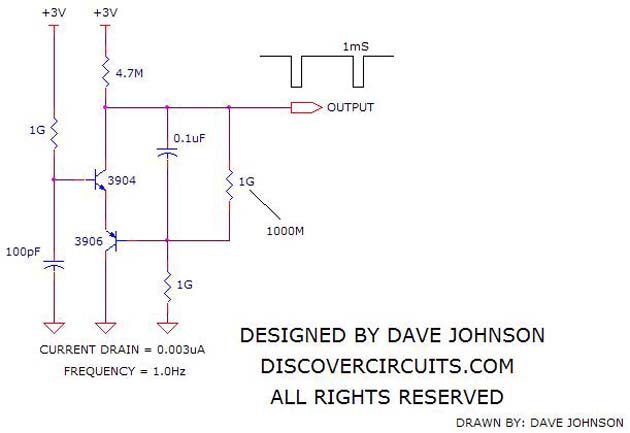
Ultra Low Current Oscillator
The circuit operates as a unijunction transistor relaxation oscillator. The base of the lower PNP transistor is biased at approximately half of the supply voltage. As the 100pF capacitor charges through the 1GΩ resistor, the base of the upper NPN...

Touch on-off switch
A touch on/off switch circuit is designed using two interconnected sensitive gate SCRs. When one SCR is activated, it forces the other SCR to turn off, creating a toggling effect that allows for an on/off condition for each of the...
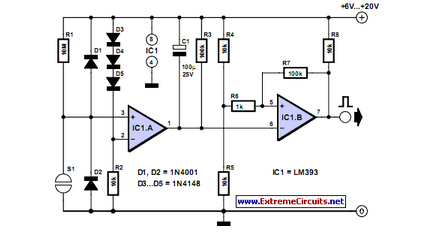
Electronic Touch Switch
Mechanical contacts have the disadvantage that they wear out. That is why it is practical to use an electronic touch switch in some situations.
The electronic touch switch serves as an effective alternative to mechanical contacts, addressing the issue of wear...

A touch-AC electronic switching circuit
Diagram 2 depicts a shake tube circuit with a capacitance (C) and a trigger voltage rectifier filter element. The circuit includes a trigger voltage transistor amplifier (H), three pull tubes (n, U, v), and utilizes a thyristor as a BCR...