


op amp IR Demodulator Design
#op-amp
#IR demodulator
#32.678 kHz
#signal detection
#LTspice
#infrared
#modulation
#demodulation
#circuit design
#simulation

Description: Designing an infrared (IR) demodulator circuit to replace the one shown in this question. The goal is to demodulate a simple IR signal modulated at 32.678 kHz, with the requirement of detecting the presence of the signal without packet decoding. Previous attempts to simulate this circuit in LTspice have not been successful, raising concerns about potential errors in the simulation or the circuit design. The circuit components include resistors R1 (2.49 kΩ), R2 (1 MΩ), R3 (1 MΩ), capacitors C1 (470 pF), C2 (220 pF), and C3 (220 pF). The voltage sources are V1 (2 V), V2 (5 V), and a pulse generator with specific timing parameters. The operational amplifier used is the LT1722, and the overall gain of the circuit is calculated to be approximately 400, necessitating a gain-bandwidth product (GBWP) of 14 MHz or higher for the chosen op-amp.
The circuit design for the IR demodulator focuses on detecting the presence of an IR signal modulated at a frequency of 32.678 kHz. The primary components include a series of resistors and capacitors that form a filtering and amplification stage, allowing for effective signal processing. The resistors R1, R2, and R3 are configured to set the gain and input impedance of the circuit, while capacitors C1, C2, and C3 serve to filter high-frequency noise and stabilize the signal.
The voltage sources, V1 and V2, provide the necessary biasing for the circuit, ensuring that the operational amplifier operates within its linear region. The pulse generator simulates the incoming modulated IR signal, which is critical for testing the circuit's response to actual IR signals.
The choice of the LT1722 operational amplifier is significant due to its high speed and low noise characteristics, which are essential for accurately demodulating the IR signal. The calculated gain of approximately 400 indicates that the circuit is designed to amplify weak IR signals to a detectable level. However, to maintain fidelity in the signal processing, the operational amplifier must have a GBWP of at least 14 MHz, which is essential for handling the 32.678 kHz modulation frequency effectively.
In summary, the IR demodulator circuit is designed with specific components and configurations to achieve reliable detection of IR signals. Proper selection of the operational amplifier and careful consideration of circuit parameters are crucial for successful operation. Further testing and refinement may be necessary to ensure the circuit functions as intended, particularly in the context of LTspice simulations and real-world applications.Designing an IR demodulator circuit to replace the one shown in this question. Basically I want to demodulate a simple IR signal modulated at 32. 678 kHz. I just need to know if the signal is present. No packets. Just IR present or not present. I have tried simulating this in LTspice with no success so I am not sure if I`ve done something ver y wrong in spice or in my circuit. I am no pro with LTspice. R1 N001 N006 2. 49K tol=1 pwr=0. 1 R2 Output N003 1Meg R3 N006 N005 1Meg C1 N005 N004 470pF C2 N003 N001 220pF C3 Output N001 220pF V1 N006 0 2. 5 V2 N002 0 5 V3 N004 0 PULSE(0. 05 0 0 0 0. 0000152587890625 0. 000030517578125 200) XU1 N005 N003 N002 0 Output LT1722. tran 12ms. lib LTC. lib. backanno. end The overall gain of the circuit is approximately 400 by my calculations. So, in choosing my op amp I would need a GBWP of 14 MHz or greater Any other critical op amp specifications for this application Note the amp showed is just a place holder until I choose the op amp.
The circuit design for the IR demodulator focuses on detecting the presence of an IR signal modulated at a frequency of 32.678 kHz. The primary components include a series of resistors and capacitors that form a filtering and amplification stage, allowing for effective signal processing. The resistors R1, R2, and R3 are configured to set the gain and input impedance of the circuit, while capacitors C1, C2, and C3 serve to filter high-frequency noise and stabilize the signal.
The voltage sources, V1 and V2, provide the necessary biasing for the circuit, ensuring that the operational amplifier operates within its linear region. The pulse generator simulates the incoming modulated IR signal, which is critical for testing the circuit's response to actual IR signals.
The choice of the LT1722 operational amplifier is significant due to its high speed and low noise characteristics, which are essential for accurately demodulating the IR signal. The calculated gain of approximately 400 indicates that the circuit is designed to amplify weak IR signals to a detectable level. However, to maintain fidelity in the signal processing, the operational amplifier must have a GBWP of at least 14 MHz, which is essential for handling the 32.678 kHz modulation frequency effectively.
In summary, the IR demodulator circuit is designed with specific components and configurations to achieve reliable detection of IR signals. Proper selection of the operational amplifier and careful consideration of circuit parameters are crucial for successful operation. Further testing and refinement may be necessary to ensure the circuit functions as intended, particularly in the context of LTspice simulations and real-world applications.Designing an IR demodulator circuit to replace the one shown in this question. Basically I want to demodulate a simple IR signal modulated at 32. 678 kHz. I just need to know if the signal is present. No packets. Just IR present or not present. I have tried simulating this in LTspice with no success so I am not sure if I`ve done something ver y wrong in spice or in my circuit. I am no pro with LTspice. R1 N001 N006 2. 49K tol=1 pwr=0. 1 R2 Output N003 1Meg R3 N006 N005 1Meg C1 N005 N004 470pF C2 N003 N001 220pF C3 Output N001 220pF V1 N006 0 2. 5 V2 N002 0 5 V3 N004 0 PULSE(0. 05 0 0 0 0. 0000152587890625 0. 000030517578125 200) XU1 N005 N003 N002 0 Output LT1722. tran 12ms. lib LTC. lib. backanno. end The overall gain of the circuit is approximately 400 by my calculations. So, in choosing my op amp I would need a GBWP of 14 MHz or greater Any other critical op amp specifications for this application Note the amp showed is just a place holder until I choose the op amp.

Bathroom automatic hand dryer circuit
Bathroom automatic hand dryer circuit. The circuit features an LED and a photosensitive transistor (VT) that together form an infrared opto coupler, serving as a signal sensing mechanism. The control element is a 1WH8778 switch integrated circuit. When hands are...

Single Capacitor Powers Audio Mixer
Micropower and low-voltage operational amplifiers enable the construction of high-performance analog signal processors that do not require batteries or wall transformers. Instead, a capacitor can serve as the power source. The circuit illustrated in Figure 1 depicts an analog mixer...

wireless on off switch
Home appliances are typically controlled using switches, sensors, and similar devices. However, physical interaction with switches can pose risks, particularly in the event of short circuits. The circuit presented here eliminates the need for physical contact to operate the appliance....

Infrared alarm barrier circuit
This infrared alarm barrier is designed to detect individuals passing through doorways, corridors, and small gates. The transmitter emits a beam of infrared light that remains invisible to the human eye. When a person interrupts the light beam, the buzzer...

Check For Op-Amp Dc Offset Shift Circuit
The DC values of op-amp offsets cannot always be assumed to remain constant when delivering AC outputs. No device is perfectly symmetrical in terms of maximum positive slew rate compared to maximum negative slew rate. As a result, there exists...
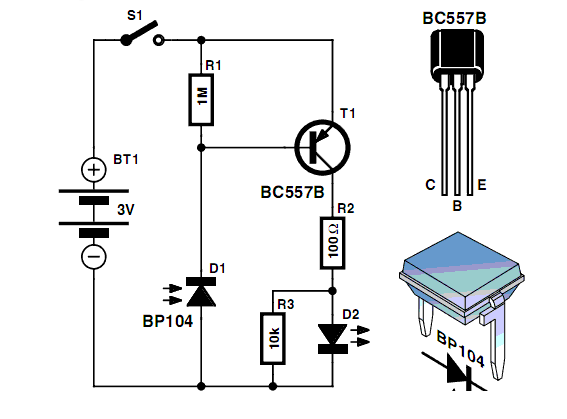
IR (Infrared) DetectorCircuit
Men, in particular, appreciate the convenience of television remote controls, which can often lead to frustration for their female partners. Men seem to have a desire to understand what...
The initial statement highlights a common dynamic in household technology usage, specifically...

Basic IR Detector/Emitter
This is a very basic infrared detector/emitter circuit. One major downside of this circuit, is that ambient infrared light will interfere with its detecting obstacles.
The described circuit functions as a basic infrared (IR) detector and emitter system, commonly utilized in...

3 Band Graphic Equalizer
This simple equalizer utilizes a single operational amplifier (op-amp) and provides three frequency ranges: low frequency, mid frequency, and high frequency. With the specified component values, it achieves approximately ±20 dB of gain or attenuation at frequencies of 50 Hz,...

Programmable Inverter/Rectifier
The operational amplifier (op amp) can function as either an inverter or a buffer, depending on the polarity controlled by a switch. When configured as a buffer, the gain remains constant at 1. In contrast, when functioning as an inverter,...