


Programmable-amplifier
#programmable amplifier
#variable gain
#CMOS analog switches
#feedback loop
#op-amp
#gain stage
#bias currents
#switch resistance

Description: A circuit may often be required to perform multiple functions. In these cases, the variable gain configuration of the circuit can be particularly advantageous. This programmable gain stage utilizes CMOS analog switches to modify the feedback amount, thereby adjusting the stage's gain. The positioning of the switching elements within the relatively low-current region of the feedback loop minimizes the impact of bias currents and switch resistance on the calculated gain of the stage. Voltage spikes can occur during the switching process, leading to a temporary reduction in gain due to the make-before-break operation of the switches. This gain reduction can be mitigated by implementing a separate voltage divider network for each gain level.
The described circuit operates as a programmable gain amplifier (PGA), which is essential in applications requiring adaptable signal amplification. The use of CMOS analog switches allows for precise control over the feedback network, enabling the gain to be dynamically adjusted based on the input signal or system requirements.
In this configuration, the feedback loop is crucial for maintaining stability and linearity of the gain. By placing the analog switches in a low-current section of the feedback loop, the circuit effectively reduces interference from bias currents, which can otherwise skew the gain calculations. This design choice enhances the performance of the amplifier in precision applications, such as instrumentation or audio processing.
The make-before-break switching mechanism is a key feature that facilitates seamless transitions between different gain settings. However, it can introduce voltage spikes, which may temporarily affect the gain. To counteract this issue, each gain setting is supported by a dedicated voltage divider network. This network helps to stabilize the output voltage during transitions and ensures that the gain remains consistent across different operating conditions.
By employing this sophisticated approach, the circuit achieves a high degree of versatility and reliability, making it suitable for a wide range of electronic applications where adjustable gain is necessary.Often a circuit will be called upon to perform several functions. In these situations, the variable gain configuration of this circuit could be quite useful. This programmable gain stage depends on CMOS analog switches to alter the amount of feedback, and thereby, the gain of the stage. Placement of the switching elements inside the relatively lowcurrent area of the feedback loop, minimizes the effects of bias currents and switch resistance on the calculated gain of the stage.
Voltage spikes can occur during the switching process, resulting in temporarily reduced gain because of the makebefore- break operation of the switches. This gain loss can be minimized by providing a separate voltage divider network for each level of gain.
The described circuit operates as a programmable gain amplifier (PGA), which is essential in applications requiring adaptable signal amplification. The use of CMOS analog switches allows for precise control over the feedback network, enabling the gain to be dynamically adjusted based on the input signal or system requirements.
In this configuration, the feedback loop is crucial for maintaining stability and linearity of the gain. By placing the analog switches in a low-current section of the feedback loop, the circuit effectively reduces interference from bias currents, which can otherwise skew the gain calculations. This design choice enhances the performance of the amplifier in precision applications, such as instrumentation or audio processing.
The make-before-break switching mechanism is a key feature that facilitates seamless transitions between different gain settings. However, it can introduce voltage spikes, which may temporarily affect the gain. To counteract this issue, each gain setting is supported by a dedicated voltage divider network. This network helps to stabilize the output voltage during transitions and ensures that the gain remains consistent across different operating conditions.
By employing this sophisticated approach, the circuit achieves a high degree of versatility and reliability, making it suitable for a wide range of electronic applications where adjustable gain is necessary.Often a circuit will be called upon to perform several functions. In these situations, the variable gain configuration of this circuit could be quite useful. This programmable gain stage depends on CMOS analog switches to alter the amount of feedback, and thereby, the gain of the stage. Placement of the switching elements inside the relatively lowcurrent area of the feedback loop, minimizes the effects of bias currents and switch resistance on the calculated gain of the stage.
Voltage spikes can occur during the switching process, resulting in temporarily reduced gain because of the makebefore- break operation of the switches. This gain loss can be minimized by providing a separate voltage divider network for each level of gain.

Auto battery current analyzer
This operational amplifier (op-amp) analyzer is designed to measure the current drawn by any device in a vehicle. It operates by detecting the minute voltage that develops across the battery cables when current flows.
To calibrate the unit, the current flow...

Phantom Wah for guitarists
This is an op-amp implementation of a Vox style wah, with the inductor replaced by a gyrator circuit. With the component values given the frequency response is similar to a standard wah. By replacing one of the resistors with a...

Amplifying DC Diode Detector Output
The small DC voltages at the output of the diode detector are challenging to amplify accurately due to DC offsets introduced by any operational amplifier (op-amp) and low-frequency noise (1/f noise). A solution to these issues is to chop the...

Op-Amp Circuit: Difference Amplifier
This circuit is a difference amplifier. It functions as an inverting amplifier that enables the subtraction of two voltages, effectively performing a summation.
The difference amplifier is a fundamental circuit configuration in analog electronics, primarily used for amplifying the difference between...
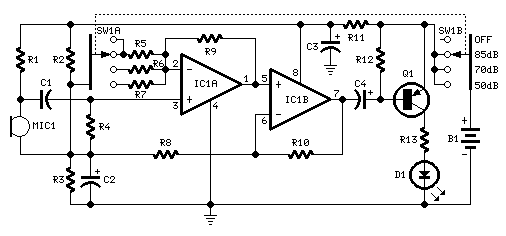
Room Noise Detector Schematic Circuit
This circuit is designed to signal the exceeding of a fixed threshold in room noise through a flashing LED. Three fixed levels are selectable: 50, 70, and 85 dB. Two operational amplifiers provide the necessary gain for sounds captured by...

Basic current to voltage converter
This basic circuit feeds the input current directly into the summing node (pin 2), causing the op-amp output to adjust and extract the same current from the summing node through resistor R1. The scale factor of the circuit is defined...

Safe-opamp-circuit
In intrinsically safe applications, it is sometimes necessary to separate sections of circuitry using resistors that limit current under fault conditions. The circuit presented offers an accurate analog output with effectively zero output impedance, despite the presence of resistors in...

The Universal Linear Component
Operational amplifiers are the simplest and most effective means of executing a variety of linear functions, ranging from basic amplification to intricate analog computations.
Operational amplifiers (op-amps) are versatile components widely utilized in electronic circuits for various applications. These devices can...
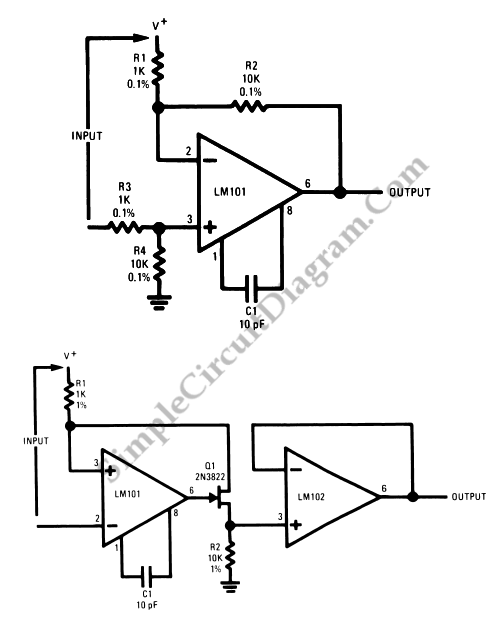
Op-Amp Application: Level Shifting Amplifier
In linear equipment design, it is sometimes necessary to take a voltage that is referenced to a certain DC level and generate an amplified output that is also referenced.
In linear circuit design, the process of amplifying a voltage that is...