


Programmable Capacitance Multiplier with DAC
#capacitance multiplier
#DAC
#analog signal processing
#signal conditioning
#operational amplifier
#filter
#simulation
#electronics
#circuit design
#analog circuits
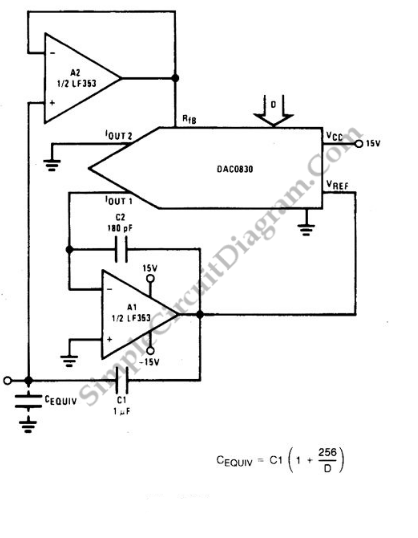
Description: A capacitance multiplier simulates a high-capacitance capacitor for analog signal processing. By utilizing a Digital-to-Analog Converter (DAC), it is possible to emulate...
A capacitance multiplier is a circuit configuration that effectively increases the apparent capacitance seen at its output compared to the actual capacitance connected to its input. This technique is particularly useful in analog signal processing applications where large capacitance values are required but physical capacitors may be impractical due to size, cost, or availability constraints.
The basic operation of a capacitance multiplier involves an operational amplifier (op-amp), a resistor, and a capacitor. The op-amp is configured in a feedback arrangement that allows it to control the voltage across the capacitor, thereby simulating a larger capacitance. The input signal is applied to the non-inverting terminal of the op-amp, while the feedback loop includes the resistor and capacitor, which together define the time constant of the circuit.
When a DAC is integrated into this design, it allows for dynamic control of the capacitance multiplier's effective capacitance. The DAC converts digital signals into analog voltages, which can then be used to adjust the feedback in real-time. This capability enables precise tuning and adaptation of the circuit to varying signal conditions, enhancing performance in applications such as audio processing, filtering, and signal conditioning.
In summary, the capacitance multiplier with a DAC provides a versatile solution for simulating high capacitance in analog circuits, allowing for improved functionality and flexibility in electronic designs.Capacitance multiplier simulate high capacitance capacitor for analog signal signal processing. By using DAC (Digital-to-Analog Converter), we can simulate..
A capacitance multiplier is a circuit configuration that effectively increases the apparent capacitance seen at its output compared to the actual capacitance connected to its input. This technique is particularly useful in analog signal processing applications where large capacitance values are required but physical capacitors may be impractical due to size, cost, or availability constraints.
The basic operation of a capacitance multiplier involves an operational amplifier (op-amp), a resistor, and a capacitor. The op-amp is configured in a feedback arrangement that allows it to control the voltage across the capacitor, thereby simulating a larger capacitance. The input signal is applied to the non-inverting terminal of the op-amp, while the feedback loop includes the resistor and capacitor, which together define the time constant of the circuit.
When a DAC is integrated into this design, it allows for dynamic control of the capacitance multiplier's effective capacitance. The DAC converts digital signals into analog voltages, which can then be used to adjust the feedback in real-time. This capability enables precise tuning and adaptation of the circuit to varying signal conditions, enhancing performance in applications such as audio processing, filtering, and signal conditioning.
In summary, the capacitance multiplier with a DAC provides a versatile solution for simulating high capacitance in analog circuits, allowing for improved functionality and flexibility in electronic designs.Capacitance multiplier simulate high capacitance capacitor for analog signal signal processing. By using DAC (Digital-to-Analog Converter), we can simulate..

First-order butterworth active Low-pass filter circuit
A Butterworth filter is a type of filter characterized by a frequency response that is flat within the passband region. This filter was first described by British engineer Stephen Butterworth.
A Butterworth filter is designed to provide a maximally flat frequency...

10x TDA1543 NOS DAC
In the supply section, a bridge rectifier and smoothing capacitor are utilized, followed by a common voltage regulator, the LM317, which is configured with resistors R1 and R2 to output approximately 8V. The supply line passes through an inductor to...

TNT1541 diy zero-oversampling dac
The TNT Convertus is a notable design that has gained significant attention as one of the first DIY DAC projects published in Italy. Although several modifications have been made to the original Convertus design, time constraints have prevented further testing...

RC Low-Pass passive Filter
What is the purpose of this circuit? Basically it has two roles: to pass the desired low frequency signals and stop the unwanted high frequency signals. Open the netlist file lpfilter1.cir with your SPICE simulator. Most simulators display the netlist...

TA-1500 fever amplifier circuit
Only the R channel is shown, with the original reference PCB label. Figure (a) illustrates the front tone circuit, which consists of a common negative feedback operational amplifier in an RC circuit configuration. The microphone signal is amplified by VTz,...

Averager and Peak Hold/Extender Signal Conditioner
A signal averager circuit can be formed by an amplifier and active signal rectifier, which is implemented using two operational amplifiers in this circuit.
The signal averager circuit utilizes two operational amplifiers (op-amps) to achieve signal averaging through amplification and rectification....

ROTARY SWITCH DEBOUNCE
A three-stage active Butterworth bandpass input filter is utilized in a radioteletype demodulator to differentiate RTTY tones from one another and from noise. The filter is centered at 2200 Hz and has a bandwidth of approximately 260 Hz, allowing for...

Long Interval RC Timer Using Op-Amp
By utilizing a high-gain, high-impedance operational amplifier, it is possible to construct a long time delay circuit using a resistor-capacitor (RC) configuration, as it allows for high...
An operational amplifier (op-amp) is a versatile component widely used in electronic circuits, particularly...

A Simple Capacitance Multiplier Power Supply For Class-A Amplifiers
Since I have provided the schematic for John L Linsley-Hood's Class-A amplifier, I felt that some readers may wish to experiment with the concept. Unfortunately, a very low ripple power supply is needed for all Class-A amps, and the most...