


Thermocouple amplifier gain circuit
#OP07
#thermocouple
#low drift
#low noise
#amplifier
#signal conditioning
#precision
#analog
#sensor interface
#instrumentation

Description: The OP07 is a low drift operational amplifier with a maximum voltage drift of 30 µV/°C and a maximum drift of 0.6 mV/V/°C. It features low noise characteristics with a maximum noise level of 0.6 pV/√Hz, offering ultra-stability with a maximum drift of 0.6 µV/°C over months. The amplifier operates within a wide supply voltage range of ±3V to ±18V. The OP27 and OP07 share similar parameters, as detailed in the accompanying table. Their pin functions are illustrated in Figure LO-1, with the application circuit depicted in the referenced figure. When resistors R3 and R4 are equal, and R1 equals R2, the OP07 can be configured as a differential instrumentation amplifier, with the amplifier gain determined by the ratio of R3 to R1. Figures 10-2 and 10-3 present two configurations of a standard operational amplifier circuit, which retains a structure similar to general operational amplifier designs. This circuit is capable of amplifying the input signal from a sensor and converting it into a 4 to 20 mA current output. The operational amplifier, along with a reference voltage source and output transistors, facilitates this conversion. The input voltage is processed through the operational amplifier, with the V driven by the sampling resistor R6 and the load resistance R1. The relationship between the output current and input voltage is given by the equation I_out = (V_IN * R_s / R_z + 5 * R_s / R_1) / R6, with the specific output current equation being I_out = (16 * V_IN / 100) + 4.0 mA.
The OP07 operational amplifier is designed for precision applications requiring minimal drift and noise, making it suitable for instrumentation and industrial sensor applications. Its low voltage drift and noise specifications ensure that the output remains stable over temperature variations and extended periods, which is critical in environments where accuracy is paramount.
In the differential instrumentation amplifier configuration, the resistors R3 and R1 play a vital role in setting the gain of the amplifier, allowing for fine-tuning of the output based on the specific application requirements. The ability to convert voltage signals into a standard current output (4-20 mA) is particularly beneficial in industrial settings where current loops are commonly used for signal transmission over long distances, minimizing the effects of noise and interference.
The circuit's performance can be further enhanced by selecting precision resistors for R1, R2, R3, and R4, which will help maintain the desired gain accuracy and linearity. Additionally, the choice of the reference voltage source is crucial for ensuring that the output current is consistently within the desired range, particularly under varying load conditions.
Overall, the OP07 operational amplifier, with its low drift, low noise, and flexible configuration options, serves as a robust solution for high-performance analog signal processing tasks in various electronic applications.OP07 low drift (maximum voltage drift 30 FLV, maximum drift 0.6vV / aC), low noise (maximum 0.6 pLVp.P), ultra-stability (maximum 0.6yV / qC. Months), wide supply voltage range (t3 ~ + 18V), high-performance operational amplifiers. OP27 and OP07 closer parameters (see table). Their pin functions shown in Figure LO-l, the application circuit as shown in FIG. When R3: R4, Ri = R2 when, OP07 constitute a differential instrumentation amplifier, the amplifier gain is determined by R3 / RI. Figure 10-2, Figure 10-3 are two cases of common operation amplifier circuit, the circuit configuration of the operational amplifier and the general structure of the same.
The circuit can be amplified input signal of the sensor is converted to 4 ~ 20mA current output circuit mainly by the operational amplifier, a reference voltage source, the output tubes. Input voltage through the operational amplifier, V driven by the sampling resistor R6 , the load resistance Ri.
In the form of a current output. Output current and input voltage relationship between the / ou-r = (VIN Rs / Rz + 5Rs / R,) / R6 according to the figure parameter / ourr = (16VlN / JOO) + 4.O (mA)
The OP07 operational amplifier is designed for precision applications requiring minimal drift and noise, making it suitable for instrumentation and industrial sensor applications. Its low voltage drift and noise specifications ensure that the output remains stable over temperature variations and extended periods, which is critical in environments where accuracy is paramount.
In the differential instrumentation amplifier configuration, the resistors R3 and R1 play a vital role in setting the gain of the amplifier, allowing for fine-tuning of the output based on the specific application requirements. The ability to convert voltage signals into a standard current output (4-20 mA) is particularly beneficial in industrial settings where current loops are commonly used for signal transmission over long distances, minimizing the effects of noise and interference.
The circuit's performance can be further enhanced by selecting precision resistors for R1, R2, R3, and R4, which will help maintain the desired gain accuracy and linearity. Additionally, the choice of the reference voltage source is crucial for ensuring that the output current is consistently within the desired range, particularly under varying load conditions.
Overall, the OP07 operational amplifier, with its low drift, low noise, and flexible configuration options, serves as a robust solution for high-performance analog signal processing tasks in various electronic applications.OP07 low drift (maximum voltage drift 30 FLV, maximum drift 0.6vV / aC), low noise (maximum 0.6 pLVp.P), ultra-stability (maximum 0.6yV / qC. Months), wide supply voltage range (t3 ~ + 18V), high-performance operational amplifiers. OP27 and OP07 closer parameters (see table). Their pin functions shown in Figure LO-l, the application circuit as shown in FIG. When R3: R4, Ri = R2 when, OP07 constitute a differential instrumentation amplifier, the amplifier gain is determined by R3 / RI. Figure 10-2, Figure 10-3 are two cases of common operation amplifier circuit, the circuit configuration of the operational amplifier and the general structure of the same.
The circuit can be amplified input signal of the sensor is converted to 4 ~ 20mA current output circuit mainly by the operational amplifier, a reference voltage source, the output tubes. Input voltage through the operational amplifier, V driven by the sampling resistor R6 , the load resistance Ri.
In the form of a current output. Output current and input voltage relationship between the / ou-r = (VIN Rs / Rz + 5Rs / R,) / R6 according to the figure parameter / ourr = (16VlN / JOO) + 4.O (mA)

Precision-threshold-detector
This circuit requires low noise, stable offset voltages, high open-loop gain, and high speed. These requirements are fulfilled by the HA5147. Standard variations of this circuit can be easily implemented using the HA-5147. For instance, hysteresis can be introduced by...

Birds singing analog signal generator circuit
The circuit illustrated is an analog signal generator designed to produce a chirping sound, simulating birds singing. It employs six CD4069 inverters to create three oscillators, with two of them functioning as ultra-low frequency oscillators. The oscillation frequency is in...
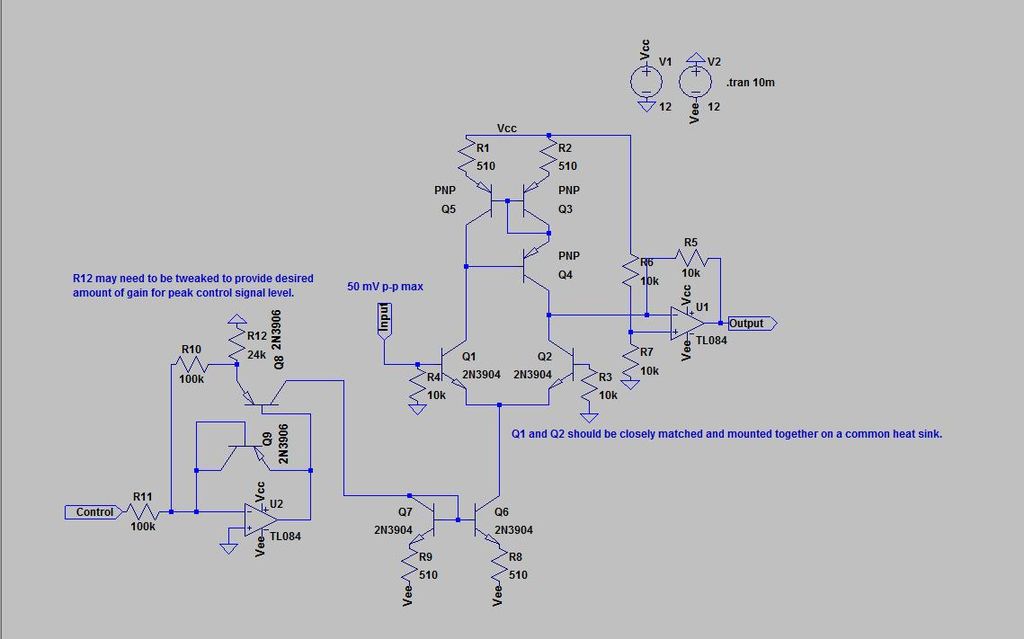
analog vocoder
This is the initial Instructable and the first attempt at a large electronics project. The circuit has been designed from scratch and is being made available.
The presented project involves the design of an electronic circuit that has been developed independently....

Thermocouple Amplifier circuit (CA3193)
The circuit requires a 15-volt power supply and employs a precision operational amplifier, CA3193 BiMOS, to amplify the generated signal by more than 500 times. Three 22-megohm resistors are utilized to ensure a large-scale output in the event of a...

Self Oscillating Amplifier for Distortion Testing
The circuit is based on a simple inductor-capacitor filter circuit, and needs only a pot and a small light bulb to set and stabilise the oscillation. The frequency is fixed, and with a good inductor should be capable of very...
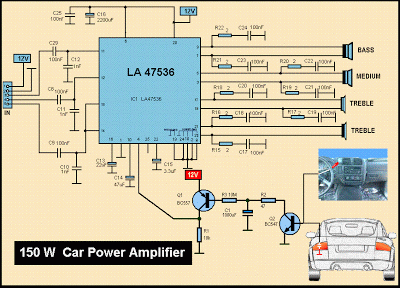
Schematic MP3 Car Audio Power AmplifierCircuits
This is a diagram of a car audio active loudspeaker utilizing the LF353 operational amplifier from National Semiconductor. For optimal performance, the NE5532 is recommended to split the audio signal into three frequency bands using an active filter. The SANYO...

ADT70 internal functional block diagram
The ADI I70 is a signal conditioning integrated circuit designed for RTD/PRTD applications, particularly suitable for 1K and 100Ω platinum RTDs (PRTDs). The ADT70 features an integrated instrumentation amplifier, an operational amplifier, a 2.5V reference power supply, and a matching...

Tv-audio-amplifier
The amplifier captures the audio output signal from the TV and amplifies it to drive a set of earphones for private listening. It is constructed using an LM324 quad operational amplifier and an LM386 low-power audio amplifier. The circuit employs...

Low Noise And Drift Composite Amp Circuit
This circuit combines the advantages of low input offset voltage and drift without compromising the overall dynamic performance of the system. When compared to a standalone FET input operational amplifier, the composite amplifier circuit demonstrates a 20-fold improvement in voltage...