


TL081 4 Order Filter Circuit
#TL081
#filter circuit
#high order filter
#low distortion
#cascaded sections
#OA IC
#signal processing
#active filter
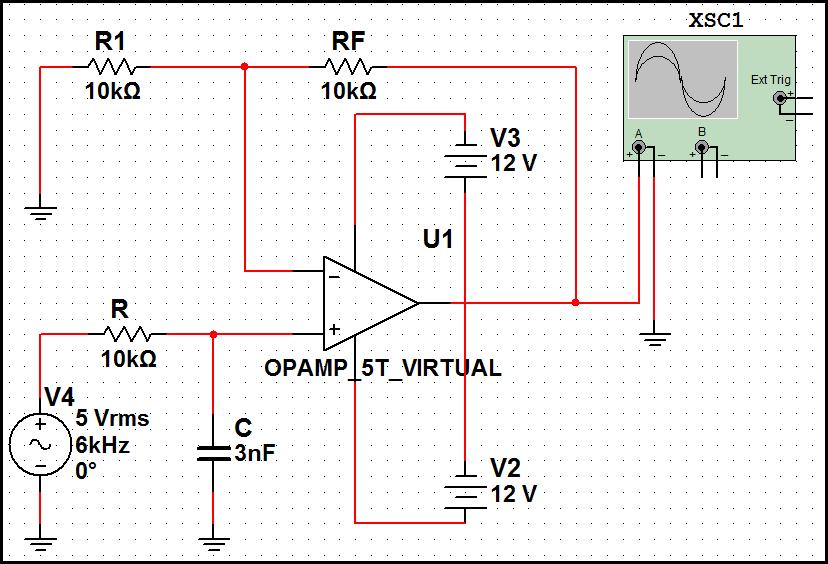
Description: High-order filters are typically designed with two or more cascaded sections. An order 4 filter requires only one operational amplifier integrated circuit (OA IC), allowing for lower distortion.
High-order filters are essential in various applications, including audio processing, signal conditioning, and communication systems. The design of an order 4 filter using a single operational amplifier (OA) IC can significantly reduce complexity and cost while maintaining performance.
In this configuration, the filter can be implemented using a Sallen-Key topology or a multiple feedback (MFB) structure. The Sallen-Key design is favored for its simplicity and ease of implementation. It consists of a resistor-capacitor (RC) network that determines the cutoff frequency and the quality factor (Q) of the filter.
To construct the order 4 filter, two cascaded second-order sections can be utilized. Each section comprises two resistors and two capacitors, with the OA IC serving as the active component. The transfer function of the filter can be expressed in terms of the component values, allowing for precise tuning of the filter characteristics.
The selection of component values is critical in achieving the desired filter response. Resistors and capacitors should be chosen to meet the specifications for cutoff frequency, gain, and phase response. Additionally, the operational amplifier must have sufficient bandwidth and low noise characteristics to ensure the integrity of the signal is preserved.
To achieve lower distortion, careful attention should be paid to the layout and grounding of the circuit. Proper decoupling of the power supply to the OA IC is also essential to minimize noise and ensure stable operation.
Overall, the design of a fourth-order filter using a single OA IC offers a practical solution for applications requiring high performance with reduced complexity.Filters with high orders are designed usually with 2 or more cascaded sections. This order 4 filter need only one OA IC , so we can achieve lower distorsio..
High-order filters are essential in various applications, including audio processing, signal conditioning, and communication systems. The design of an order 4 filter using a single operational amplifier (OA) IC can significantly reduce complexity and cost while maintaining performance.
In this configuration, the filter can be implemented using a Sallen-Key topology or a multiple feedback (MFB) structure. The Sallen-Key design is favored for its simplicity and ease of implementation. It consists of a resistor-capacitor (RC) network that determines the cutoff frequency and the quality factor (Q) of the filter.
To construct the order 4 filter, two cascaded second-order sections can be utilized. Each section comprises two resistors and two capacitors, with the OA IC serving as the active component. The transfer function of the filter can be expressed in terms of the component values, allowing for precise tuning of the filter characteristics.
The selection of component values is critical in achieving the desired filter response. Resistors and capacitors should be chosen to meet the specifications for cutoff frequency, gain, and phase response. Additionally, the operational amplifier must have sufficient bandwidth and low noise characteristics to ensure the integrity of the signal is preserved.
To achieve lower distortion, careful attention should be paid to the layout and grounding of the circuit. Proper decoupling of the power supply to the OA IC is also essential to minimize noise and ensure stable operation.
Overall, the design of a fourth-order filter using a single OA IC offers a practical solution for applications requiring high performance with reduced complexity.Filters with high orders are designed usually with 2 or more cascaded sections. This order 4 filter need only one OA IC , so we can achieve lower distorsio..

Scratch Filter
Designed to produce a 12-dB/octave roll-off above the 10-kHz cutoff frequency, this low-pass active filter will help reduce needle scratch on records. It utilizes an LM387 low-noise amplifier integrated circuit (IC).
The low-pass active filter described is engineered to attenuate high-frequency...

Low distortion oscillator
The 2N5485 JFET can oscillate in a circuit with very low harmonic distortion. This JFET local oscillator is ideal when low harmonic content is needed for an effective mixer circuit.
The 2N5485 is a Junction Field Effect Transistor (JFET) that is...

Digitally tuned low power active filter
This constant gain, constant Q, variable frequency filter provides simultaneous low-pass, bandpass, and high-pass outputs. With the specified component values, the center frequency will be 235 Hz for high logic inputs and 23.5 Hz for low logic inputs. The quality...

Filter Wiz PRO
Filter Wiz PRO active filter designer version 4 has just been released. Version 4 represents a major advance in the rapid design of stable and effective active filters. More: completely new interface - allows instant access to all completed phases...

Active bandpass filter
The circuit is a two-pole active filter utilizing a TL081 operational amplifier. This type of circuit is applicable only for quality factors (Qs) less than 10. The component values for this filter are determined using specific equations.
The two-pole active filter...

Low Distortion Oscillator
The 2N4416 JFET exhibits very low harmonic distortion, making it ideal for smooth oscillation in electronic circuits. It is particularly effective in applications where minimal harmonic content is essential for high-performance mixer circuits. Below is the circuit diagram of a...

4 microphones mixer circuit with TL081
A TL081 operational amplifier is utilized as a high impedance to low impedance converter and as a signal mixer. The input impedance is approximately 1 megohm, while the output impedance is around 1 kohm. The circuit is powered by two...

The frequency shift demodulator circuit composed of active filter
Replacing the LC modulation circuit with an active filter allows for the elimination of large and costly inductance coils in frequency shift key control demodulators. This approach not only reduces the size of the circuit but also enhances the performance...

Active band-reject filter
A filter with a band-reject characteristic is commonly known as a notch filter. A typical circuit employing a µ741 operational amplifier is shown in a unity-gain configuration for this type of active filter. The filter response curve illustrated represents a...