


1Mhz-voltage-to-frequency-converter
#voltage-to-frequency
#converter
#LTC1052
#charge feedback
#5V supply
#1MHz
#linearity
#temperature coefficient

Description: This stabilized voltage-to-frequency converter operates within a range of 1 Hz to 1.25 MHz, featuring a linearity of 0.05% and a typical temperature coefficient of 20 ppm/°C. The circuit is powered by a single 5-V supply. It employs a charge feedback scheme that enables the LTC1052 to close a loop around the entire circuit, rather than merely controlling the offset. This method improves linearity and stability; however, it also incorporates the settling time of the loop into the overall voltage-to-frequency step-response characteristic.
The voltage-to-frequency converter is an essential component in various applications where precise frequency generation from a voltage input is required. The operational range of 1 Hz to 1.25 MHz makes it suitable for both low-frequency and high-frequency applications. The specified linearity of 0.05% indicates that the output frequency will closely follow the input voltage, ensuring accuracy in applications such as signal processing and data conversion.
The single 5-V supply simplifies the power requirements, making the circuit easier to integrate into battery-powered or low-power systems. The use of the LTC1052 operational amplifier in a charge feedback configuration is critical for achieving the desired performance metrics. By closing the feedback loop around the entire circuit, the design minimizes errors associated with offset voltages and enhances the overall stability of the output frequency.
The temperature coefficient of 20 ppm/°C indicates that the frequency output will vary minimally with temperature changes, which is vital for applications requiring consistent performance across varying environmental conditions. However, it is important to note that the inclusion of the loop's settling time can affect the speed of the response to changes in the input voltage. This characteristic must be considered in the design and application of the converter, especially in systems that demand rapid frequency changes or high-speed operation.
Overall, this stabilized voltage-to-frequency converter design represents a robust solution for applications demanding high precision and reliability in frequency generation from voltage inputs.This stabilized voltage-to-frequency converter features 1 Hz -1.25 MHz operation, 0.05% linearity, and a temperature coefficient of typically 20 ppm/°C. This circuit runs from a single 5-V supply. The converter uses a charge feedback scheme to allow the LTC1052 to close a loop around the entire circuit, instead of simply controlling the offset.
This approach enhances linearity and stability, but introduces the loop"s settling time into the overall voltage-to-frequency step-response characteristic.
The voltage-to-frequency converter is an essential component in various applications where precise frequency generation from a voltage input is required. The operational range of 1 Hz to 1.25 MHz makes it suitable for both low-frequency and high-frequency applications. The specified linearity of 0.05% indicates that the output frequency will closely follow the input voltage, ensuring accuracy in applications such as signal processing and data conversion.
The single 5-V supply simplifies the power requirements, making the circuit easier to integrate into battery-powered or low-power systems. The use of the LTC1052 operational amplifier in a charge feedback configuration is critical for achieving the desired performance metrics. By closing the feedback loop around the entire circuit, the design minimizes errors associated with offset voltages and enhances the overall stability of the output frequency.
The temperature coefficient of 20 ppm/°C indicates that the frequency output will vary minimally with temperature changes, which is vital for applications requiring consistent performance across varying environmental conditions. However, it is important to note that the inclusion of the loop's settling time can affect the speed of the response to changes in the input voltage. This characteristic must be considered in the design and application of the converter, especially in systems that demand rapid frequency changes or high-speed operation.
Overall, this stabilized voltage-to-frequency converter design represents a robust solution for applications demanding high precision and reliability in frequency generation from voltage inputs.This stabilized voltage-to-frequency converter features 1 Hz -1.25 MHz operation, 0.05% linearity, and a temperature coefficient of typically 20 ppm/°C. This circuit runs from a single 5-V supply. The converter uses a charge feedback scheme to allow the LTC1052 to close a loop around the entire circuit, instead of simply controlling the offset.
This approach enhances linearity and stability, but introduces the loop"s settling time into the overall voltage-to-frequency step-response characteristic.

Low Cost Monolithic Voltage-to-Frequency Converter
The AD7740 is the smallest and most affordable 12-bit Voltage-to-Frequency Converter (VFC) available. As a synchronous converter, its output frequency is tied to a fixed master clock frequency, which enhances temperature stability compared to asynchronous VFCs. With a 1 MHz...

1MHz PIERCE OSCILLATORS
A simple network design is a key feature of the Pierce circuit, as illustrated by these 1-MHz oscillators. Operating the crystal slightly above resonance requires only one high-gain transistor stage. Operating it exactly at series resonance requires an additional RC...

Voltage-to-frequency-converter
This circuit can accept positive, negative, or differential control voltages. The output frequency is zero when the control voltage is zero. The 741 operational amplifier forms a current source controlled by the voltage Ec to charge the timing capacitor C1...
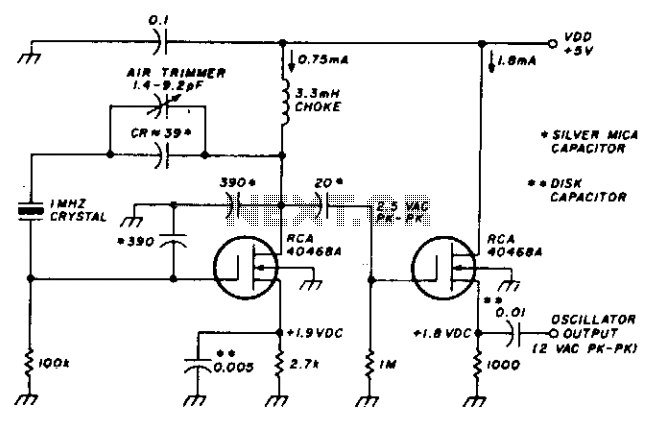
1Mhz fet crystal oscillator
This stable oscillator circuit exhibits less than a 1 Hz frequency change over a VDD range of 3 to 9 volts. Stability is attributed to the use of MOSFET devices and stable capacitors.
The described oscillator circuit is designed to maintain...

Simple Low-Frequency V/F Converter
In this circuit, capacitor CI is charged to a fixed reference level and then discharged. The integrator IC1 charges CI until IC1 has a -6.2 V output, at which point comparator IC2 outputs a low signal. FET Q1 triggers one...

Precision voltage-to-frequency converter
This circuit utilizes a conventional operational amplifier in conjunction with a feedback capacitor (CF) to perform integration. When the output of the integrator exceeds the nominal threshold level at pin 6 of the LM131, it triggers the timing cycle. The...

Wide-range-voltage-to-frequency-converter
This circuit operates based on the frequency variation of the function generator in relation to the input voltage (ViN). The frequency is influenced by the capacitance and resistor connected to pin 6, with the resistor being substituted by a Field...
1MHz PIERCE OSCILLATORS
A simple network design is a key feature of the Pierce circuit, as illustrated by these 1-MHz oscillators. Operating the crystal slightly above resonance requires only one high-gain transistor stage. Operating it exactly at series resonance requires an additional RC...

Voltage-To-Frequency Converter Ii
This voltage-to-frequency converter (VFC) accepts bipolar AC inputs. For -10 to +10 V inputs, the converter produces a proportional 0 to 10 kHz output. Linearity is 0.04%, and the temperature coefficient (TC) is approximately 50 ppm/°C. To understand the circuit,...