


A High Power Planar Triode Oscillator Designed by Using FEM Modeling

Description: COMSOL's integration of SPICE® elements into its finite element method (FEM) allows for direct modeling of oscillators. In this approach, the triode and load are described using FEM, while all other circuit components are simulated with SPICE®. This modeling does not simply apply any module; it requires prior computation of the beam's conductivity through the partial differential equation (PDE) interface. This paper serves as a benchmark, demonstrating the impact of triode geometry on circuit performance, particularly in terms of frequency and efficiency, and their variations throughout the process. It offers users of high-power triodes and tetrodes the opportunity to tailor their designs to achieve optimal tube performance, including thermal considerations.
The integration of SPICE® elements into COMSOL's FEM framework facilitates a sophisticated approach to oscillator modeling. By enabling the triode and load to be represented through finite element analysis, the simulation can capture complex physical phenomena that influence circuit behavior. The SPICE® components, on the other hand, allow for the simulation of a wide range of circuit elements, enhancing the overall accuracy of the model.
The requirement for prior computation of beam conductivity through the PDE interface indicates a focus on the dynamic interactions within the circuit, particularly in high-frequency applications where the behavior of the beam can significantly affect performance metrics. The benchmark study presented in the paper highlights how variations in triode geometry—such as electrode spacing, shape, and material properties—can lead to significant differences in both frequency response and efficiency. This information is crucial for engineers and designers working with high-power tubes, as it provides insights into how design choices impact thermal performance and overall circuit functionality.
In conclusion, the combination of FEM and SPICE® in COMSOL presents a powerful tool for the design and analysis of high-frequency oscillators, allowing for detailed exploration of component interactions and performance optimization. This capability is essential for engineers aiming to develop high-power triodes and tetrodes that meet specific operational requirements while ensuring efficient thermal management.COMSOL, adding SPICE® elements into its FEM, gives the possibility of a direct modeling of oscillators: triode and load are FEM described while all the other components of the circuit are just simulated using SPICE ®. The modeling is not a straight application of any module but needs the previous computation of the conductivity of the beam throug
h the PDE interface. This paper is a bench mark showing the influence of the triode geometry on the performances of the circuit, mainly frequency and efficiency, and their evolution all along the process. It gives to the user of high power triodes/tetrodes the possibility to enter into their design in order to have a tube well matched to their needs, including on the thermal points.
The integration of SPICE® elements into COMSOL's FEM framework facilitates a sophisticated approach to oscillator modeling. By enabling the triode and load to be represented through finite element analysis, the simulation can capture complex physical phenomena that influence circuit behavior. The SPICE® components, on the other hand, allow for the simulation of a wide range of circuit elements, enhancing the overall accuracy of the model.
The requirement for prior computation of beam conductivity through the PDE interface indicates a focus on the dynamic interactions within the circuit, particularly in high-frequency applications where the behavior of the beam can significantly affect performance metrics. The benchmark study presented in the paper highlights how variations in triode geometry—such as electrode spacing, shape, and material properties—can lead to significant differences in both frequency response and efficiency. This information is crucial for engineers and designers working with high-power tubes, as it provides insights into how design choices impact thermal performance and overall circuit functionality.
In conclusion, the combination of FEM and SPICE® in COMSOL presents a powerful tool for the design and analysis of high-frequency oscillators, allowing for detailed exploration of component interactions and performance optimization. This capability is essential for engineers aiming to develop high-power triodes and tetrodes that meet specific operational requirements while ensuring efficient thermal management.COMSOL, adding SPICE® elements into its FEM, gives the possibility of a direct modeling of oscillators: triode and load are FEM described while all the other components of the circuit are just simulated using SPICE ®. The modeling is not a straight application of any module but needs the previous computation of the conductivity of the beam throug
h the PDE interface. This paper is a bench mark showing the influence of the triode geometry on the performances of the circuit, mainly frequency and efficiency, and their evolution all along the process. It gives to the user of high power triodes/tetrodes the possibility to enter into their design in order to have a tube well matched to their needs, including on the thermal points.
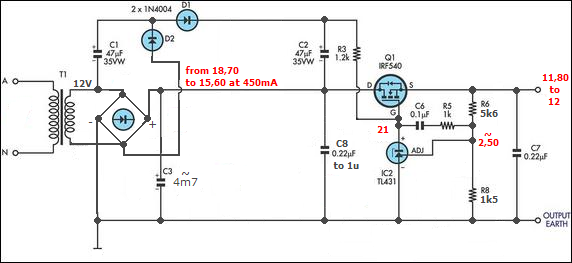
high power regulator
The half-linear design allows for reduced thermal considerations, as the linear regulator only needs to handle 1-5W instead of the full 75W per rail. MOSFETs operate in their linear region, just below the rated voltage for RDS(on), but they are...

3000 Watt Inverter
This is a high-power inverter circuit designed to deliver an AC power output of 3000W. It converts 12 Volt DC battery voltage into a square wave voltage with a frequency of 50 Hz and a duty cycle of 25%.
The inverter...
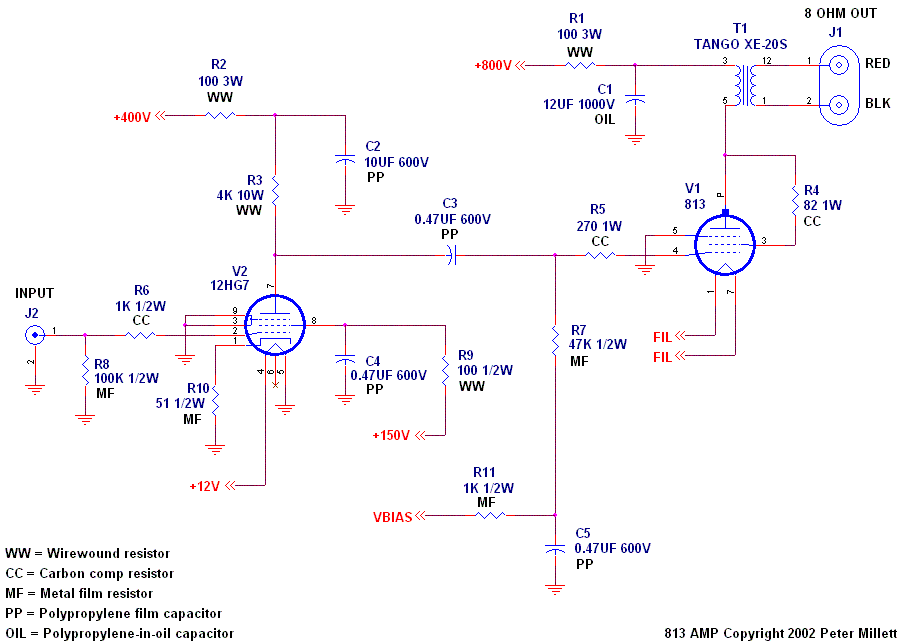
813 SE triode amps
This is a single-ended triode amplifier built using the 813 transmitting pentode, configured as a triode. It is a powerful single-ended amplifier that operates effectively. A single pentode, the 12HG7 video amplifier tube, serves as the driver, while a solid-state...

High power control for sensitive contacts
Two simple arrangements for resistive loads are shown in A and B. The circuit in A will provide load power when the actuating contact is closed, and no power when the contact is open. B provides the reverse of this...

high power amplifier 300w circuit
There is no substitute for sheer power—low-efficiency speakers, outdoor sound systems, or perhaps the full dynamic range of a high-power amplifier. Whatever the requirement, this super power module should meet the needs. The amplifier can be divided into three distinct...
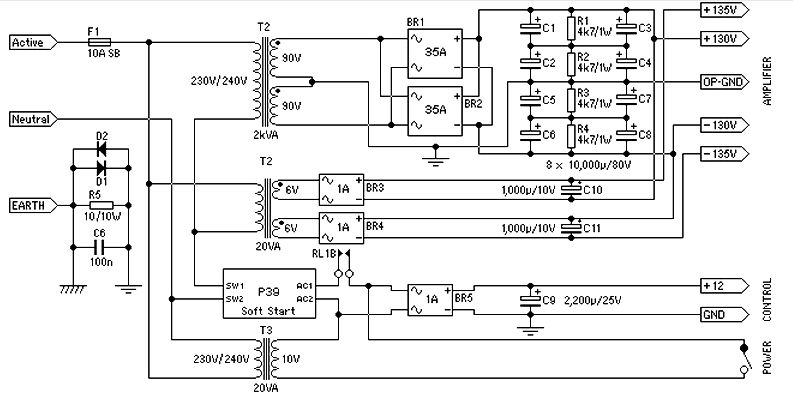
power supply for 1500 watt audio power amplifier
Power supply for a 1500-watt audio power amplifier. This power supply circuit is paired with a high-power audio amplifier rated at 1500 watts. A serious approach is required to design the power supply for the amplifier. First, a step-down transformer...

800W high power mosfet amplifier Schematic Diagram
This amplifier is suitable for various applications that demand high power, low noise, minimal distortion, and superior sound quality. Examples include subwoofer amplifiers, front-of-house (FOH) stage amplifiers, and individual channels of high-powered surround sound amplifiers. For a detailed explanation of...

2800w high power audio amplifier
The mono high power amplifier is rated at 1400 W. To create a stereo high power amplifier, which would require a total of 2800 W, the necessary components and PCB must be doubled. The schematic circuit diagram provided is incomplete....

Spice Component Circuit Modeling and Simulation
When designing an offline boost-mode switching power supply, the objective was to model the power transformer to simulate inrush current and other startup behaviors. After conducting research and engaging in discussions on platforms like Google Groups and DIYAudio, as well...