


Butler emitter follower oscillator
#Butler oscillator
#emitter follower
#series resonance
#RF oscillator
#high frequency
#circuit design
#parasitics free
#electronic oscillator
#resonant circuit
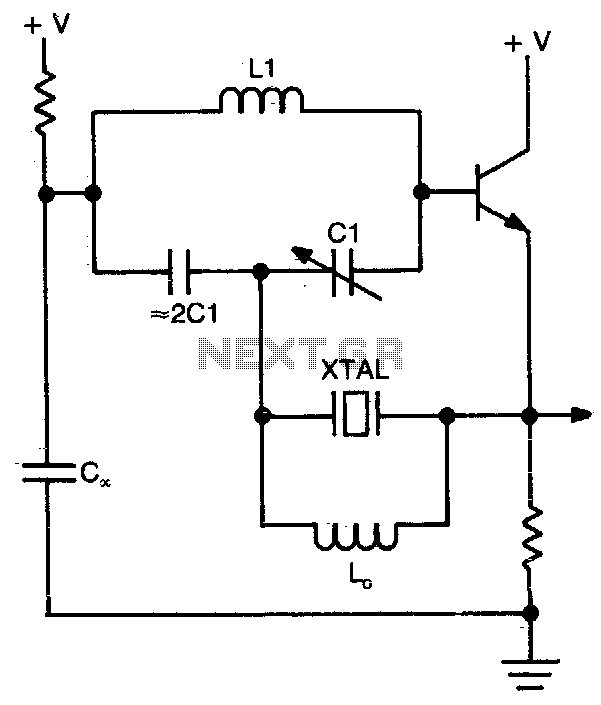
Description: This circuit operates at or near series resonance. It is a well-designed circuit with no parasitics. It is easy to tune and has good frequency stability.
The circuit in question utilizes series resonance to achieve optimal performance. At series resonance, the inductive and capacitive reactances are equal in magnitude but opposite in phase, resulting in a purely resistive impedance. This characteristic allows for maximum current flow through the circuit at the resonant frequency, making it highly efficient for applications such as RF signal processing and filtering.
The absence of parasitic elements is a significant advantage, as parasitics can introduce unwanted losses and distortions that degrade circuit performance. This circuit's design minimizes these effects, ensuring that the desired signal characteristics are preserved.
Tuning the circuit is facilitated by adjustable components, such as variable capacitors or inductors, which enable precise control over the resonant frequency. This feature is particularly beneficial in applications where frequency adjustments are necessary, such as in oscillators or tunable filters.
Moreover, the circuit exhibits good frequency stability, which is crucial for maintaining consistent performance over time and varying operating conditions. Stability is often enhanced through careful component selection and layout design, reducing susceptibility to temperature variations and other environmental factors.
Overall, this circuit design is suitable for a range of applications requiring reliable performance at or near resonance, combining ease of tuning with robust frequency stability.This circuit operates at or near series resonance. It is a good circuit design with no parasitics It is easy to tune with good frequency stability.
The circuit in question utilizes series resonance to achieve optimal performance. At series resonance, the inductive and capacitive reactances are equal in magnitude but opposite in phase, resulting in a purely resistive impedance. This characteristic allows for maximum current flow through the circuit at the resonant frequency, making it highly efficient for applications such as RF signal processing and filtering.
The absence of parasitic elements is a significant advantage, as parasitics can introduce unwanted losses and distortions that degrade circuit performance. This circuit's design minimizes these effects, ensuring that the desired signal characteristics are preserved.
Tuning the circuit is facilitated by adjustable components, such as variable capacitors or inductors, which enable precise control over the resonant frequency. This feature is particularly beneficial in applications where frequency adjustments are necessary, such as in oscillators or tunable filters.
Moreover, the circuit exhibits good frequency stability, which is crucial for maintaining consistent performance over time and varying operating conditions. Stability is often enhanced through careful component selection and layout design, reducing susceptibility to temperature variations and other environmental factors.
Overall, this circuit design is suitable for a range of applications requiring reliable performance at or near resonance, combining ease of tuning with robust frequency stability.This circuit operates at or near series resonance. It is a good circuit design with no parasitics It is easy to tune with good frequency stability.
Fishermans Dipper
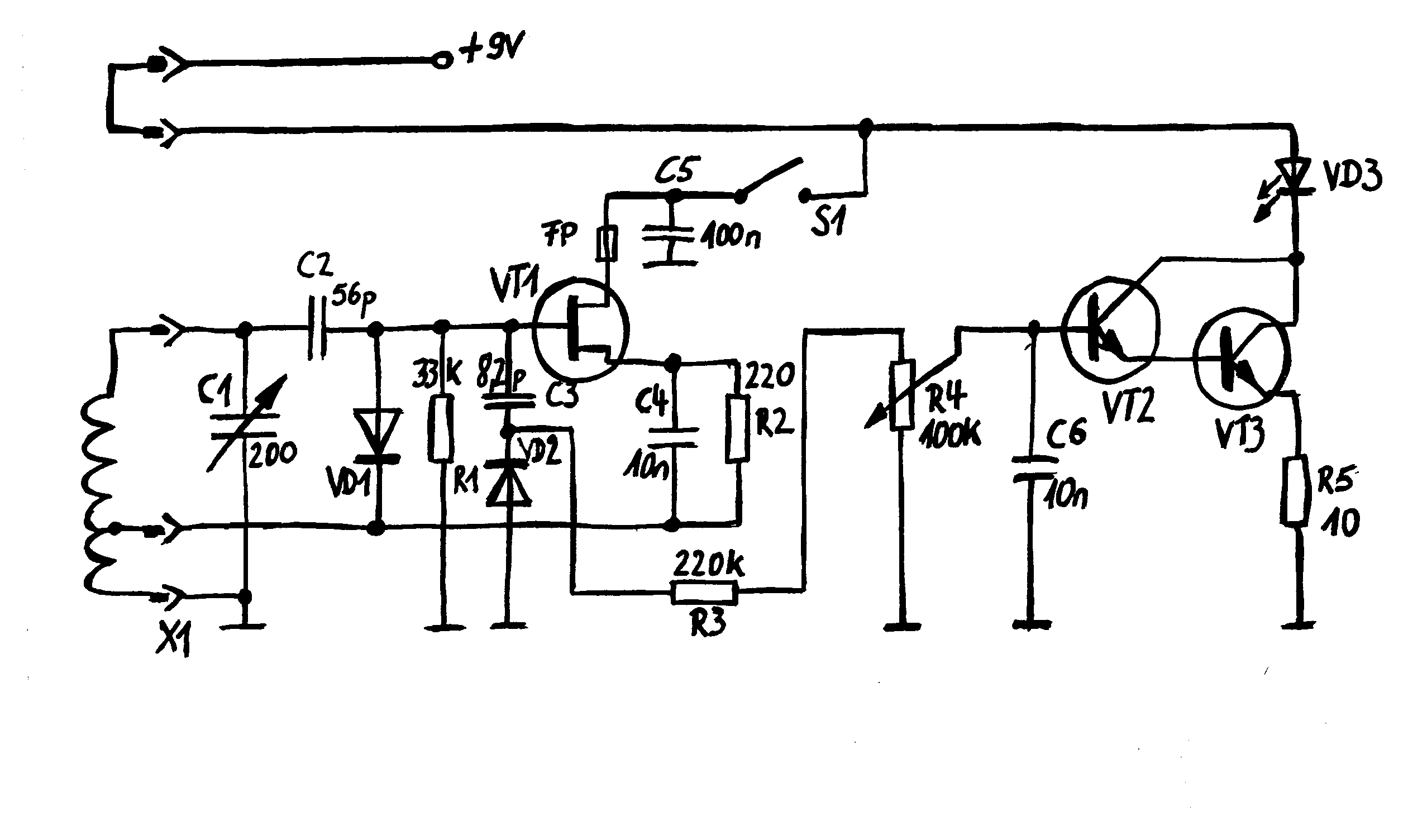
The measuring resonant circuit, while actively operating, is loosely coupled to the resonant circuit of the dipper, meaning it is brought close to it. The dipper is tuned from the lowest to the highest frequency. When the dipper and the...

Automobile-locater
This locator consists of two main components. The first component is an RF oscillator, with its circuit illustrated in Fig. 8-4a. The second component is a sensitive receiver, depicted in Fig. 8-4b. The core of the oscillator is a 555...
Metal Detectors
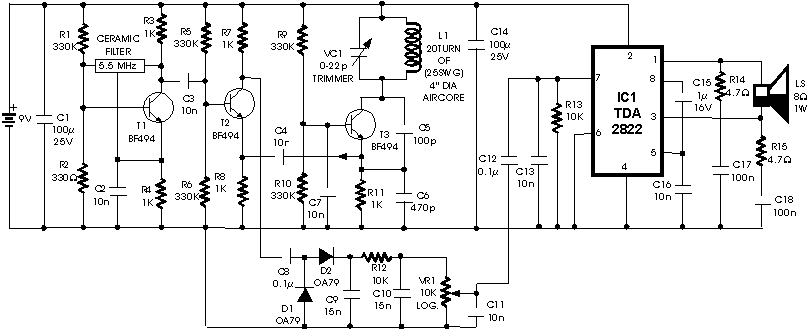
The circuit presented is a metal detector that operates based on the superheterodyne principle, which is commonly utilized in superhet receivers. It employs two RF oscillators, both fixed at a frequency of 5.5 MHz. The first RF oscillator consists of...

Electronic Projects
This program includes circuit design CAD, simulation, and auto-routing PC layout. PSPICE is also utilized at Unisys, which offers more capabilities but costs six times as much and requires annual renewal. With these requirements and others in mind, a variation...

10Mhz coaxial line driver
The circuit is ideal for high-frequency line driving systems that necessitate a wide power bandwidth at elevated output current levels. The integrated circuit used is HA2530. The bandwidth of the circuit is constrained solely by the single pole response of...

High Frequency Generator Circuit
This circuit design for a high-frequency waveform generator is highly beneficial for electronic experiments and designs. The circuit generates sine wave oscillations, but it can also be modified to produce triangle or square wave functions.
The high-frequency waveform generator circuit typically...

7MHz high frequency carrier oscillator
The 2SA130 transistor is used in an oscillator circuit with an oscillation frequency of 7 MHz. The power supply voltage is 6V, and the load is a frequency-selective resonant circuit with a quality factor of 600.
The circuit utilizes the 2SA130...
High frequency switch
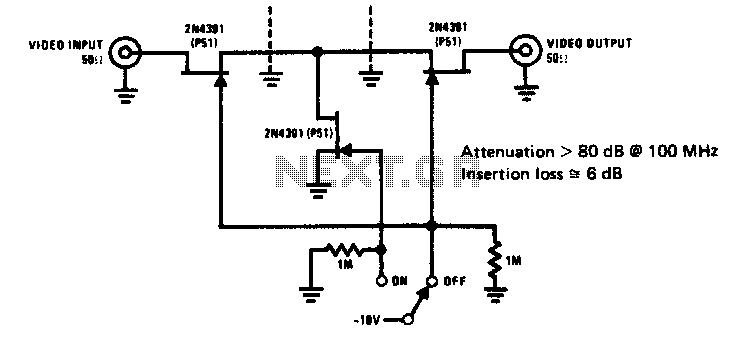
The 2N4391 features a low ON resistance of 30 ohms and a high OFF impedance of less than 0 pF when in the off state. With appropriate layout and an optimal switch configuration, the stated performance can be easily attained.
The...

rc snubber resonant design
This configuration forms a tank circuit with a quality factor (Q) of R multiplied by the square root of the capacitance (C) divided by the inductance (L), resulting in a Q value of 1. This indicates a relatively low quality...