


Common non-sinusoidal oscillator circuit waveform sawtooth oscillator use multivibrator
#sawtooth oscillator
#multivibrator
#non-sinusoidal
#waveform
#frequency formula
#signal generator
#electronic oscillator
#circuit design
#wave shaping

Description: Common non-sinusoidal oscillator circuit, waveform and frequency formula - sawtooth oscillator - use multivibrator.
The sawtooth oscillator is a type of non-sinusoidal waveform generator that produces a triangular or sawtooth-shaped output signal. This oscillator is commonly utilized in various applications, including audio synthesis, signal processing, and timing circuits. The fundamental operation of a sawtooth oscillator involves charging and discharging a capacitor through a resistor, which results in a linear ramp-up of voltage followed by a rapid drop to the initial voltage level.
The circuit typically employs a multivibrator configuration, often using operational amplifiers or transistors. In a standard implementation, a capacitor is charged through a resistor until it reaches a predetermined threshold voltage, at which point the output switches state, causing the capacitor to discharge rapidly. The frequency of the sawtooth waveform can be determined by the values of the resistor and capacitor according to the formula:
\[ f = \frac{1}{T} = \frac{1}{R \cdot C \cdot \ln(\frac{V_{max}}{V_{min}})} \]
where \( f \) is the frequency, \( R \) is the resistance, \( C \) is the capacitance, \( V_{max} \) is the maximum voltage, and \( V_{min} \) is the minimum voltage.
For practical implementation, the circuit can be designed using a 555 timer in astable mode or with a combination of transistors configured as a Schmitt trigger. In both cases, careful selection of resistor and capacitor values is crucial for achieving the desired frequency and waveform characteristics. The output can be further processed or filtered to meet specific application requirements, such as generating audio signals or controlling other electronic components.
Overall, the sawtooth oscillator is a versatile circuit that can be adapted for various electronic applications by modifying component values and configurations to tailor its performance. Common non-sinusoidal oscillator circuit, waveform and frequency formula - sawtooth oscillator - use multivibrator
The sawtooth oscillator is a type of non-sinusoidal waveform generator that produces a triangular or sawtooth-shaped output signal. This oscillator is commonly utilized in various applications, including audio synthesis, signal processing, and timing circuits. The fundamental operation of a sawtooth oscillator involves charging and discharging a capacitor through a resistor, which results in a linear ramp-up of voltage followed by a rapid drop to the initial voltage level.
The circuit typically employs a multivibrator configuration, often using operational amplifiers or transistors. In a standard implementation, a capacitor is charged through a resistor until it reaches a predetermined threshold voltage, at which point the output switches state, causing the capacitor to discharge rapidly. The frequency of the sawtooth waveform can be determined by the values of the resistor and capacitor according to the formula:
\[ f = \frac{1}{T} = \frac{1}{R \cdot C \cdot \ln(\frac{V_{max}}{V_{min}})} \]
where \( f \) is the frequency, \( R \) is the resistance, \( C \) is the capacitance, \( V_{max} \) is the maximum voltage, and \( V_{min} \) is the minimum voltage.
For practical implementation, the circuit can be designed using a 555 timer in astable mode or with a combination of transistors configured as a Schmitt trigger. In both cases, careful selection of resistor and capacitor values is crucial for achieving the desired frequency and waveform characteristics. The output can be further processed or filtered to meet specific application requirements, such as generating audio signals or controlling other electronic components.
Overall, the sawtooth oscillator is a versatile circuit that can be adapted for various electronic applications by modifying component values and configurations to tailor its performance. Common non-sinusoidal oscillator circuit, waveform and frequency formula - sawtooth oscillator - use multivibrator

Two-function-signal-generator
This circuit allows for continuous variation of the frequencies of the triangle and square waves produced, covering a full decade. When the resistance of RS is approximately equal to R3, the amplitudes of the two waveforms will be equal (A_SQUARE...

Multivibrator
A multivibrator is a type of relaxation oscillator consisting of two stages that are coupled, with the input of one stage derived from the output of the other. Essentially, a multivibrator comprises two amplifier circuits arranged with regenerative feedback, where...

multivibrator
A multivibrator is a relaxation oscillator that utilizes two tubes, transistors, or other electronic devices.
A multivibrator circuit is a type of oscillator that generates a square wave output. It typically consists of two active devices, such as transistors or vacuum...

Signal Generator 20KHz
This function generator IC is specified to work to 20 MHz. So far, this unit works nicely to 50KHz. Since I seldom need signals higher than that, it has taken up a happy home on my workbench and further development...
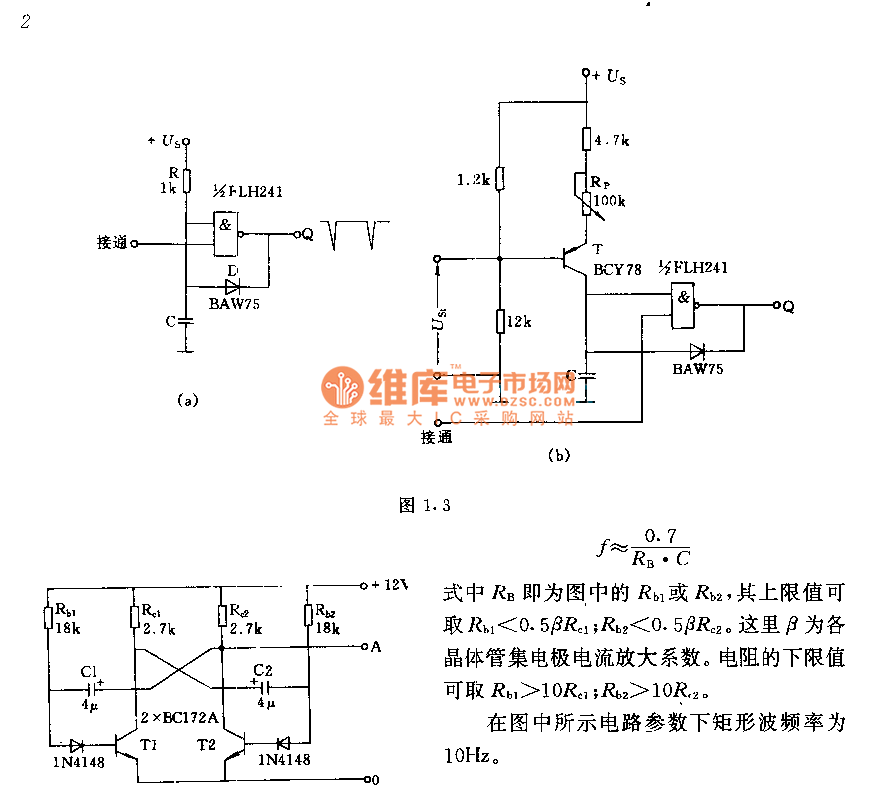
Astable flip-flop multivibrator circuit
The circuit consists of two components whose parameters and models are designed to simultaneously generate a rectangular wave with a duty cycle of 1:1. The frequency is defined by the equation f = 0.7/(RB * C), where RB refers to...
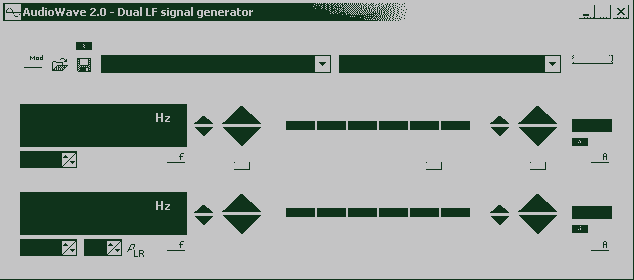
AudioWave 2.0
With AudioWave 2.0 your soundcard becomes a comfortable LF-signal-generator, which produces signals from 1Hz to 20 kHz with a resolution of 1 Hz. Phase shift between left and right channel is adjustable from 180° to +180° and an attenuator can...

Electronic Head or Tail Circuit
The principle utilized in this electronic head or tail circuit is straightforward: a multivibrator controls a flip-flop. The multivibrator oscillates as long as the button S1 is pressed, while the flip-flop toggles on and off at a frequency of several...

20Hz signal generator (phone-ringing) circuit diagram
The circuit described is a 20Hz signal generator suitable for telephone ringing systems, alarm systems, and various other electronic applications. It consists of a transformer (T) and two transistors (VT1 and VT2), forming a push-pull oscillator. The two transistors operate...

Test Signal Generator
This signal generator uses a three channel DAC to generate Composite video signal (CVBS) and S video signal (Y/C separated) at the same time, left one channel is not used in NTSC format. It is assigned for one of the...