


Keying oscillator circuit
#keying oscillator
#monoflop
#CC4098
#NAND gate
#CC4011
#frequency adjustable
#duty cycle
#digital logic
#signal generation
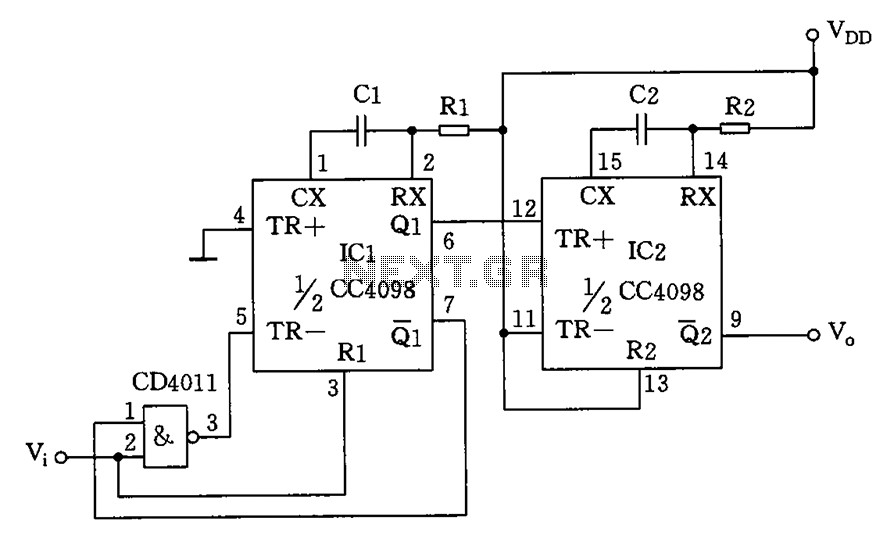
Description: The circuit depicted features a double oscillator utilizing a monostable multivibrator CC4098 and a quad 2-input NAND gate CC4011, among other components. This circuit allows for adjustable frequency and duty cycle. It is primarily designed as a keying oscillator, functioning as a single-shot generator, suitable for producing low-frequency signals with less precision.
The described circuit employs the CC4098, a versatile monostable multivibrator, which is pivotal for generating a single output pulse in response to a triggering input. The duration of this pulse can be adjusted by varying the external resistor and capacitor values connected to the CC4098, thus allowing for customization of the output signal's timing characteristics. The CC4011 NAND gates are configured to create an oscillator circuit that can be tuned to the desired frequency range. By adjusting the feedback and timing components, the oscillation frequency can be modified, providing flexibility in the signal generation process.
The combination of the CC4098 and CC4011 enables the creation of a keying oscillator that can produce a low-frequency square wave signal. This signal is useful in various applications, such as driving other circuits, modulation, or as a timing reference. The circuit's ability to adjust both frequency and duty cycle makes it suitable for applications requiring different signal characteristics without the need for complex modifications.
In summary, this circuit design effectively integrates a monostable multivibrator and NAND gates to create a flexible low-frequency signal generator, emphasizing ease of use and adaptability for various electronic applications. Circuit as shown by the double oscillator is keyed monoflop CC4098, Quad 2-input NAND gate CC4011 and other composition. The circuit is the frequency and duty cycle adjustable keying oscillator constituted by a single-shot, mainly for less precision low-frequency signal generator.
The described circuit employs the CC4098, a versatile monostable multivibrator, which is pivotal for generating a single output pulse in response to a triggering input. The duration of this pulse can be adjusted by varying the external resistor and capacitor values connected to the CC4098, thus allowing for customization of the output signal's timing characteristics. The CC4011 NAND gates are configured to create an oscillator circuit that can be tuned to the desired frequency range. By adjusting the feedback and timing components, the oscillation frequency can be modified, providing flexibility in the signal generation process.
The combination of the CC4098 and CC4011 enables the creation of a keying oscillator that can produce a low-frequency square wave signal. This signal is useful in various applications, such as driving other circuits, modulation, or as a timing reference. The circuit's ability to adjust both frequency and duty cycle makes it suitable for applications requiring different signal characteristics without the need for complex modifications.
In summary, this circuit design effectively integrates a monostable multivibrator and NAND gates to create a flexible low-frequency signal generator, emphasizing ease of use and adaptability for various electronic applications. Circuit as shown by the double oscillator is keyed monoflop CC4098, Quad 2-input NAND gate CC4011 and other composition. The circuit is the frequency and duty cycle adjustable keying oscillator constituted by a single-shot, mainly for less precision low-frequency signal generator.

Simple-window-detector
This simple window detector utilizes half of a 7400 quad NAND gate along with four resistors, selected to ensure that the voltage at point A exceeds the voltage at point B for any input voltage. When no input is applied...

Lantern controller circuit diagram of a two-dimensional
The circuit primarily consists of the NAND gate IC1 (CD4096), a counting/timing distribution circuit IC2 (CD4017), an analog electronic switch IC3 (CD4066), and a D flip-flop IC4 (CD40174), along with other components. The controller is capable of managing the progressive...

NAND gate S-R flip-flop
The parts list specifies a ten-segment LED unit, but the illustration depicts two individual LEDs instead. This change is due to limited space on the breadboard for the switch assembly, two integrated circuits, and the bar graph. If space permits,...

Loop lighting control circuit
This circuit illustrates a circular lighting control system. It consists of four two-input NAND gates from the CD4011 series, which form a non-inverting multivibrator. This multivibrator generates a pulse that is used to shape the output of an RS flip-flop...

Human reaction speed test circuit
The circuit for testing human reaction speed is illustrated in the figure. It includes NAND gates D25 and D26, along with other components that generate a multivibrator output clock pulse with a period of approximately 50 milliseconds. The circuit is...

Basic gate function
To start, connect a single NAND gate to two input switches and one LED, as illustrated. Initially, using an 8-position switch and a 10-segment LED bar graph may appear excessive, given that only two switches and one LED are required...

Duty Cycle Selector
The Duty Cycle Selector is a unique project designed to select the duty cycle in 9 steps up to 100%. It includes a circuit diagram and a description of the duty cycle selector and various digital circuits.
The Duty Cycle Selector...

HORN CIRCUIT_FOR_MOTORCYCLE_USE
Gates U1-a and U1-b of the 4093 quad 2-input NAND Schmitt trigger are connected in variable, low-frequency square-wave oscillator circuits. The output of gate U1-a is connected to one of the inputs of gate U1-b. The square-wave output of gate...
Digital Electronics Education
The goal of Advanced Digital Electronics courses is to connect basic logic gates (combinational circuits) with technical subjects related to binary counter topologies (both Asynchronous and Synchronous), shift registers, memory, and Digital Signal Processors (DSP), which are categorized as sequential...