


Low Distortion Wien Bridge Oscillator

Description: This Wien bridge oscillator utilizes an incandescent lamp to stabilize its amplitude. The amplitude stabilization results in a low distortion output and supports multiple frequencies.
The Wien bridge oscillator is a type of electronic oscillator that generates sine waves. It is known for its ability to produce low-distortion outputs, which is essential in various applications, including audio signal generation and testing. The core of the oscillator consists of a bridge circuit that includes resistors and capacitors arranged in a specific configuration to set the frequency of oscillation.
In this particular design, the use of an incandescent lamp serves a dual purpose. Firstly, it acts as a variable resistor, whose resistance changes with the temperature. This property allows for automatic gain control, which stabilizes the amplitude of the output signal. As the amplitude of the oscillation increases, the lamp heats up, causing its resistance to rise and thereby reducing the gain. Conversely, if the amplitude decreases, the lamp cools down, lowering its resistance and increasing the gain. This feedback mechanism ensures that the output remains stable and minimizes distortion.
The circuit typically includes an op-amp configured as a non-inverting amplifier to provide the necessary gain. The frequency of oscillation can be adjusted by changing the values of the resistors and capacitors in the bridge circuit. This flexibility allows the oscillator to operate at multiple frequencies, making it suitable for various applications.
Overall, the incorporation of an incandescent lamp in the Wien bridge oscillator design enhances its performance by providing effective amplitude stabilization, resulting in a high-quality, low-distortion sine wave output across a range of frequencies.This Wien bridge oscillator uses incandescent lamp to stabilize its amplitude. This amplitude stabilization gives a low distortion output. Multiple frequency..
The Wien bridge oscillator is a type of electronic oscillator that generates sine waves. It is known for its ability to produce low-distortion outputs, which is essential in various applications, including audio signal generation and testing. The core of the oscillator consists of a bridge circuit that includes resistors and capacitors arranged in a specific configuration to set the frequency of oscillation.
In this particular design, the use of an incandescent lamp serves a dual purpose. Firstly, it acts as a variable resistor, whose resistance changes with the temperature. This property allows for automatic gain control, which stabilizes the amplitude of the output signal. As the amplitude of the oscillation increases, the lamp heats up, causing its resistance to rise and thereby reducing the gain. Conversely, if the amplitude decreases, the lamp cools down, lowering its resistance and increasing the gain. This feedback mechanism ensures that the output remains stable and minimizes distortion.
The circuit typically includes an op-amp configured as a non-inverting amplifier to provide the necessary gain. The frequency of oscillation can be adjusted by changing the values of the resistors and capacitors in the bridge circuit. This flexibility allows the oscillator to operate at multiple frequencies, making it suitable for various applications.
Overall, the incorporation of an incandescent lamp in the Wien bridge oscillator design enhances its performance by providing effective amplitude stabilization, resulting in a high-quality, low-distortion sine wave output across a range of frequencies.This Wien bridge oscillator uses incandescent lamp to stabilize its amplitude. This amplitude stabilization gives a low distortion output. Multiple frequency..
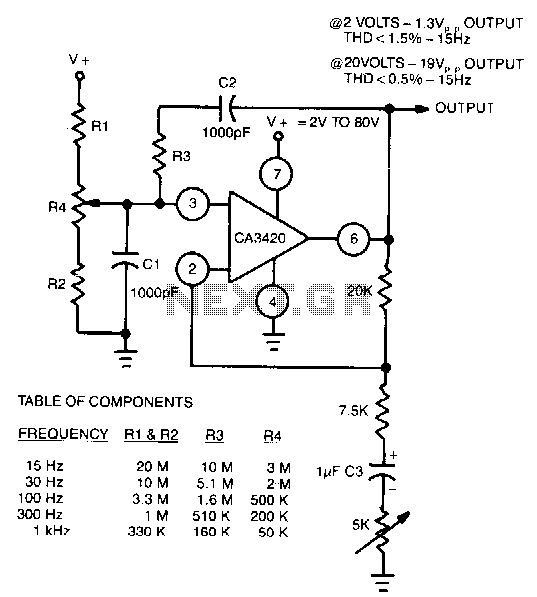
Single-supply-wien-bridge-oscillator
The adjustment of R4 contributes to the comparatively symmetrical output transfer characteristic of the CA3420 BiMOS operational amplifier. To extend the lower operating frequency, remove C3 and use a dual supply.
The CA3420 is a high-performance BiMOS operational amplifier that combines...
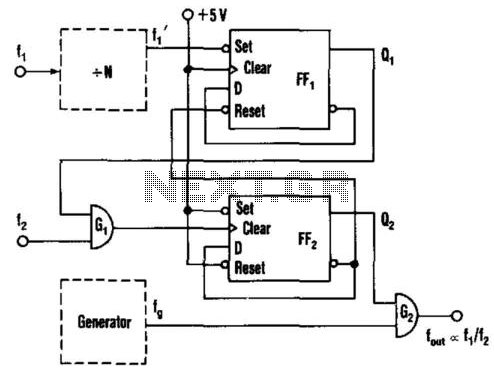
Frequency-Ratio Monitoring Circuit
This circuit generates an output frequency that is linearly proportional to the ratio of two input frequencies. Each pulse of the bias frequency will open a switch for a period equal to half of the second input frequency, allowing a...

Low Distortion Oscillator
The 2N4416 JFET exhibits very low harmonic distortion, making it ideal for smooth oscillation in electronic circuits. It is particularly effective in applications where minimal harmonic content is essential for high-performance mixer circuits. Below is the circuit diagram of a...

Wien bridge oscillator
A field effect transistor (FET), designated as Q1, functions within the linear resistive region to facilitate automatic gain control. The attenuation of the RC network is one-third at the oscillation frequency with zero phase shift, necessitating that the amplifier gain,...

Wien bridge oscillator schematic
This is a simple scheme for a bridge oscillator. It provides a nice sinusoidal signal. This type of oscillator uses an op-amp. The weakening of the oscillating member (R1, R2, C1, C2) is 3x. To compensate, the attenuated signal is...

Analysis of a Digitally Controlled Wien Bridge Oscillator
The circuit utilizes standard components, produces a good sine wave, and exhibits a degree of immunity to the specific operational amplifier it is designed around. However, it can be easily misunderstood, and oversimplifications regarding its operation may lead designers to...

Low distortion oscillator
The 2N5485 JFET can oscillate in a circuit with very low harmonic distortion. This JFET local oscillator is ideal when low harmonic content is needed for an effective mixer circuit.
The 2N5485 is a Junction Field Effect Transistor (JFET) that is...

1 KHz Frequency Wien Bridge Oscillator
The circuit was designed to create an electronic oscillator known as a Wien Bridge Oscillator, which can be used for the creation of low-frequency sine waves.
The Wien Bridge Oscillator is a type of electronic oscillator that generates sine waves. It...

Single Pentode Wien Bridge Oscillator
The oscillator was designed to utilize resistors and capacitors instead of large low-frequency LC tank circuits for generating audio frequencies. It achieved low distortion (less than 0.5%) by employing a two-stage amplifier with sufficient negative feedback to set the gain...