


Precision Gated Oscillator Circuit

Description: A 1-kHz gated oscillator with no long turn-on cycle is shown. R2, R3, and D1 preset the voltage on tuning capacitor C1 to a percentage of the supply voltage.
The circuit described functions as a gated oscillator operating at a frequency of 1 kHz. The primary components involved include resistors R2 and R3, diode D1, and tuning capacitor C1.
In this configuration, R2 and R3 are used to create a voltage divider that sets the reference voltage for the tuning capacitor C1. This configuration allows for precise control over the voltage applied to C1, which is crucial for determining the oscillation characteristics of the circuit. The diode D1 serves to prevent reverse current flow, ensuring that the voltage across C1 remains stable and within the desired range.
The oscillator operates without a long turn-on cycle, which implies that it can quickly reach its stable oscillation state upon activation. This characteristic is beneficial for applications requiring rapid response times. The gating mechanism likely involves a control signal that enables or disables the oscillator, allowing for flexibility in its operation.
Overall, this circuit is suitable for applications where a stable, low-frequency oscillation is required, and the ability to adjust the oscillation characteristics through the tuning capacitor is advantageous. The design emphasizes simplicity and efficiency, making it an effective solution for various electronic applications. A 1-kHz gated oscillator with no long turn-on cycle is show. R2, R3, and D1 preset the voltage on tuning capacitor CI to % of the supply voltage.
The circuit described functions as a gated oscillator operating at a frequency of 1 kHz. The primary components involved include resistors R2 and R3, diode D1, and tuning capacitor C1.
In this configuration, R2 and R3 are used to create a voltage divider that sets the reference voltage for the tuning capacitor C1. This configuration allows for precise control over the voltage applied to C1, which is crucial for determining the oscillation characteristics of the circuit. The diode D1 serves to prevent reverse current flow, ensuring that the voltage across C1 remains stable and within the desired range.
The oscillator operates without a long turn-on cycle, which implies that it can quickly reach its stable oscillation state upon activation. This characteristic is beneficial for applications requiring rapid response times. The gating mechanism likely involves a control signal that enables or disables the oscillator, allowing for flexibility in its operation.
Overall, this circuit is suitable for applications where a stable, low-frequency oscillation is required, and the ability to adjust the oscillation characteristics through the tuning capacitor is advantageous. The design emphasizes simplicity and efficiency, making it an effective solution for various electronic applications. A 1-kHz gated oscillator with no long turn-on cycle is show. R2, R3, and D1 preset the voltage on tuning capacitor CI to % of the supply voltage.

Precision-voltage-inverter
This circuit enables the inversion of a reference signal with an accuracy of 1 ppm. It features high input impedance and does not require any trimming.
The described circuit is designed to invert a reference voltage signal while maintaining a high...

Precision calibration standard
An external power supply that provides a voltage higher than the maximum expected rating of the zener diodes to be tested is required. Potentiometer RV1 is adjusted until the meter reading stabilizes. This reading represents the breakdown voltage of the...
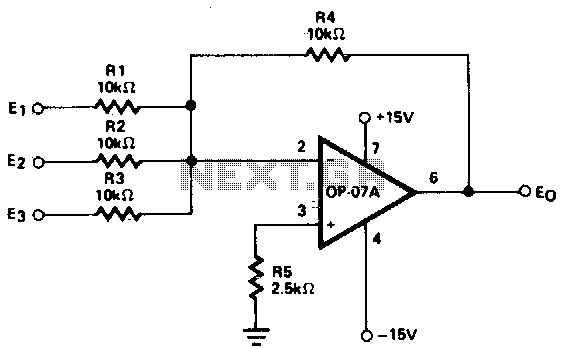
Adjustment-free precision summing amplifier
This circuit generates continuous outputs that depend on multiple input variables.
The circuit in question typically employs a combination of operational amplifiers (op-amps), resistors, and potentiometers to achieve its functionality. The outputs can be tailored based on the variations in...
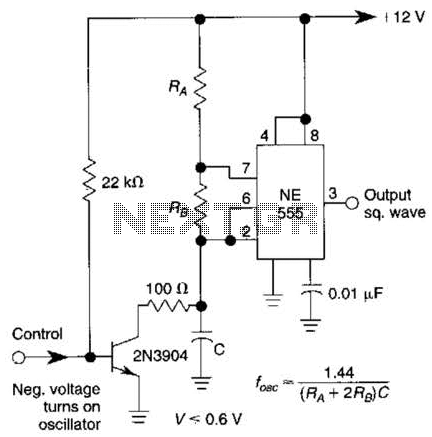
Gated 1Khz Oscillator (Normally Off) Circuit
This gated 1-kHz oscillator provides a press-to-turn-on functionality, with waveforms available at the output of pin 3 and across capacitor CI.
The gated 1-kHz oscillator circuit is designed to produce a square wave output that can be activated by a momentary...

Gated 1Khz Oscillator (Normally On) Circuit
This gated 1-kHz oscillator provides press-to-turn-off functionality, along with waveforms available at the output of pin 3 and across capacitor C1.
The gated 1-kHz oscillator circuit is designed to generate a square wave output at a frequency of 1 kHz. This...

Precision Lf Oscillator Circuit
Using Rl, R7, and D1 to preset CI to one third of the supply voltage. This circuit avoids a longer first cycle period than subsequent cycles.
The circuit described involves the use of resistors Rl and R7 along with diode D1...

Precision Oscillator With 20ns Switching
A precision oscillator can be constructed using a quartz crystal; however, with appropriate component selection, it is also possible to build one using an RC (resistor and capacitor) circuit.
An RC oscillator generates an oscillating signal through the use of resistors...

Precision-full-wave-rectifier
This circuit provides accurate full-wave rectification. The output impedance is low for both input polarities, and the errors are small at all signal levels. It is important to note that the output will not sink heavy currents, except for a...

Precision-threshold-detector
This circuit requires low noise, stable offset voltages, high open-loop gain, and high speed. These requirements are fulfilled by the HA5147. Standard variations of this circuit can be easily implemented using the HA-5147. For instance, hysteresis can be introduced by...