


Precision Squarer

Description: A squarer circuit is utilized to shape a signal, producing a more defined square wave. This circuit is beneficial for converting a signal to achieve a very fast rise time.
The squarer circuit is designed to convert an input signal into a square wave with a sharp transition between high and low states. It typically consists of components such as operational amplifiers, resistors, and capacitors, which work together to enhance the signal's characteristics.
The operational amplifier is often configured in a comparator mode, where it compares the input signal to a reference voltage. When the input signal exceeds the reference voltage, the output switches to the high state; conversely, when the input signal falls below the reference voltage, the output switches to the low state. This rapid transition results in a square wave output.
To ensure the squarer circuit provides a fast rise time, careful selection of components is essential. The feedback network, composed of resistors and capacitors, must be tailored to minimize propagation delay and optimize the circuit's frequency response. Additionally, the use of Schmitt trigger configurations can further enhance the circuit's performance by providing hysteresis, which prevents noise from causing unwanted oscillations in the output.
Applications of squarer circuits are prevalent in digital electronics, where clean square waves are essential for clock signals, pulse generation, and signal conditioning. The ability to produce a precise square wave from a noisy or distorted input signal makes this circuit invaluable in various electronic systems.Squarer circuit is used to shape signal, to get more defined square wave. This circuit is useful to make convert the signal so it has very fast rise time. Here..
The squarer circuit is designed to convert an input signal into a square wave with a sharp transition between high and low states. It typically consists of components such as operational amplifiers, resistors, and capacitors, which work together to enhance the signal's characteristics.
The operational amplifier is often configured in a comparator mode, where it compares the input signal to a reference voltage. When the input signal exceeds the reference voltage, the output switches to the high state; conversely, when the input signal falls below the reference voltage, the output switches to the low state. This rapid transition results in a square wave output.
To ensure the squarer circuit provides a fast rise time, careful selection of components is essential. The feedback network, composed of resistors and capacitors, must be tailored to minimize propagation delay and optimize the circuit's frequency response. Additionally, the use of Schmitt trigger configurations can further enhance the circuit's performance by providing hysteresis, which prevents noise from causing unwanted oscillations in the output.
Applications of squarer circuits are prevalent in digital electronics, where clean square waves are essential for clock signals, pulse generation, and signal conditioning. The ability to produce a precise square wave from a noisy or distorted input signal makes this circuit invaluable in various electronic systems.Squarer circuit is used to shape signal, to get more defined square wave. This circuit is useful to make convert the signal so it has very fast rise time. Here..

3 square waves generator
The circuit generates three square wave outputs with a 120° phase difference between each output. The reference clock frequency is set to twice the desired output frequency. This can be achieved using a crystal oscillator followed by a series of...

4-Decade Square-Wave Generator
This circuit generates a square wave with a frequency range of 2 Hz to 20 kHz. It employs an operational amplifier in a relaxation oscillator configuration. The output voltage is approximately 15 V peak-to-peak. Resistors R1 through R4 serve as...

Square-wave generator circuit
T1 and T2 in the circuit form the inherent oscillator, while T3 serves as the output stage. The network consists of a high-pass filter (C3, C4, R6, and R7) and a low-pass filter. The output from this network is fed...

Square wave generator III
The generator described is designed for generating multiburst square waveforms and can be utilized to characterize the response of television monitor amplifiers. The circuit functions as an RC oscillator using NAND gates (IC4-4011), with the capacitor C periodically altered by...

Square wave oscillator
An attempt has been made to follow an instructable for some time; however, understanding its schematic remains challenging. The issue is not a lack of knowledge regarding the symbols used.
In electronic schematics, symbols represent various components and their connections within...

Rounding Off a square wave
To "round" your square wave, you need to integrate it twice; once to produce a triangular wave, and a second time to produce a parabolic waveform. A parabolic wave looks pretty much sinusoidal. You can do this passively using a...

Convert periodic waveforms to square waves
Converting periodic waveforms to square waves is an integral part of extracting a clock signal from data, creating waveform generators, and making timing-pulse generators. Any square-wave-conversion circuit is more valuable when the square wave's duty cycle is variable and controllable....
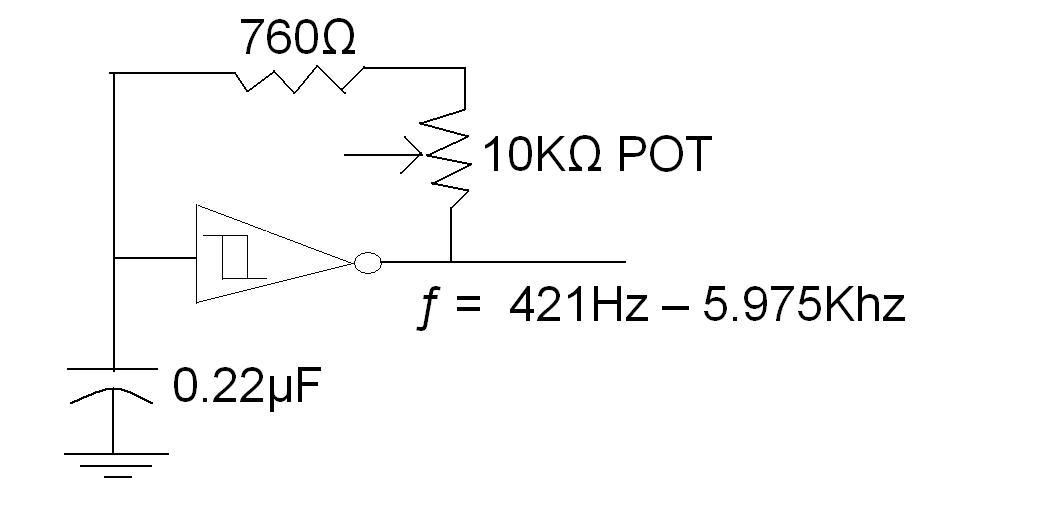
square wave 2 sine wave convertion
A TTL square wave needs to be converted into a sine wave, with a frequency range of 4Hz to 60Hz. One method to achieve this is by filtering the square wave using a high-order filter. However, if the frequency varies,...

Square wave oscillator
This generator operates at frequencies exceeding 100 kHz. The lower frequency limit is determined by capacitor Cl. Additionally, the frequency remains constant for supply voltages down to +5 V.
The generator described is a versatile electronic oscillator capable of producing high-frequency...