


Replacing Crystals and Ceramic Resonators with Silicon Oscillators
#silicon oscillators
#crystal replacement
#ceramic resonator
#microcontroller clock
#clock circuits
#frequency stability
#timing devices
#electronic components
#circuit design
#technical advantages

Description: A brief note explaining the process of substituting crystal and ceramic resonator clock circuits with silicon oscillators, while emphasizing the technical benefits these devices provide in microcontroller clock applications.
Silicon oscillators serve as an effective alternative to traditional crystal and ceramic resonator clock circuits, particularly in microcontroller applications. These oscillators are integrated circuits that generate clock signals through internal oscillation mechanisms, offering several advantages over their counterparts.
One significant benefit of silicon oscillators is their compact size. Unlike crystal and ceramic resonators, which require additional space for mounting and may necessitate specific PCB layouts to accommodate their physical dimensions, silicon oscillators can be designed in smaller packages, thus optimizing board space. This is particularly advantageous in applications where space is at a premium.
Another advantage is the improved temperature stability that silicon oscillators provide. While crystal and ceramic resonators can experience frequency drift due to temperature fluctuations, silicon oscillators can be engineered to maintain consistent performance across a wider temperature range. This reliability is crucial for applications that operate in varying environmental conditions.
Additionally, silicon oscillators often feature lower power consumption compared to traditional resonators. This characteristic is essential for battery-operated devices, where energy efficiency is paramount. The reduced power requirements of silicon oscillators contribute to longer battery life and overall enhanced system performance.
Furthermore, silicon oscillators offer greater flexibility in frequency selection. Designers can easily adjust the output frequency by changing the internal configuration of the oscillator, which allows for rapid prototyping and customization for specific applications. This adaptability is not as straightforward with crystal and ceramic resonators, which are typically fixed-frequency devices.
In summary, the transition from crystal and ceramic resonators to silicon oscillators in microcontroller clock applications presents several technical advantages, including reduced size, improved temperature stability, lower power consumption, and enhanced frequency flexibility. These factors make silicon oscillators a compelling choice for modern electronic designs.A short note describing how to replace crystal and ceramic resonator clock circuits with silicon oscillators and highlighting some of the technical advantages offered by these devices in microcontroller clock applications..
Silicon oscillators serve as an effective alternative to traditional crystal and ceramic resonator clock circuits, particularly in microcontroller applications. These oscillators are integrated circuits that generate clock signals through internal oscillation mechanisms, offering several advantages over their counterparts.
One significant benefit of silicon oscillators is their compact size. Unlike crystal and ceramic resonators, which require additional space for mounting and may necessitate specific PCB layouts to accommodate their physical dimensions, silicon oscillators can be designed in smaller packages, thus optimizing board space. This is particularly advantageous in applications where space is at a premium.
Another advantage is the improved temperature stability that silicon oscillators provide. While crystal and ceramic resonators can experience frequency drift due to temperature fluctuations, silicon oscillators can be engineered to maintain consistent performance across a wider temperature range. This reliability is crucial for applications that operate in varying environmental conditions.
Additionally, silicon oscillators often feature lower power consumption compared to traditional resonators. This characteristic is essential for battery-operated devices, where energy efficiency is paramount. The reduced power requirements of silicon oscillators contribute to longer battery life and overall enhanced system performance.
Furthermore, silicon oscillators offer greater flexibility in frequency selection. Designers can easily adjust the output frequency by changing the internal configuration of the oscillator, which allows for rapid prototyping and customization for specific applications. This adaptability is not as straightforward with crystal and ceramic resonators, which are typically fixed-frequency devices.
In summary, the transition from crystal and ceramic resonators to silicon oscillators in microcontroller clock applications presents several technical advantages, including reduced size, improved temperature stability, lower power consumption, and enhanced frequency flexibility. These factors make silicon oscillators a compelling choice for modern electronic designs.A short note describing how to replace crystal and ceramic resonator clock circuits with silicon oscillators and highlighting some of the technical advantages offered by these devices in microcontroller clock applications..

Ceramic Resonator Oscillator Circuit
A ceramic resonator can be utilized to construct an oscillator. A single digital inverter can be employed to create a Pierce oscillator.
To design a Pierce oscillator using a ceramic resonator and a digital inverter, the following components and configurations are...

case stepper
Beige Bag Software has been offering affordable and innovative circuit design tools since 1990. B2 Spice provides schematics as well as analog, digital, and mixed-mode electronic circuit simulation. It integrates with EAGLE and CADSTAR PCB software.
B2 Spice is a powerful...

Ceramic Resonators
The feedback resistor sets the bias of the oscillation circuit. Typically, CMOS ICs utilize feedback resistances ranging from 100k ohms to 10M ohms (commonly 1M ohms), while TTL ICs employ feedback resistances from 1k ohms to 10k ohms (usually 4.7k...

Electronic Projects
This program includes circuit design CAD, simulation, and auto-routing PC layout. PSPICE is also utilized at Unisys, which offers more capabilities but costs six times as much and requires annual renewal. With these requirements and others in mind, a variation...
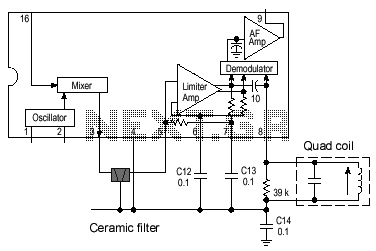
Ceramic resonator oscillator
This receiver is MC3371. Pin 16 is the RF input to the mixer and pin 1 and pin 2 is the local oscillator. The product comes out at pin 3. Imagine you want to receive at 100MHz. The local oscillator...

question about ceramic resonator
The resonator appears to be highly susceptible to harmonics. For instance, if the resonator frequency is set at 455 kHz, it also permits frequencies at 910 Hz, 1820 kHz, and 3.640 MHz, which seems to be dominant. Frequencies around 3...