


Staircase-generator
#staircase generator
#diode pump
#high-input impedance
#charge transfer
#counters
#negative-going edge
#signal processing
#pulse generation

Description: This circuit is a high-input impedance version of the diode pump or staircase generator. Charge transfer occurs at the negative-going edge of the input signal. The most common application for staircase generators is in low-cost counters. By resetting the capacitor when the output reaches a predetermined level, the circuit can reliably count up to a maximum of about 10.
The high-input impedance diode pump or staircase generator circuit is designed to efficiently convert input signals into a stepped output voltage. It typically consists of a capacitor, a diode, and a reset mechanism, all working in conjunction to achieve accurate counting. The capacitor serves as the energy storage element, while the diode ensures that the charge can only flow in one direction, preventing discharge when the input signal transitions.
In operation, the circuit responds to the negative-going edge of the input signal, which triggers the transfer of charge from the capacitor to the output. This charge transfer results in a voltage increment that corresponds to the logic level changes in the input signal. The output voltage will rise incrementally until it reaches a predefined threshold, at which point the circuit resets the capacitor, preparing it for the next counting cycle.
The design of this staircase generator allows for a maximum count of approximately 10, making it suitable for applications requiring simple counting mechanisms. The high-input impedance characteristic minimizes the loading effect on the preceding circuit stages, thus preserving signal integrity. This feature is particularly advantageous in low-cost counter applications, where precision and reliability are essential.
Overall, this circuit exemplifies a practical solution for implementing counting functions in electronic systems, combining simplicity with effectiveness in its design and operation.This circuit is a high-input impedance version of the so-called diode pump or staircase generator. Note that charge transfer takes place at the negative-going edge of the input signal. The most common application for staircase generators is in low-cost counters. By resetting the capacitor when the output reaches a predetermined level, the circuit can be made to count reliably up to a maximum of about 10.
The high-input impedance diode pump or staircase generator circuit is designed to efficiently convert input signals into a stepped output voltage. It typically consists of a capacitor, a diode, and a reset mechanism, all working in conjunction to achieve accurate counting. The capacitor serves as the energy storage element, while the diode ensures that the charge can only flow in one direction, preventing discharge when the input signal transitions.
In operation, the circuit responds to the negative-going edge of the input signal, which triggers the transfer of charge from the capacitor to the output. This charge transfer results in a voltage increment that corresponds to the logic level changes in the input signal. The output voltage will rise incrementally until it reaches a predefined threshold, at which point the circuit resets the capacitor, preparing it for the next counting cycle.
The design of this staircase generator allows for a maximum count of approximately 10, making it suitable for applications requiring simple counting mechanisms. The high-input impedance characteristic minimizes the loading effect on the preceding circuit stages, thus preserving signal integrity. This feature is particularly advantageous in low-cost counter applications, where precision and reliability are essential.
Overall, this circuit exemplifies a practical solution for implementing counting functions in electronic systems, combining simplicity with effectiveness in its design and operation.This circuit is a high-input impedance version of the so-called diode pump or staircase generator. Note that charge transfer takes place at the negative-going edge of the input signal. The most common application for staircase generators is in low-cost counters. By resetting the capacitor when the output reaches a predetermined level, the circuit can be made to count reliably up to a maximum of about 10.

WIDE RANGE STAIRCASE GENERATOR
The circuit features high input impedance and low output impedance, which minimizes voltage droop between pulses. A staircase waveform is generated by the combination of diode D2 and capacitor C2, which is bootstrapped on the output to ensure equal amplitude...

Pulse generation by interrupting a light beam
This circuit generates a pulse when an object on the conveyor belt obstructs the light source. The light source continuously keeps the phototransistor activated, resulting in a high logic level voltage at the Schmitt-trigger inverter and a TTL-compatible low logic...

Interpolating Scanner Circuit
This design is for an interpolating scanner, a circuit featuring multiple signal inputs, a control voltage input, and a signal output. The output selectively transitions between inputs, smoothly fading from one to the next as the control voltage increases. A...
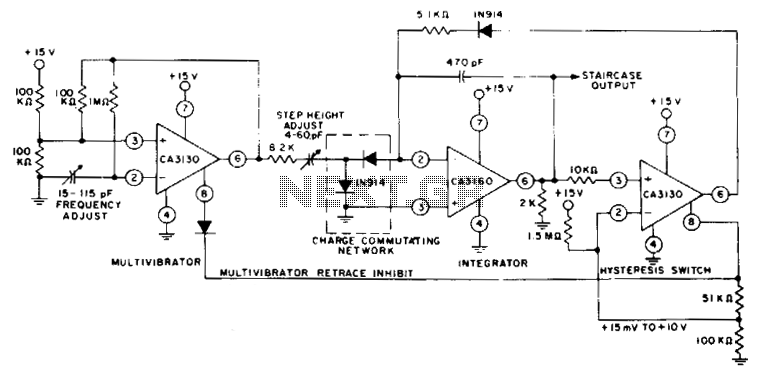
Staircase generator
Two CA3130 operational amplifiers are utilized, with one functioning as a multivibrator and the other serving as a hysteresis switch. Additionally, a CA3160 amplifier is employed as a linear staircase generator. The circuit incorporates three BiMOS operational amplifiers.
The circuit design...