


Subaudible tone encoder
#twin-T oscillator
#subaudible tones
#frequency generator
#audio frequency
#preset tones
#93Hz to 170Hz
#signal encoder
#low frequency oscillator

Description: This twin-T oscillator generates six preset subaudible tones ranging from 93 to 170 Hz across three distinct frequency ranges.
The twin-T oscillator is a specific type of electronic oscillator that utilizes a twin-T network configuration to produce audio signals at subaudible frequencies. The circuit typically consists of two T-shaped networks composed of resistors and capacitors, which are configured to create phase shifts necessary for oscillation.
In this design, the oscillator is capable of producing six different frequencies, specifically within the range of 93 Hz to 170 Hz. The selection of these frequencies is achieved through the adjustment of component values or through the use of switches that alter the resistor and capacitor configurations, enabling the user to choose from three distinct frequency ranges.
The operation of the twin-T oscillator is based on the principle of feedback, where a portion of the output signal is fed back into the input in a manner that sustains oscillation. The stability and accuracy of the generated frequencies are influenced by the tolerance of the components used, particularly the resistors and capacitors, as well as the quality of the power supply.
In practical applications, such oscillators can be utilized in sound synthesis, alarm systems, and various audio applications where low-frequency tones are required. The ability to produce multiple preset tones makes this oscillator versatile for different uses, including experimental sound design and audio testing. Proper grounding and shielding are essential in the circuit design to minimize unwanted noise and ensure signal integrity.This twin-T oscillator produces six preset subaudible tones from 93 to 170 Hz in three ranges.
The twin-T oscillator is a specific type of electronic oscillator that utilizes a twin-T network configuration to produce audio signals at subaudible frequencies. The circuit typically consists of two T-shaped networks composed of resistors and capacitors, which are configured to create phase shifts necessary for oscillation.
In this design, the oscillator is capable of producing six different frequencies, specifically within the range of 93 Hz to 170 Hz. The selection of these frequencies is achieved through the adjustment of component values or through the use of switches that alter the resistor and capacitor configurations, enabling the user to choose from three distinct frequency ranges.
The operation of the twin-T oscillator is based on the principle of feedback, where a portion of the output signal is fed back into the input in a manner that sustains oscillation. The stability and accuracy of the generated frequencies are influenced by the tolerance of the components used, particularly the resistors and capacitors, as well as the quality of the power supply.
In practical applications, such oscillators can be utilized in sound synthesis, alarm systems, and various audio applications where low-frequency tones are required. The ability to produce multiple preset tones makes this oscillator versatile for different uses, including experimental sound design and audio testing. Proper grounding and shielding are essential in the circuit design to minimize unwanted noise and ensure signal integrity.This twin-T oscillator produces six preset subaudible tones from 93 to 170 Hz in three ranges.

Circuit Diagram Of 60 Hz Frequency Signal Generator
The following circuit illustrates a stable 60 Hz frequency signal generator circuit diagram. Features include a 0.068 µF capacitor incorporated within a feedback loop, allowing for DC-to-AC conversion.
This circuit is designed to generate a stable 60 Hz sine wave output,...
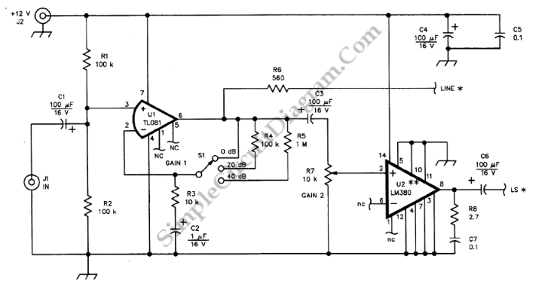
General-Purpose AF Power Amplifier
This is a schematic diagram of a general-purpose audio frequency (AF) amplifier circuit. The circuit employs inexpensive 1/4-W resistors, as high precision is not required.
The general-purpose audio frequency (AF) amplifier circuit is designed to amplify audio signals for various applications,...

Frequency Generator Counter
The functional generator is a device that any well-equipped electronic lab should possess, even if it is not frequently used. However, its convenience is greatly appreciated when needed. This scheme was published in the magazine Everyday Practical Electronics, 2000, issue...

Audio Oscillator
A low distortion audio frequency sine wave can be generated by passing the output of a simple square wave oscillator through a sharp cutoff low-pass filter to attenuate the odd harmonic components. The output level of the sine wave is...

Frequency Generator:
Building your own Zapper. It requires one capacitor of 1 microfarad (C2), preferably unpolarized to eliminate concerns regarding positive and negative terminals. If a polarized capacitor is used, the longer leg indicates the positive side; refer to the schematic for...

Electronic Drum Synthesizer
The circuit consists of two twin-T oscillators configured to operate just below the oscillation threshold. To initiate oscillation, the circuit can be activated by touching the Touch Pad.
The circuit utilizes twin-T oscillator configurations, which are known for their ability to...
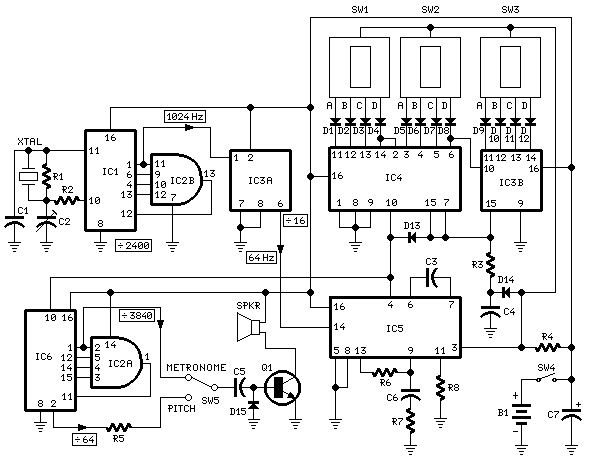
Precision Metronome/Pitch
Precision Frequency generator 1 to 999 Hz Precision Metronome 1 to 999 beats per minute. CMos IC1 and IC2B quad AND gate form a 2.4576 MHz crystal oscillator plus a 2400 times divider. IC3A provides further division by 16, delivering...

Frequency Generator circuit
This is a useful instrument for workshops. The standard of the produced frequencies is 10 to 1. The basic frequency is produced by a crystal with high accuracy. The circuit consists of the oscillator, around the crystal and the frequency...

Generator circuit
The 60 Hz frequency generator circuit is essential for creating inverters or hardware related to AC current voltage. This 60 Hz frequency generator is straightforward and highly accurate, producing a precision square wave output. The core of this generator is...