


Triangle-square wave VCO
#VCO
#triangle wave
#square wave
#Schmitt trigger
#frequency control
#switching FET
#buffered outputs
#voltage swing

Description: The voltage-controlled oscillator (VCO) features two buffered outputs: a triangle wave and a square wave. The frequency is influenced by the output voltage swing of the Schmitt trigger, IC2. Enhanced performance can be achieved by substituting Q1 with a switching FET. Additionally, utilizing fast FET operational amplifiers will enhance high-frequency performance.
The voltage-controlled oscillator (VCO) circuit is designed to generate two distinct waveforms: a triangle wave and a square wave, both of which are buffered to ensure signal integrity and drive capability. The frequency of the generated waveforms is primarily determined by the output voltage swing of the Schmitt trigger, designated as IC2 in the schematic. The Schmitt trigger's output provides a stable reference point that influences the oscillation frequency, allowing for precise control over the waveform characteristics.
To optimize the performance of the VCO, it is recommended to replace the transistor Q1 with a switching field-effect transistor (FET). This substitution is advantageous due to the FET's high input impedance and rapid switching capabilities, which significantly enhance the overall response time of the circuit. The use of a switching FET can reduce power consumption and improve linearity in the output waveforms, making it suitable for applications requiring high fidelity and fast signal transitions.
Furthermore, incorporating fast FET operational amplifiers into the design will further improve the high-frequency performance of the circuit. These operational amplifiers are characterized by their ability to handle rapid changes in signal levels without introducing significant distortion or delay. Their implementation will ensure that the VCO maintains its performance across a wide range of frequencies, making it ideal for applications in signal processing, modulation, and frequency generation.
Overall, the combination of a Schmitt trigger, a switching FET, and fast FET op-amps creates a robust VCO design capable of delivering high-quality waveforms with precise frequency control and enhanced performance characteristics.The VCO has two buffered outputs; a triangle wave and a square wave. Frequency is dependent on the output voltage swing of the Schmitt trigger, IC2. Superior performance can be obtained by replacing Ql with a switching FET. Fast FET op amps will improve high frequency performance.
The voltage-controlled oscillator (VCO) circuit is designed to generate two distinct waveforms: a triangle wave and a square wave, both of which are buffered to ensure signal integrity and drive capability. The frequency of the generated waveforms is primarily determined by the output voltage swing of the Schmitt trigger, designated as IC2 in the schematic. The Schmitt trigger's output provides a stable reference point that influences the oscillation frequency, allowing for precise control over the waveform characteristics.
To optimize the performance of the VCO, it is recommended to replace the transistor Q1 with a switching field-effect transistor (FET). This substitution is advantageous due to the FET's high input impedance and rapid switching capabilities, which significantly enhance the overall response time of the circuit. The use of a switching FET can reduce power consumption and improve linearity in the output waveforms, making it suitable for applications requiring high fidelity and fast signal transitions.
Furthermore, incorporating fast FET operational amplifiers into the design will further improve the high-frequency performance of the circuit. These operational amplifiers are characterized by their ability to handle rapid changes in signal levels without introducing significant distortion or delay. Their implementation will ensure that the VCO maintains its performance across a wide range of frequencies, making it ideal for applications in signal processing, modulation, and frequency generation.
Overall, the combination of a Schmitt trigger, a switching FET, and fast FET op-amps creates a robust VCO design capable of delivering high-quality waveforms with precise frequency control and enhanced performance characteristics.The VCO has two buffered outputs; a triangle wave and a square wave. Frequency is dependent on the output voltage swing of the Schmitt trigger, IC2. Superior performance can be obtained by replacing Ql with a switching FET. Fast FET op amps will improve high frequency performance.

Variable-capacitance-diode-sparked-vco
A 7415124 multivibrator can be converted into a wideband voltage-controlled oscillator (VCO) by substituting the conventional fixed capacitor with a variable-capacitance diode. The primary drawback of this configuration is the 30-V biasing voltage required by the diode. Capacitors C1 and...

Small Footprint Square Wave Oscillator
This is a compact square wave oscillator that operates at a 50% duty cycle, with a variable frequency ranging from 10 kHz to 30 MHz. The frequency range can be extended to 1 kHz by substituting a 1 MΩ resistor...

LC square wave generator
A square-wave generator utilizing an LC circuit can achieve improved frequency stability, as illustrated in the accompanying chart. This three-terminal capacitor oscillator is capable of generating a square wave, with an operational amplifier serving as the active component.
The square-wave generator...

Simple Square Wave Generator Circuits
The circuit employs a field-effect transistor (FET) at the input of a Schmitt trigger, allowing the use of a low-value capacitor. The trigger, controlled by Q1 and O2, exhibits a hysteresis of approximately 3V, regulated by a 3V zener diode....

The SC (Schmitt Comparator) Head
I'll eventually post an explanation, but in the meantime, here it is. Meanwhile, a slightly refined version (with flashing LEDs to indicate "lock") was posted a few weeks later:
The provided description indicates a project involving a circuit that utilizes flashing...

Linear-triangle-wave-timer
Utilizing a single current source for both the charge and discharge paths in this circuit guarantees that the rise and fall times at the capacitor terminal are identical. A Darlington pair is employed to ensure consistent biasing of the integrated...

square wave oscillator circuit
This is a square wave oscillator (digital, similar to 8-bit music). It is based on the LM386 amplifier integrated circuit, which is also the foundation for the mini guitar amplifier. The design includes a simple power switch connected to the...

Trimless IF VCO
This paper is a tutorial discussion of intermediate frequency voltage-controlled oscillator (IF VCO) design considerations. A Colpitts topology is analyzed and used to explore performance impacts.
The discussion on IF VCO design considerations focuses on the critical aspects of voltage-controlled oscillators...
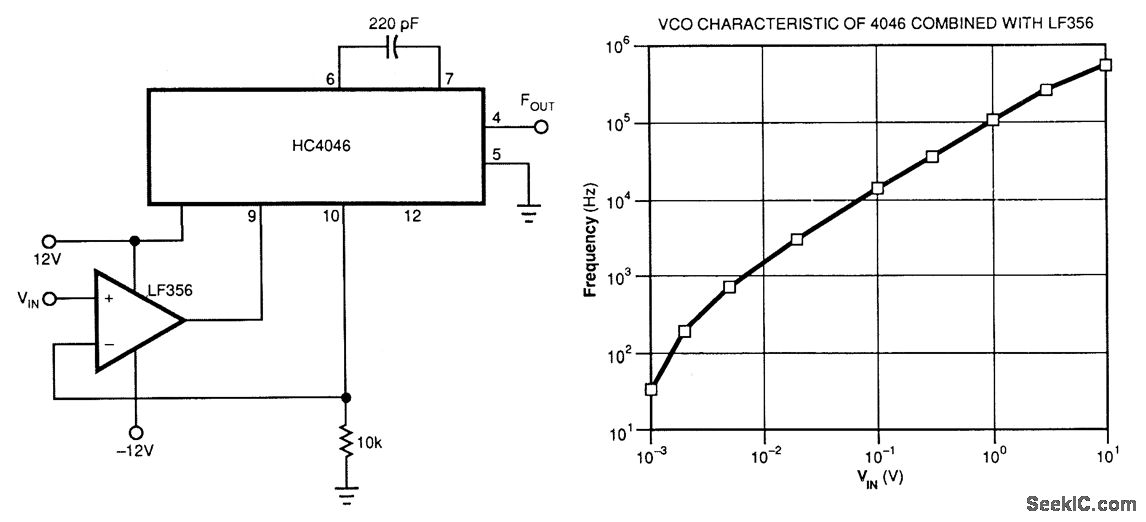
LINEAR VCO
This voltage-controlled oscillator (VCO) utilizes an LF356 operational amplifier to generate a linear frequency versus voltage characteristic in conjunction with the CMOS HC4046. The frequency range can be adjusted by modifying the capacitor linked between pins 6 and 7 of...