


two-tone generator
#Wien bridge oscillator
#741 operational amplifier
#two-tone generator
#audio frequency
#standard component values
#non-harmonic frequencies
#1458 dual op-amp
#500-2000 Hz range

Description: Two 741 operational amplifiers serve as the active components in this Wien bridge oscillator configuration. The dual version of the 741, known as the 1458, can also be utilized. The frequencies of the two oscillators are selected to correspond with standard component values, and it is possible to employ other frequencies ranging from 500 to 2000 Hz, provided they are not harmonically related. The output level of U1A is established by a resistive divider, while the output of U1B can be adjusted via resistor Rl. The outputs from the two oscillators are combined in U2, which functions as an op-amp adder with a unity gain. The output from U2 can be fine-tuned using resistor R2.
The Wien bridge oscillator is a widely used circuit for generating sine waves, characterized by its simplicity and effectiveness. In this configuration, the two 741 operational amplifiers (or the 1458 dual op-amp) play crucial roles in establishing the oscillation frequency and maintaining stability. The oscillator circuit is designed to operate within a frequency range of 500 to 2000 Hz, ensuring that the selected frequencies do not exhibit harmonic relationships, which could lead to distortion in the output waveform.
In the circuit, the first operational amplifier, U1A, is configured to set the output level through a resistive divider network. This arrangement allows for precise control over the amplitude of the signal generated by U1A. The second operational amplifier, U1B, features an adjustable output, which is controlled by the variable resistor Rl. This adjustability is essential for fine-tuning the oscillator's performance and ensuring that the output remains stable.
The outputs from both U1A and U1B are combined in the third operational amplifier, U2, which acts as an adder with unity gain. This configuration allows for the summation of the two oscillating signals, resulting in a composite output that retains the desired characteristics of both oscillators. The final output from U2 can be adjusted further using resistor R2, providing an additional level of control over the amplitude of the output signal.
Overall, this Wien bridge oscillator design effectively utilizes operational amplifiers to generate stable sine wave outputs across a specified frequency range, making it suitable for various applications in signal generation and waveform synthesis.Two 741 operational amplifiers are used for the active element in this Wien bridge oscillator. (The 1458 is the dual version of the 741.) Frequencies of the two oscillators were chosen to fit standard component values. Other frequencies between 500 and 2000 Hz can be employed. They should not be harmonically related. The output level of U1A is set by a resistive divider, while the output of U1B is adjustable through Rl. The output of the two oscillators is combined in U2, an op-amp adder with unity gain. The output from U2 can be adjusted using R2.
The Wien bridge oscillator is a widely used circuit for generating sine waves, characterized by its simplicity and effectiveness. In this configuration, the two 741 operational amplifiers (or the 1458 dual op-amp) play crucial roles in establishing the oscillation frequency and maintaining stability. The oscillator circuit is designed to operate within a frequency range of 500 to 2000 Hz, ensuring that the selected frequencies do not exhibit harmonic relationships, which could lead to distortion in the output waveform.
In the circuit, the first operational amplifier, U1A, is configured to set the output level through a resistive divider network. This arrangement allows for precise control over the amplitude of the signal generated by U1A. The second operational amplifier, U1B, features an adjustable output, which is controlled by the variable resistor Rl. This adjustability is essential for fine-tuning the oscillator's performance and ensuring that the output remains stable.
The outputs from both U1A and U1B are combined in the third operational amplifier, U2, which acts as an adder with unity gain. This configuration allows for the summation of the two oscillating signals, resulting in a composite output that retains the desired characteristics of both oscillators. The final output from U2 can be adjusted further using resistor R2, providing an additional level of control over the amplitude of the output signal.
Overall, this Wien bridge oscillator design effectively utilizes operational amplifiers to generate stable sine wave outputs across a specified frequency range, making it suitable for various applications in signal generation and waveform synthesis.Two 741 operational amplifiers are used for the active element in this Wien bridge oscillator. (The 1458 is the dual version of the 741.) Frequencies of the two oscillators were chosen to fit standard component values. Other frequencies between 500 and 2000 Hz can be employed. They should not be harmonically related. The output level of U1A is set by a resistive divider, while the output of U1B is adjustable through Rl. The output of the two oscillators is combined in U2, an op-amp adder with unity gain. The output from U2 can be adjusted using R2.

Audio Oscillator
A Wien bridge oscillator generates sine waves with a very low distortion level. It produces zero phase shift at only one frequency (f = 1/2πRC), which becomes the oscillation frequency. Stable oscillation can only occur if the loop gain remains...

transistors Problems with Wien Bridge oscillator circuit simulation in Mutisim
Construct a Wien bridge oscillator that operates at 2.1 kHz and can be activated by a transistor. The inclusion of a transistor switch in the circuit allows for control of the oscillator's operation from a PIC microcontroller. However, during simulation...
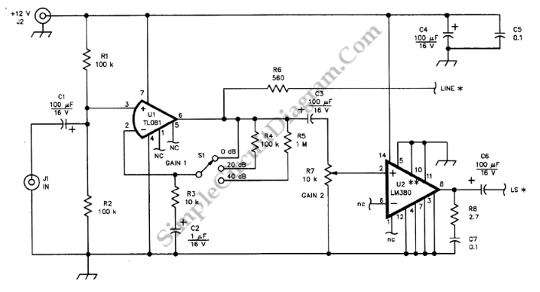
General-Purpose AF Power Amplifier
This is a schematic diagram of a general-purpose audio frequency (AF) amplifier circuit. The circuit employs inexpensive 1/4-W resistors, as high precision is not required.
The general-purpose audio frequency (AF) amplifier circuit is designed to amplify audio signals for various applications,...

Audio Oscillator
A low distortion audio frequency sine wave can be generated by passing the output of a simple square wave oscillator through a sharp cutoff low-pass filter to attenuate the odd harmonic components. The output level of the sine wave is...