


bipolar 15 v and 5v from car battery supply
#bipolar
#15V
#5V
#car battery
#voltage supply
#power conversion
#DC power
#electronic circuit
#voltage regulation
#automotive power
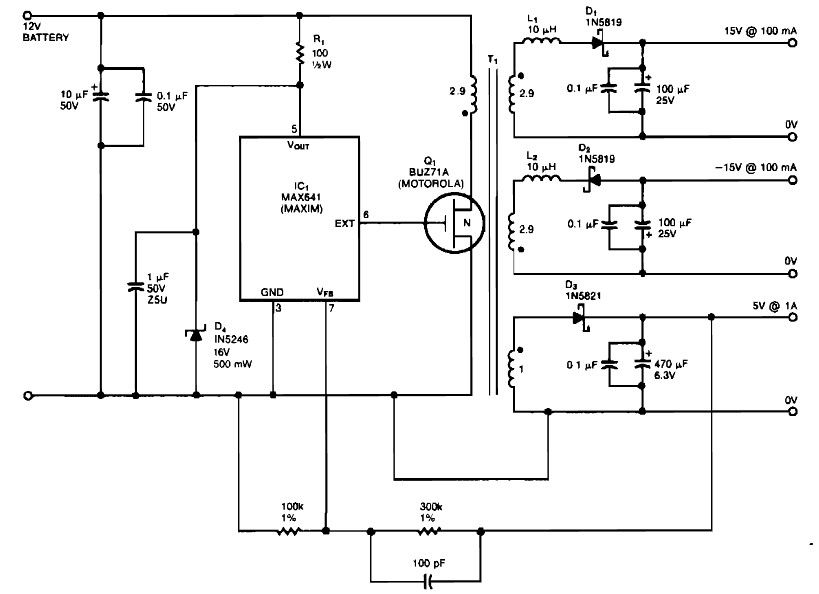
Description: Bipolar +/- 15V and 5V from car battery supply power supply. Refer to the specified page for an explanation of the related circuit diagram.
The described power supply circuit is designed to provide bipolar voltage outputs of +/- 15V and a stable 5V from a standard car battery, which typically delivers a nominal voltage of 12V. This type of power supply is essential for various automotive electronic applications that require both positive and negative voltage rails.
The circuit architecture typically includes a step-up (boost) converter to generate the positive voltage rail (e.g., +15V) and an inverter or a charge pump to create the negative voltage rail (e.g., -15V). The 5V output can be derived from a linear voltage regulator or a buck converter, ensuring that it remains stable under varying load conditions.
Key components in this circuit may include:
1. **Voltage Regulators**: Linear regulators such as the LM7815 for +15V and LM7915 for -15V, along with an LM7805 for the 5V output, are commonly used. These components regulate the output voltage by dissipating excess voltage as heat.
2. **Boost Converter**: A boost converter circuit can be implemented to step up the 12V from the car battery to +15V. This typically involves an inductor, a switch (transistor), a diode, and a capacitor to smooth the output.
3. **Charge Pump/Inverter**: To create the -15V rail, a charge pump can be utilized, which uses capacitors and switches to invert the voltage. Alternatively, a dedicated inverter IC can be employed for this purpose.
4. **Filtering Capacitors**: Capacitors are essential for filtering out noise and providing stability to the output voltage. They should be placed close to the output terminals of the regulators.
5. **Protection Diodes**: Diodes may be included to protect against reverse polarity and to prevent back EMF from damaging sensitive components.
6. **Heat Sinks**: If linear regulators are used, heat sinks should be installed to dissipate heat generated during voltage regulation, particularly when the load current is significant.
The circuit should also include proper input and output connections, ensuring that the power supply can interface seamlessly with the intended load. Additionally, appropriate fuses or circuit breakers should be incorporated to protect the circuit from overcurrent conditions.
Overall, this bipolar power supply design is crucial for powering various automotive electronic devices, ensuring reliable operation and performance.Bipolar +/- 15V and 5V from Car Battery supply power supply. Go to that page to read the explanation about above power supply related circuit diagram.
The described power supply circuit is designed to provide bipolar voltage outputs of +/- 15V and a stable 5V from a standard car battery, which typically delivers a nominal voltage of 12V. This type of power supply is essential for various automotive electronic applications that require both positive and negative voltage rails.
The circuit architecture typically includes a step-up (boost) converter to generate the positive voltage rail (e.g., +15V) and an inverter or a charge pump to create the negative voltage rail (e.g., -15V). The 5V output can be derived from a linear voltage regulator or a buck converter, ensuring that it remains stable under varying load conditions.
Key components in this circuit may include:
1. **Voltage Regulators**: Linear regulators such as the LM7815 for +15V and LM7915 for -15V, along with an LM7805 for the 5V output, are commonly used. These components regulate the output voltage by dissipating excess voltage as heat.
2. **Boost Converter**: A boost converter circuit can be implemented to step up the 12V from the car battery to +15V. This typically involves an inductor, a switch (transistor), a diode, and a capacitor to smooth the output.
3. **Charge Pump/Inverter**: To create the -15V rail, a charge pump can be utilized, which uses capacitors and switches to invert the voltage. Alternatively, a dedicated inverter IC can be employed for this purpose.
4. **Filtering Capacitors**: Capacitors are essential for filtering out noise and providing stability to the output voltage. They should be placed close to the output terminals of the regulators.
5. **Protection Diodes**: Diodes may be included to protect against reverse polarity and to prevent back EMF from damaging sensitive components.
6. **Heat Sinks**: If linear regulators are used, heat sinks should be installed to dissipate heat generated during voltage regulation, particularly when the load current is significant.
The circuit should also include proper input and output connections, ensuring that the power supply can interface seamlessly with the intended load. Additionally, appropriate fuses or circuit breakers should be incorporated to protect the circuit from overcurrent conditions.
Overall, this bipolar power supply design is crucial for powering various automotive electronic devices, ensuring reliable operation and performance.Bipolar +/- 15V and 5V from Car Battery supply power supply. Go to that page to read the explanation about above power supply related circuit diagram.

capacitor Explaining a car voltage regulator circuit
The circuit regulates approximately 12V from the car battery down to 5V for use by an Atmel AVR microcontroller. The presence of two capacitors on each side of the linear regulator LM7805 raises questions regarding their purpose. It is suggested...
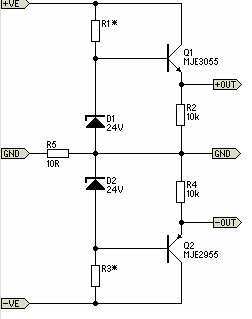
Simple Pre-Regulator
There will be many occasions when it is beneficial to utilize the P05 supply module sourced from a higher voltage supply. For instance, this could be advantageous when integrating balanced inputs.
The P05 supply module is designed to facilitate the conversion...

DC Voltage Regulator Circuit
This circuit regulates a DC power output and has a wide range of applications. It can be utilized to control the speed of a motor, a pump, a toy train, or the brightness of an LED or lamp. Essentially, it...
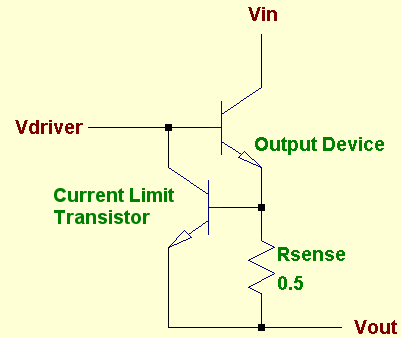
protected
A voltage regulator is designed to provide a fixed voltage to any load. This inherently means it must supply the necessary current through that load to satisfy Ohm's Law, I = V/R. As the resistance (R) approaches zero, such as...

variable voltage and current power supply
An alternative method for utilizing operational amplifiers (op-amps) to regulate a power supply is illustrated below. The power transformer necessitates an additional winding to provide the op-amps with a bipolar voltage of +/- 8 volts. This negative voltage is also...

Voltage regulator for projection lamp
The circuit regulates the RMS output voltage across a load, specifically a projection lamp, to 100 volts ±2% for input voltages ranging from 105 to 250 volts AC. This regulation is achieved by indirectly sensing the light output of lamp...

build a power supply using a dc adapter
Many different devices require DC power and thus need an I.T.E power supply. I.T.E stands for "Information Technology Equipment." An example of such a device is an iPod speaker system that is no longer functional, which originally came with a...

100v / 10ma regulator circuit
The circuit features no-load and short circuit protection mechanisms. To accommodate short circuit conditions, it is necessary to increase resistors R1 and R2 to allow for power dissipation; for example, R1 can be set to 1.2kΩ with a power rating...
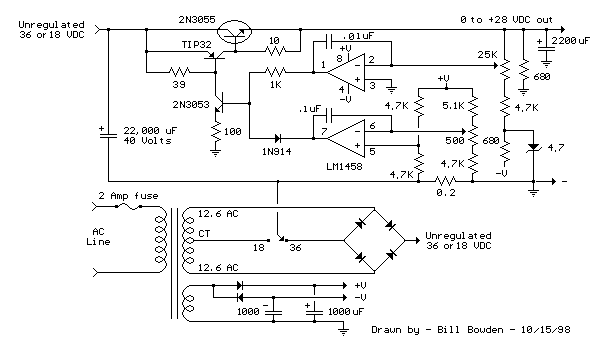
Current and Variable Voltage Power Supply
Another adjustment of application operational amplifiers to adapt a power supply is apparent below. The power supply requires an additional adjustment to supply the op-amps with a bipolar voltage (+/- 8 volts), and the negative voltage is also used to...